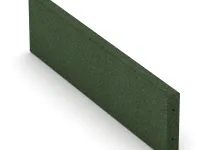
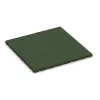
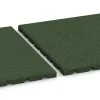
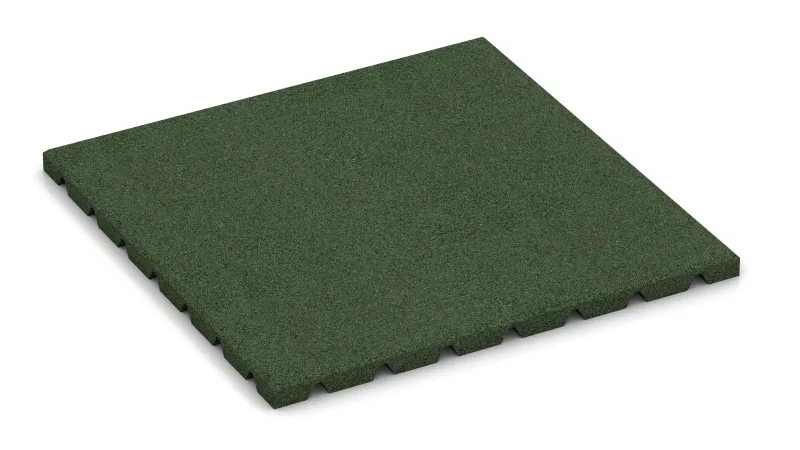
Wall protection panel FS "Grass Green"
- /
-
Delivery in approx.
7-14 days - €40.00 / 4 Piece / m²
- (3.85 kg / Piece)
EAN: 4251469305281 | Item no.: 0528
The WARCO wall protection panel is a tough and versatile solution for long-lasting protection of both walls and vehicles. It can be used indoors – for example in underground car parks, garages, warehouses or production halls – as well as outdoors on masonry and exterior walls. With its elastic material and reliable shock absorption, the panel not only protects the wall surface but also prevents dents and scratches on vehicles and doors from minor bumps.
Format and options
Each panel measures 50 × 50 cm and is available in four thicknesses: 2.5 cm, 3 cm, 4 cm and 4.5 cm. Depending on requirements, panels can be installed individually, in a single row, in two rows one above the other, or staggered for broader coverage.
Material & features
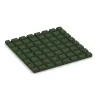
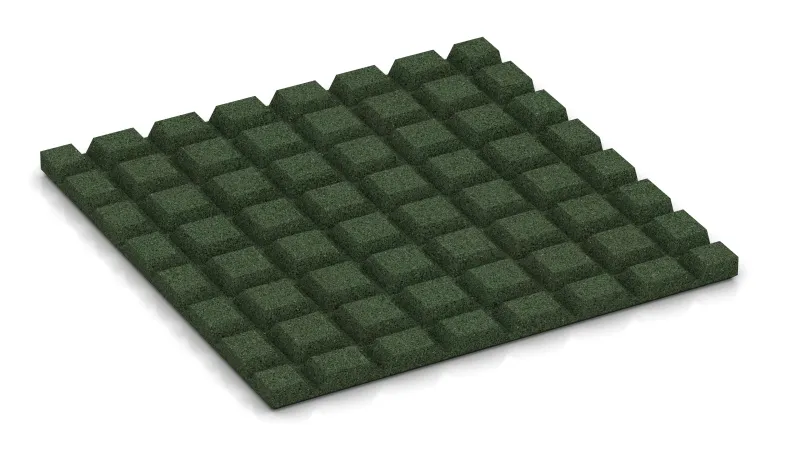
Made from ELT rubber granulate, the wall protection panel combines durability with flexibility. Its open-pore structure absorbs impact effectively and reduces noise on contact. The material is easy to maintain, long-lasting and weather-resistant, making it ideal for everyday use in demanding environments.
Installation
Installation is quick and simple with WARCO PU adhesive. Plastic connectors can also be used to align panels precisely and hold them securely in place.
Key benefits
• 50 × 50 cm, thicknesses 2.5 / 3 / 4 / 4.5 cm
• elastic ELT rubber granulate, shock- and noise-absorbing
• protects both walls and vehicles from damage and scratches
• easy installation with PU adhesive; connectors help with alignment
• can be fitted individually, in rows, double rows or staggered
• suitable for both indoor and outdoor areas
• durable, weather-resistant and low-maintenance
• a practical way to prevent damage and save money every day
The WARCO wall protection panel is a simple yet effective product that keeps walls and vehicles safe while reducing repair costs day after day.



Discount
Product Highlights
Characteristics
Product Details – Material and Structure

Comparative values
To calculate how many tiles you need for your project, simply use the online installation planner available in the shop. This free browser-based tool is directly accessible on each product page – just below the price and quantity selection. Click on “Plan installation” to open the tool instantly – no registration or download required.
Enter the dimensions of your area, such as the length and width in metres. The planner will then automatically calculate the total number of tiles required, including a realistic allowance for offcuts. You’ll also be shown a suitable layout pattern for the selected product. The tool is user-friendly, accurate and ideal for planning your material requirements with confidence.
WARCO offers several connection systems for floor tiles, each differing in design, installation method and visual appearance. Below is an overview of the key differences:
Puzzle joint (visible)
In this system, the tile edges feature an interlocking profile reminiscent of classic jigsaw teeth or mushroom-shaped connectors. During installation, the profiles of adjacent tiles interlock to form a continuous connection across the full tile thickness.
The joint profile may be formed directly during pressing or precisely cut after the tile has cured. Whether the joint is visible in the finished surface depends on the edge finish (e.g. with or without chamfer) and the surface colouration.
The symmetrical shape ensures uniform load transfer and makes this type of joint the most mechanically stable option.
Plug-in connectors (plastic dowels)
This system uses separate connecting elements, typically round plastic dowels, which are inserted into pre-drilled holes along the sides of the tiles. The tiles themselves have smooth, straight edges similar to precast concrete slabs.
Installation is carried out in a half-bond (stretcher bond) pattern: each tile is connected via dowels to two tiles in the row above and two in the row below. This prevents lateral shifting, although some movement along the length of the dowels remains possible. For this reason, an edge restraint must be installed around the perimeter to stabilise the entire area.
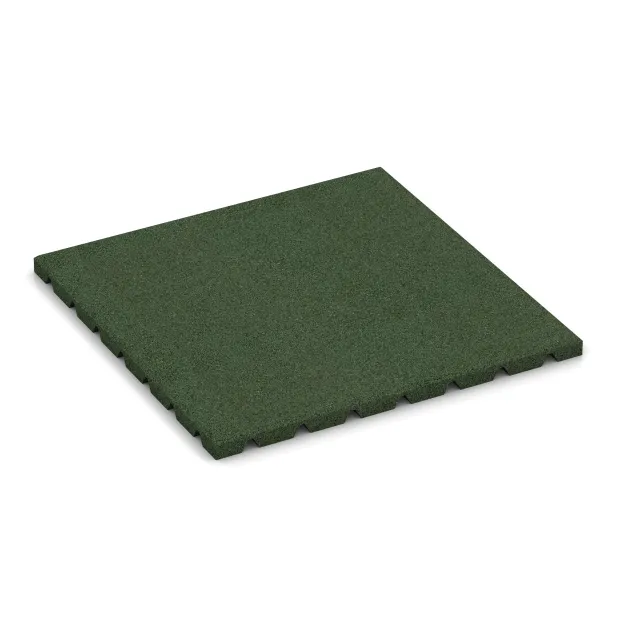
Concealed puzzle joint
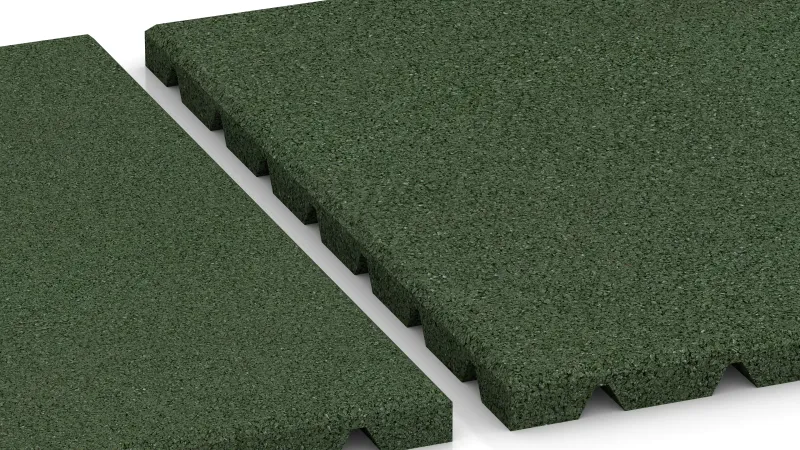
This method is based on the same mechanical principle as the classic puzzle joint, but is designed to be invisible in the finished surface. The interlocking profile is located on the underside of the tile, integrated into a rebated step joint.
Two tile edges feature a positive locking profile, the other two a matching negative profile. When laid, the tiles interlock securely from below, forming a durable mechanical connection. From above, the surface appears seamless and aligned, typically with a clean, square joint pattern similar to a chessboard layout.