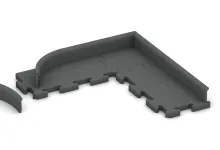
Playground safety mat – 110 cm FS "Slate grey"
- /
-
Delivery in approx.
7-14 days - €61.30 / 1 Piece / m²
- (28.10 kg / Piece)
EAN: 4251469356634 | Item no.: 5663
This 4 cm-thick playground safety mat in a 100 × 100 cm format is certified to BS EN 1177 and provides reliable impact protection up to a critical fall height of 110 cm. It is suitable for indoor areas and sheltered outdoor spaces. It offers dependable fall protection where a moderate installation height is required and creates a durable, shock-absorbing and low-maintenance play surface.
Typical applications
This safety mat is used in indoor play centres, climbing gyms, activity studios, training areas, supervised play spaces and sheltered outdoor play areas. Its large 100 × 100 cm format reduces the number of joints and creates a smooth, calm play surface that is easy to keep clean. The mat also provides noticeable footfall noise reduction and enhances comfort on hard indoor floors.
Material & construction
The mat is made from homogeneous PU-bound ELT (end-of-life tyre) rubber granulate. The material is elastic, resilient and abrasion-resistant, providing the required shock absorption for a critical fall height of up to 110 cm. The structured underside, formed from inverted truncated pyramids, increases dimensional stability, supports elasticity and contributes to consistent long-term performance.
Connection & installation
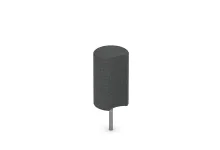
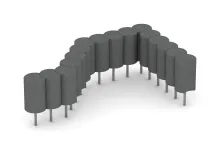
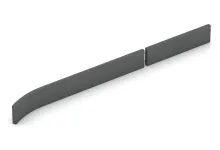
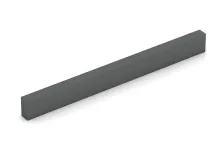
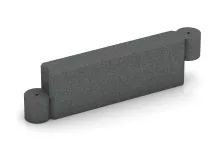
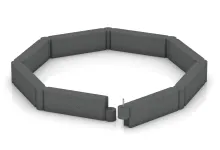
The mats are installed in a bonded pattern using plastic interlocking connectors that link the mats across the joints and prevent lateral movement. Suitable sub-bases include firm, level and load-bearing indoor surfaces or sheltered outdoor substrates such as concrete, screed or ceramic flooring. A continuous perimeter edging is required.
Properties & safety
The mat meets the requirements of BS EN 1177 for a critical fall height of 110 cm. It is slip-resistant, sound-absorbing, thermally insulating and toxicologically safe. Its reaction-to-fire performance corresponds to class Efl.
Care & cost-effectiveness
Play areas surfaced with these mats remain stable, functional and easy to maintain. The surface can be cleaned simply by sweeping or damp wiping. This makes the playground safety mat a long-lasting and economical flooring solution for indoor and sheltered outdoor play and activity areas.


Discount
Product Highlights
Characteristics
Product Details – Material and Structure


Comparative values
To calculate how many tiles you need for your project, simply use the online installation planner available in the shop. This free browser-based tool is directly accessible on each product page – just below the price and quantity selection. Click on “Plan installation” to open the tool instantly – no registration or download required.
Enter the dimensions of your area, such as the length and width in metres. The planner will then automatically calculate the total number of tiles required, including a realistic allowance for offcuts. You’ll also be shown a suitable layout pattern for the selected product. The tool is user-friendly, accurate and ideal for planning your material requirements with confidence.
Proper installation is essential to ensure the performance, safety and longevity of Playground Safety Mats and Playground Safety Tiles. The recommended method depends on the intended use, the condition of the sub-base and the specific product type.
Suitable sub-base – stable, level and free-draining
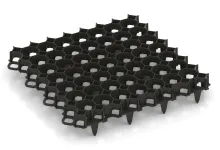
For outdoor installations, WARCO recommends a long-term stable, water-permeable base layer. Proven options include plastic ground reinforcement grids (gravel stabilisation panels) or an existing bound and porous sub-base such as porous concrete. If the base is not permeable, exposed surfaces must include a drainage gradient of at least 1.5 %. Installation on loose materials like sand, gravel or crushed stone is not recommended, as these tend to shift under resilient rubber tiles.
Laying pattern and connection systems
Depending on the product, tiles are installed in a half-bond or cross-bond pattern. WARCO offers two connection systems: plastic alignment dowels or form-fitting interlocking profiles. Especially the interlocking system ensures dimensional stability and prevents lateral displacement of the surface.
Cutting and fitting
Tiles can be trimmed to size using a circular saw or jigsaw (with blades suitable for rubber or wood), or a sharp utility knife. Accurate cuts and clean joins are especially important at edges, transitions and around fixed structures.
Edge finishing and trip protection
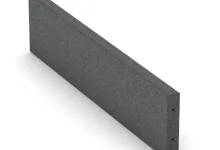
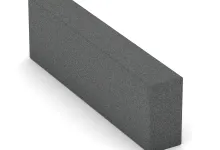
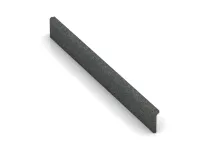
All exposed edges should be finished using bevelled or ramp-edge tiles to eliminate trip hazards. In public areas such as playgrounds, edging with kerbstones, frame profiles or flat perimeter barriers is recommended – and mandatory when using systems with plastic dowels.
Adhesive fixing and edge bonding (optional)
On solid surfaces like concrete or asphalt, tiles may be spot- or fully bonded using a single-component polyurethane adhesive. Edge tiles can also be bonded to each other to further stabilise the area. Ramped and corner tiles with bevelled profiles should always be glued down on firm substrates.
Installation under suitable conditions
Installation should be carried out at ambient temperatures between 5 °C and 17 °C. The material must be dry and acclimatised before laying. Avoid installing in direct sunlight or at temperatures above 18 °C, as the tiles may expand during handling and compromise the fit.
WARCO offers several connection systems for floor tiles, each differing in design, installation method and visual appearance. Below is an overview of the key differences:
Puzzle joint (visible)
In this system, the tile edges feature an interlocking profile reminiscent of classic jigsaw teeth or mushroom-shaped connectors. During installation, the profiles of adjacent tiles interlock to form a continuous connection across the full tile thickness.
The joint profile may be formed directly during pressing or precisely cut after the tile has cured. Whether the joint is visible in the finished surface depends on the edge finish (e.g. with or without chamfer) and the surface colouration.
The symmetrical shape ensures uniform load transfer and makes this type of joint the most mechanically stable option.
Plug-in connectors (plastic dowels)
This system uses separate connecting elements, typically round plastic dowels, which are inserted into pre-drilled holes along the sides of the tiles. The tiles themselves have smooth, straight edges similar to precast concrete slabs.
Installation is carried out in a half-bond (stretcher bond) pattern: each tile is connected via dowels to two tiles in the row above and two in the row below. This prevents lateral shifting, although some movement along the length of the dowels remains possible. For this reason, an edge restraint must be installed around the perimeter to stabilise the entire area.
Concealed puzzle joint
This method is based on the same mechanical principle as the classic puzzle joint, but is designed to be invisible in the finished surface. The interlocking profile is located on the underside of the tile, integrated into a rebated step joint.
Two tile edges feature a positive locking profile, the other two a matching negative profile. When laid, the tiles interlock securely from below, forming a durable mechanical connection. From above, the surface appears seamless and aligned, typically with a clean, square joint pattern similar to a chessboard layout.
The required thickness of Playground Safety Mats and Tiles depends on the critical fall height they are intended to protect against. As a general rule: the higher the potential fall height, the thicker the mat or tile must be – provided it offers the necessary shock absorption.
Typical values for thickness and fall height (in accordance with DIN EN 1177):
– Up to 100 cm fall height: approx. 30 mm thick
– Up to 150 cm fall height: 40–50 mm thick
– Up to 200 cm fall height: 65–80 mm thick
– Up to 300 cm fall height: 90–100 mm thick
Durability also depends on thickness
For a given fall height, multiple tile thicknesses are often certified – especially when comparing different manufacturers. In general: the thinner the tile for the same certified fall height, the more stress it endures in daily use – and the faster it wears out. Thicker and heavier tiles typically offer longer service life at the same level of protection.
The sub-base also plays a role
A loose, elastic base layer can help improve impact absorption. However, it is not taken into account when determining the certified fall height. On hard surfaces such as asphalt or concrete, the full impact protection must be provided by the tile itself. This is why Playground Safety Mats and Tiles are tested in accordance with EN 1177 on concrete.
Use certified products only
What matters most is not just the material thickness, but the certified critical fall height. WARCO offers Playground Safety Mats and Tiles in various thicknesses – each tested according to DIN EN 1177 and clearly labelled with their certified performance.