Fitness Turf Tile HZ "Black Artificial Grass"
- /
-
Delivery in approx.
3-4 weeks - €118.00 / 4 Piece / m²
- (7.38 kg / Piece)
EAN: 4251469313750 | Item no.: 1375
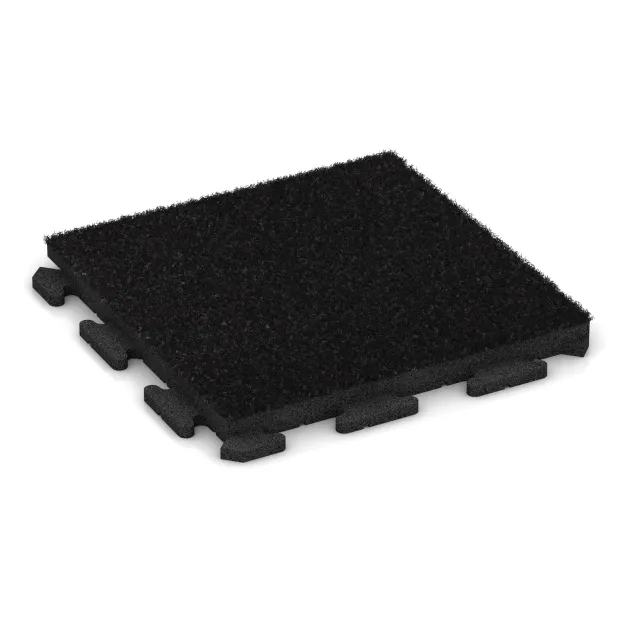
The WARCO Fitness Turf Tile combines the stability of a rubber tile with the look and feel of high-quality artificial turf. This creates a training surface that looks like a continuous grass carpet and can be used flexibly both indoors and outdoors.
Seamless turf appearance
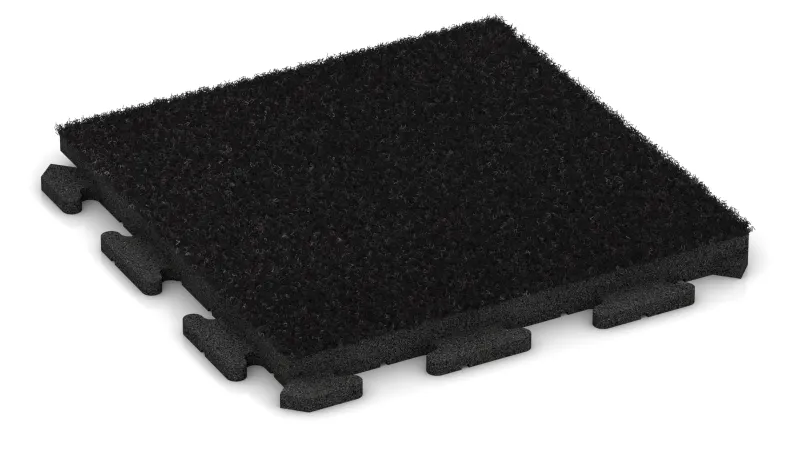
The tiles are permanently laminated with an artificial turf surface. Thanks to the concealed zipper interlock, they connect precisely to form a closed surface. After brushing, the turf fibres stand upright, covering the joints and creating a homogeneous appearance with no visible tile structure.
Rubber granulate carrier plate
The tiles are 3 or 4 cm thick and consist of PU-bonded rubber granulate, serving as a stable carrier plate for the laminated turf. This construction ensures an even, dimensionally stable base that holds the turf surface securely in place. At the same time, the carrier plate provides good cushioning and elasticity, increasing training comfort and making the surface pleasant to walk and train on.
Indoor and outdoor use
The Fitness Turf Tile is weatherproof and suitable for both indoor and outdoor applications. It allows gym studios, home gyms or outdoor functional areas to be designed with a natural and visually attractive turf surface.
Areas of application
The Fitness Turf Tile is not intended for zones requiring maximum durability or strong impact absorption. Its main advantage lies in the turf look and feel. It is suitable for functional and sprint areas, special studio zones or private gyms that benefit from a natural-looking training surface.
Easy installation
The handy 50 × 50 cm tiles are easy to install thanks to the concealed zipper interlock. Once brushed, the turf surface appears uniform and seamless, giving the area a professional appearance.


Discount
Product Highlights
Characteristics
Product Details – Material and Structure


Comparative values
To calculate how many tiles you need for your project, simply use the online installation planner available in the shop. This free browser-based tool is directly accessible on each product page – just below the price and quantity selection. Click on “Plan installation” to open the tool instantly – no registration or download required.
Enter the dimensions of your area, such as the length and width in metres. The planner will then automatically calculate the total number of tiles required, including a realistic allowance for offcuts. You’ll also be shown a suitable layout pattern for the selected product. The tool is user-friendly, accurate and ideal for planning your material requirements with confidence.
Yes, that is the standard approach. The vast majority of our customers – whether private, municipal, or commercial – install the delivered WARCO tiles themselves or with their own staff. The installation is simple and requires no special skills. Only fitting the curb into a concrete foundation with back support demands a little extra craftsmanship. Cutting the elements to size and laying them on a suitable substrate is not challenging. You can find all essential installation information in our Expert Advice – FAQ section on our website.
WARCO offers several connection systems for floor tiles, each differing in design, installation method and visual appearance. Below is an overview of the key differences:
Puzzle joint (visible)
In this system, the tile edges feature an interlocking profile reminiscent of classic jigsaw teeth or mushroom-shaped connectors. During installation, the profiles of adjacent tiles interlock to form a continuous connection across the full tile thickness.
The joint profile may be formed directly during pressing or precisely cut after the tile has cured. Whether the joint is visible in the finished surface depends on the edge finish (e.g. with or without chamfer) and the surface colouration.
The symmetrical shape ensures uniform load transfer and makes this type of joint the most mechanically stable option.
Plug-in connectors (plastic dowels)
This system uses separate connecting elements, typically round plastic dowels, which are inserted into pre-drilled holes along the sides of the tiles. The tiles themselves have smooth, straight edges similar to precast concrete slabs.
Installation is carried out in a half-bond (stretcher bond) pattern: each tile is connected via dowels to two tiles in the row above and two in the row below. This prevents lateral shifting, although some movement along the length of the dowels remains possible. For this reason, an edge restraint must be installed around the perimeter to stabilise the entire area.
Concealed puzzle joint
This method is based on the same mechanical principle as the classic puzzle joint, but is designed to be invisible in the finished surface. The interlocking profile is located on the underside of the tile, integrated into a rebated step joint.
Two tile edges feature a positive locking profile, the other two a matching negative profile. When laid, the tiles interlock securely from below, forming a durable mechanical connection. From above, the surface appears seamless and aligned, typically with a clean, square joint pattern similar to a chessboard layout.