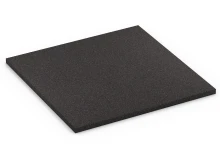
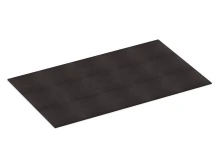
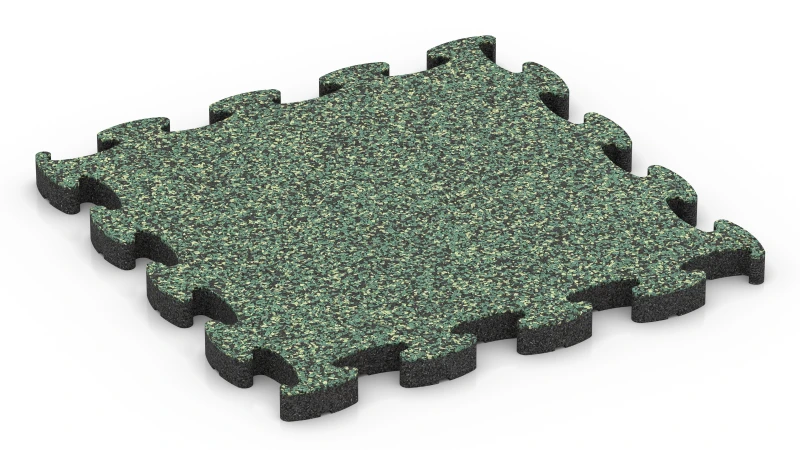
Fitness Active Floor System XT "English lawn"
- /
-
Ready to ship
in approx. 3-4 weeks – production yet to start - €113.57 / 5.03 Piece / m²
- (4.87 kg / Piece)
EAN: 4251469368439 | Item no.: 6843
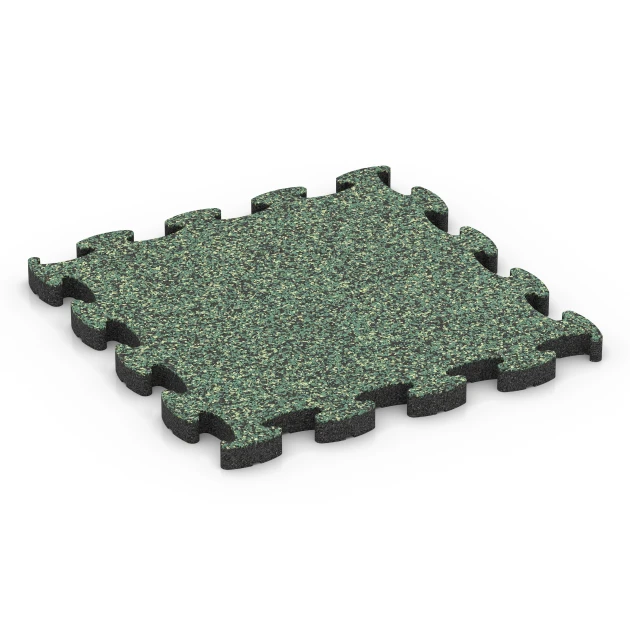
Fitness Active Floor System Type XT consists of precision-cut fitness tiles with a wearing layer of through-coloured EPDM rubber granules, so the colour remains as the surface wears. Only a tight joint remains between the tiles, making the floor look like a poured surface. The flooring is comfortably resilient underfoot, slip-resistant and durable. Functional tiles can be added underneath to create a layered system.
What is the flooring like to train on?
Calisthenics, floor exercises and martial arts involve frequent contact with the floor, often barefoot. Training may include jumping, landing, kneeling or lying on your back for an exercise. The resilient flooring cushions impacts from jumps and landings, helping to protect knees and feet. Kneeling and lying down are comfortable too. Its grippy surface is slip-resistant. It also reduces the sound of footsteps, jumps and weights being set down. People in the flat below will notice the reduction too.
What are the fitness tiles made from?
The upper wearing layer is made from newly manufactured, fully through-coloured EPDM rubber granules. This means the tiles retain their colour as the surface wears. The substantial wearing layer also contributes to resilience. The base layer is made from recycled tyre rubber granules, known as ELT granules. It carries the weight and is designed for effective shock absorption. Gym equipment and weight benches do not normally leave permanent indentations. Screed, tiles or parquet underneath remain protected. The tiles may smell of rubber when first unpacked. With good ventilation, the smell soon fades.
How are the fitness tiles laid?
The tiles are simply laid in position, with no drilling, adhesive or screws. The substrate, such as screed, concrete, tiles or parquet, must provide lasting support and be stable and largely level. The tiles can also be laid over underfloor heating. The rounded jigsaw interlock holds the tiles together, so the edges do not lift. The tiles can also be laid outdoors. Edge tiles are cut with a jigsaw or circular saw. On request and for an additional charge, WARCO supplies the tiles ready cut based on a DXF file generated by the laying planner.
How easy is the flooring to clean indoors and outdoors?
Indoors, clean the flooring with a vacuum cleaner, broom or mop. For damp mopping, use warm water and a neutral cleaner. Because the tiles allow water through, wring out the mop thoroughly. In areas where many people train, such as a fitness centre, the tiles can also be wiped with alcohol-based disinfectants. Outdoors, rain washes fine dirt through the tiles. On an impermeable substrate, water drains along the underside in the direction of the gradient, allowing the surface to dry quickly. The tiles are frost-resistant.
What makes the flooring a system?
Type XX functional tiles can be laid beneath the fitness tiles, with several layers stacked if needed. They are available in two thicknesses and three densities. A lower density provides greater shock absorption. A higher density carries more weight and suits zones where weights are dropped. This gives each training zone the build-up it needs. The thicker version of the fitness tiles is also recommended for heavy weights.


Discount
Product Highlights
Characteristics
Product Details – Material and Structure


Comparative values
An XT tile can be laid directly as a floor covering or on an underlay of XX functional tiles. Depending on the configuration, the floor build-up is single-layer, two-layer or multi-layer.
The XT tile is made entirely from recycled tyre rubber granules (ELT), or has a body of these granules with a permanently bonded top layer of coloured EPDM rubber granules. A three-dimensional interlock is cut into the tile edges: during installation, the teeth of one tile engage in the matching recesses of the next, creating a continuous tiled surface. XT tiles are 1.8 or 2.8 cm thick and come in three density grades: elastic, standard and stable.
The XX functional tile is also made from recycled tyre rubber granules (ELT). Beneath the XT tile, it spreads point loads, damps vibrations and impact sound, increases shock absorption and adds to the overall build-up height. It is likewise 1.8 or 2.8 cm thick and is offered in three damping classes. The functional tiles are laid edge to edge. In a multi-layer construction, the tiles should be offset from one layer to the next so that the joints do not align.
An XT tile combined with one or more functional tiles forms a sandwich construction. The thickness and density of the XT tile are selected for the intended application. In a sandwich construction, the thickness and damping class of the functional tiles are selected as well. Tiles of different densities can also be combined in a multi-layer construction to match the properties of the floor build-up to the application.
Where rubber tiles are laid in several layers, the load-bearing capacity, shock absorption and overall thickness of the floor can be tailored to the intended use. The XT surface tile forms the top, visible layer and determines abrasion resistance. One or more XX functional tiles sit beneath it. Both XT surface tiles and XX functional tiles are made from PU-bound rubber granules and are available in a range of thicknesses and densities.
The choice and combination of the two tile types sets the overall thickness, load-bearing capacity and shock absorption of the system, allowing it to be tailored to the application. Systems of the same overall thickness can offer different levels of shock absorption. In playgrounds, a system designed for shock absorption can offer a higher critical fall height.
In weight-training areas, a shock-absorbing system can dissipate some of the impact energy. Indoors, it can improve impact sound insulation and reduce the transmission of structure-borne sound. It can also improve vibration damping beneath machinery and plant, or in vibration-sensitive areas.
A rubber tile’s class indicates how much cushioning it provides underfoot and how much weight it can support: class 1 supports the most weight, class 3 provides the most cushioning, and class 2 falls between them on both counts. The more cushioning a tile provides, the more it gives under load.
Class 1 gives the least under load because it has the highest load-bearing capacity and provides the least cushioning. It spreads heavy loads applied at a single point across its surface and reduces vibration. It is for indoor use only.
Class 2 can be used indoors or outdoors. It has moderate load-bearing capacity and cushioning, offering a balance of support and give underfoot. It is typically laid beneath patio and balcony coverings or paving slabs, and in entrance areas.
Class 3 has the lowest load-bearing capacity and provides the most cushioning. It gives the most under load and absorbs the most impact energy, so it is suitable where a springy surface and noise reduction are needed. It can be used indoors or outdoors. All three classes are available in two sizes, 52 × 52 cm and 104 × 104 cm, and two thicknesses, 1.8 cm and 2.8 cm.
Different rubber tiles can be combined in a layered system. Type XX tiles are available in three cushioning grades; any number can be used in any order beneath the surface tile. Each of these layers can have its own cushioning grade, density and thickness. The visible surface is formed by a type XT surface tile or another surface tile, whose density and elasticity need not match those of the tiles beneath it.
The order of the layers depends on how the area will be used and the performance required of the layered system. The layers are selected and arranged to balance shock absorption, load-bearing capacity and how point loads are spread. Two systems of the same overall height can therefore differ in load-bearing capacity, elasticity and damping.
Impact-absorbing flooring made from PU-bound rubber granules reduces impact sound and the structure-borne sound it generates. The elastic floor covering absorbs impacts and reduces their transfer to the substrate.
Impact sound occurs when walking, jumping, moving furniture or setting down weights cause a floor or storey slab to vibrate. These vibrations travel through solid building components as structure-borne sound and can become audible as airborne sound in other rooms.
Structure-borne sound can also be caused by machinery and by installations fixed to the building. It may have causes and transmission paths other than impact sound, so it cannot be reduced by a floor covering alone.
Under load, a floor covering made from rubber granules deforms elastically. This deformation transfers the load to the substrate less abruptly, reduces the peak force and, through the covering’s internal damping, further weakens the remaining vibrations.
Sound-insulation tiles reduce excitation of the substrate from footsteps, jumps and impacting objects. Where higher requirements apply, multi-layer flooring systems with functional layers of differing elasticity can further reduce impact transmission. Their effectiveness depends on the properties of each layer, the load applied, and the existing floor or slab structure.
Rubber gym floor coverings made from rubber granules can be used for cardio, classes, equipment-based training, functional training, HYROX, boxing, gymnastics, free-weight training and strength training.
Their suitability depends on the thickness, elasticity and shock absorption being matched to the intended use. For cardio, classes and permanently installed training equipment, gym tiles at least 1 cm thick are suitable under normal use. For dynamic exercises, higher loads or greater requirements for elasticity and shock absorption, tiles at least 2 cm thick are recommended.
In functional training and HYROX, the covering is subjected to running, jumping, moving weights and sled exercises. For jumps and intensive contact with the surface, it must absorb shocks effectively while providing a stable training surface. Pulling and pushing sleds requires a firm, abrasion-resistant and durable surface.
For boxing and gymnastics, rubber gym floor coverings are available with elasticity and shock absorption matched to the respective movement patterns. Under permanently installed strength equipment, compressive strength, slip resistance and stable support are the main considerations.
In free-weight areas, thicker tiles or multilayer systems are required. These cushion the impact of weights being set down or dropped, distribute loads, reduce peak loads and limit the transfer of vibrations.
Multilayer systems combine different properties within a single floor covering. A dense top layer provides a firm, abrasion-resistant training surface, while a more elastic, shock-absorbing layer beneath it improves impact and vibration absorption. Density, rubber granule particle size, compaction and shock absorption are selected for each layer according to its function.
Within a comparable construction, a thicker tile allows greater deformation, resulting in greater shock absorption. There is no single gym floor covering for every application: single-layer and multilayer systems can be matched to the type of training, equipment and weights, potential drop heights, intensity of use and building conditions.
Rubber flooring for exercise equipment in an outdoor gym can be made from PU-bound rubber granules. It is slip-resistant, shock-absorbing, weather-resistant and frost-resistant.
For outdoor use, porous, water-permeable gym tiles are used. Rainwater passes through the tiles across their entire area, while the surface provides stable footing when wet.
Thickness and construction depend on the intended types of training. For calisthenics, equipment training and functional training, a balance between stability and shock absorption is required. Tiles of about 3 cm are suitable for many of these applications.
As well as thickness, density and construction affect the properties of rubber flooring. For kettlebells, barbells and other heavy weights, thicker tiles or multilayer surfacing systems are appropriate.
Where impact-absorbing surfacing is required around training equipment, the critical fall height determined in accordance with BS EN 1177 must be at least equal to the required free height of fall.
A home gym needs a specialist gym floor covering designed for point loads and dynamic loads from training equipment, free weights, jumps and other movement-intensive exercises.
For these loads, a gym floor covering made from PU-bound rubber granules is slip-resistant, protects the substrate, absorbs part of the impact energy and reduces impacts and vibrations.
For effective basic cushioning, the gym floor covering should be at least 10 mm thick. The greater the equipment weight, impact load or potential drop height of weights, the higher-performing the gym floor covering must be. Damping cannot be determined from covering thickness alone: the relevant factors are the performance values of the specific gym floor covering, such as force reduction and impact sound reduction. Density and granule fraction are particularly significant for these performance values.
Where weights are dropped, the gym floor covering must be matched to their weight and drop height. Construction protection mats and comparable makeshift measures are not designed for use as gym floor coverings.
Outdoor rubber tiles should be cleared of leaves, soil and sand regularly.
Loose dirt can be swept away with a rubber broom or rinsed off with a hose. Rain also washes much of the dust and pollen away through water-permeable tiles.
Regular maintenance reduces the work required for more thorough cleaning.
For thorough outdoor cleaning, a pressure washer is suitable. The water jet loosens dirt from the textured surface and removes more persistent residues such as dog mess or food residue.
Where clean water is not sufficient, use either a neutral cleaner suitable for rubber or a mildly acidic cleaner. A specialist rubber cleaner is not required. Biodegradable Sonett WC Cleaner Mint is particularly suitable and has a pH value of around 5 to 6.
Apply the cleaner evenly, either neat or slightly diluted. After 10 to 15 minutes, work it in with a brush, then rinse the area thoroughly with clean water.
When brushing, use moderate pressure only. Excessive pressure can loosen granules from the bonded matrix.
Strongly alkaline cleaners, abrasive products and solvent-based cleaning products are unsuitable, as they can attack the surface of the rubber tiles.
The appropriate cleaning method for rubber tiles within buildings depends on the area in which they are used and the surface texture.
In private homes, rubber brooms, vacuum cleaners or mops are usually sufficient for regular maintenance. A neutral cleaner suitable for rubber should be used. A mildly acidic cleaner may be used for mineral deposits.
Water-permeable rubber floor coverings must not be flooded where the substrate does not provide suitable drainage.
For larger or commercial areas, a scrubber dryer with a cylindrical brush is recommended. The brush type and contact pressure of the scrubber dryer must be matched to the floor covering.
Within buildings, a pressure washer is only suitable for stables or appropriately equipped halls where adequate drainage is available. It can also remove stubborn dirt from the textured tile surface.