
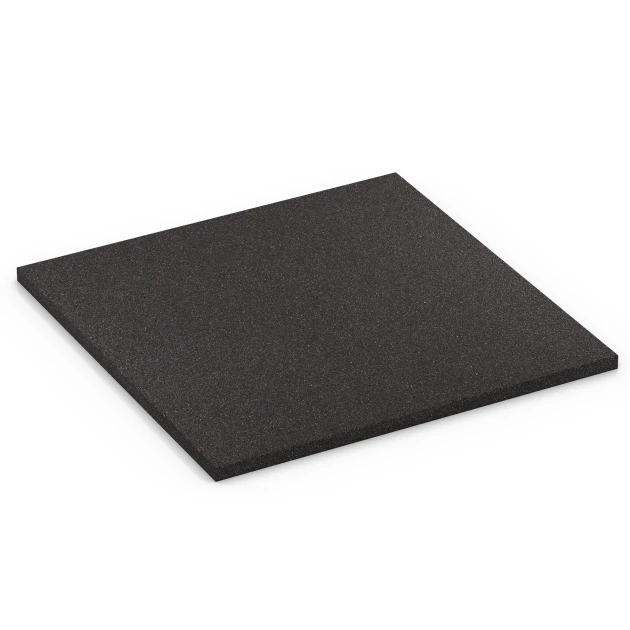
Base Layer Class 3 XX "Anthracite"
- /
-
Ready to ship
in approx. 3-4 weeks – production yet to start - €31.85 / 3.70 Piece / m²
- (3.16 kg / Piece)
EAN: 4251469364813 | Item no.: 6481
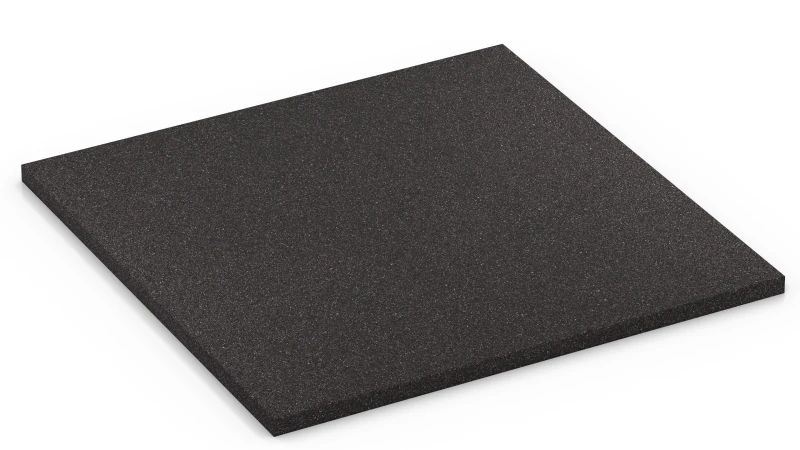
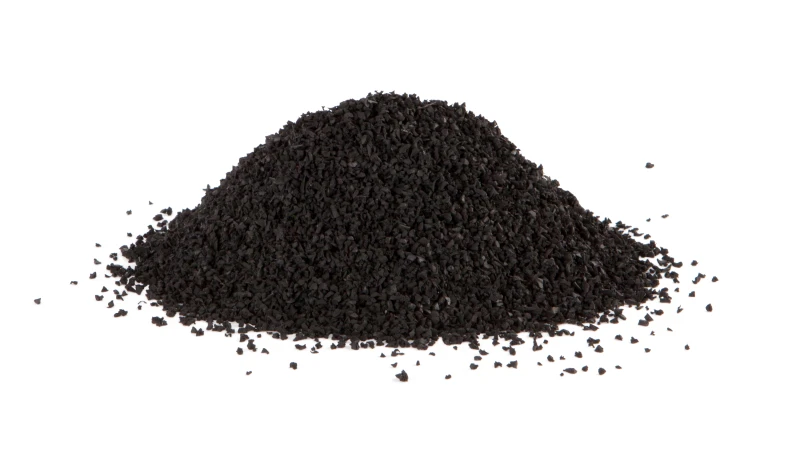
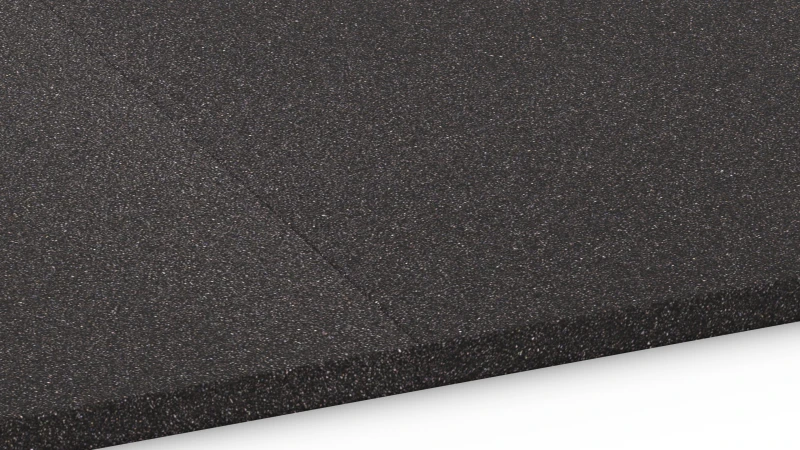
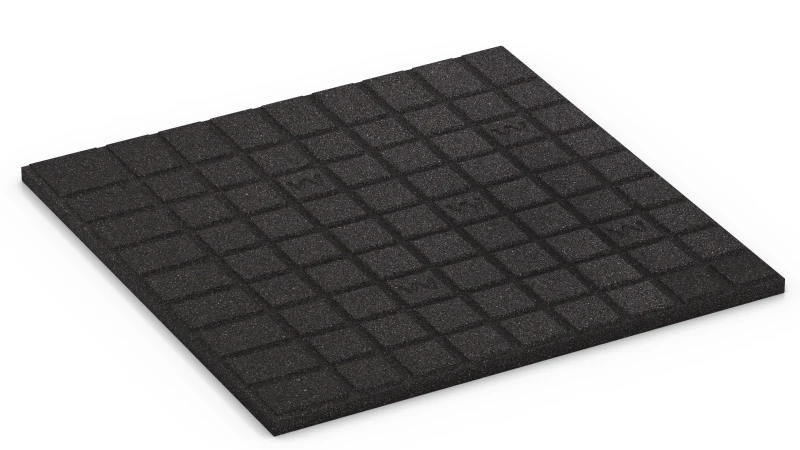
Base Layer Class 3 is an underlay panel within a multilayer floor system made from rubber granules bonded with polyurethane. It is used in shock- and vibration-absorbing floor constructions. Each layer in the system has a specific function. The top panel forms the finished floor surface. The underlay panels beneath it provide vibration and shock absorption, build-up height and load-bearing capacity. Sandwich constructions with two or more layers are possible. The underlay panels are graded in three damping classes, from highly shock-absorbing to stable and resilient. Class 3 is the highly shock-absorbing class with the lowest density and the greatest compression travel. It is water-permeable and resistant to frost and can be used indoors and outdoors.
What does Base Layer Class 3 do?
Base Layer Class 3 takes lower static and dynamic loads while providing the greatest shock absorption. Typical dynamic loads include a child falling from play equipment or someone landing from a jump. The kinetic energy of such an impact must be dissipated over a deformation distance. The panel compresses, slows the moving load and converts part of the energy into heat. The available compression travel must match the load. If a layer yields too readily, its compression travel is exhausted before the load has been slowed sufficiently. The panel then bottoms out and much higher impact peaks are transmitted to the subfloor. At 700 kg/m³, Base Layer Class 3 has the lowest density of the three classes and the greatest compression travel. It therefore cushions impacts most gently. High point loads are best accommodated beneath a layer with greater load-bearing capacity. This reduces impact peaks on the subfloor most effectively and significantly reduces the transfer of impact sound and structure-borne sound.
Where can Base Layer Class 3 be used?
Base Layer Class 3 is used where impacts and sound need to be attenuated as much as possible. Typical applications include impact-absorbing surfacing to BS EN 1177, with a build-up height determined by the required critical fall height, as well as gymnastics and training areas. It is also suitable for areas requiring sound insulation, such as a training room above living accommodation. Almost all WARCO floor coverings can form the finished floor surface, as can concrete or natural stone slabs.
Why use several layers rather than one thick panel?
Base Layer Class 3 can be combined with underlay panels in Classes 1 and 2. This allows shock absorption and load-bearing capacity to be distributed progressively across several layers. As the lower layer, Class 3 increases shock absorption. A Class 2 layer above it, or a Class 1 layer indoors, spreads the load over a sufficiently large area so that Base Layer Class 3 does not bottom out. Shock absorption, load-bearing capacity and build-up height can therefore be matched to the requirements. A sandwich construction is also longer-lasting and more economical than a single thick panel because only the top panel needs replacing when it becomes worn.
How is Base Layer Class 3 laid?
Base Layer Class 3 is dry-laid edge to edge in a staggered pattern, without mortar or adhesive. In multilayer constructions, the layers are also offset from each other so that every joint lies over an unbroken panel. The build-up height is determined by the selected thicknesses of 1.8 cm and 2.8 cm and the number of layers. The panel can be cut with a circular saw or a jigsaw.



Discount
Product Highlights
Characteristics
Product Details – Material and Structure
Comparative values
A rubber tile’s class indicates how much cushioning it provides underfoot and how much weight it can support: class 1 supports the most weight, class 3 provides the most cushioning, and class 2 falls between them on both counts. The more cushioning a tile provides, the more it gives under load.
Class 1 gives the least under load because it has the highest load-bearing capacity and provides the least cushioning. It spreads heavy loads applied at a single point across its surface and reduces vibration. It is for indoor use only.
Class 2 can be used indoors or outdoors. It has moderate load-bearing capacity and cushioning, offering a balance of support and give underfoot. It is typically laid beneath patio and balcony coverings or paving slabs, and in entrance areas.
Class 3 has the lowest load-bearing capacity and provides the most cushioning. It gives the most under load and absorbs the most impact energy, so it is suitable where a springy surface and noise reduction are needed. It can be used indoors or outdoors. All three classes are available in two sizes, 52 × 52 cm and 104 × 104 cm, and two thicknesses, 1.8 cm and 2.8 cm.
Different rubber tiles can be combined in a layered system. Type XX tiles are available in three cushioning grades; any number can be used in any order beneath the surface tile. Each of these layers can have its own cushioning grade, density and thickness. The visible surface is formed by a type XT surface tile or another surface tile, whose density and elasticity need not match those of the tiles beneath it.
The order of the layers depends on how the area will be used and the performance required of the layered system. The layers are selected and arranged to balance shock absorption, load-bearing capacity and how point loads are spread. Two systems of the same overall height can therefore differ in load-bearing capacity, elasticity and damping.
Where rubber tiles are laid in more than one layer, the joints in each layer should be staggered rather than positioned directly above one another. In a multi-layer build-up, each layer is offset from the one below so that the tiles in the upper layer bridge the joints in the layer beneath.
Staggering the joints in this way avoids joint lines running straight through the build-up and helps to keep the finished surface even. Outdoors, it also leaves no continuous path for vegetation to grow up from the ground beneath.
Different tile sizes can be combined in a floor with more than one layer. Surface tiles and functional tiles are designed to be used together in this way, rather than stacked with their joints aligned.
Allowing for joints, each surface tile occupies 44.6 × 44.6 cm or 97.1 × 97.1 cm. Functional tiles, by contrast, come in 52 × 52 cm or 104 × 104 cm sizes and are laid with butt joints, without interlocking edges. Their nominal dimensions are therefore also the dimensions used to calculate coverage.
The layers are laid to different grids so that their joints are offset as intended. Joints in the upper and lower layers never align to form a continuous joint through the floor.
The number of tiles must therefore be calculated separately for each layer. The floor area to be covered is the same for both, but the number of tiles required depends on the coverage dimensions of each tile type.