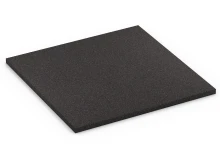
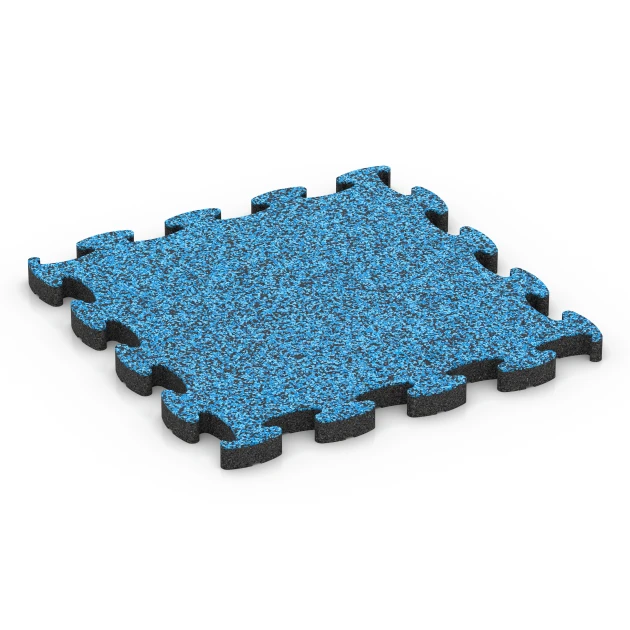
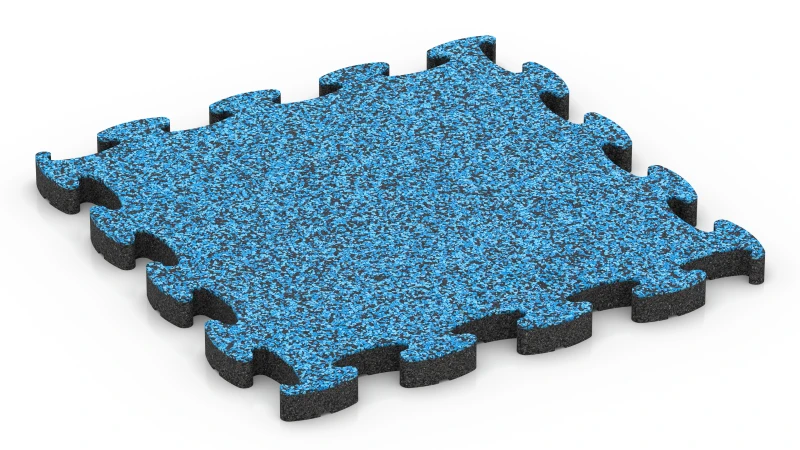
Safety Puzzle Tile XT "Atlantic"
- /
-
Ready to ship
in approx. 3-4 weeks – production yet to start - €107.04 / 5.03 Piece / m²
- (4.34 kg / Piece)
EAN: 4251469369382 | Item no.: 6938
Safety Puzzle Tile Type XT is safety surfacing for play and outdoor areas where colour and form are part of the design concept. It consists of calibrated tiles that are 2.8 cm thick and have a wearing layer of through-coloured EPDM. The tiles meet at tight joints, so the finished area looks like wet pour surfacing. Together with Type XX functional tiles, they form a multilayer build-up. Its depth depends on the free height of fall of the playground equipment.
How much design freedom is there?
The tiles are cut precisely to fit in the factory. This allows straight edges as well as curves, circles and flowing lines. Coloured zones can form a path, a circle around a piece of playground equipment or an area in a second colour. Conventional rectangular areas can also be laid. Areas with straight edges can be drawn in the laying planner on the WARCO website. The DXF file is then sent to WARCO. For curves and colour changes, WARCO needs a drawing of the area. For an additional charge, WARCO supplies the tiles cut and ready to lay.
How is the safety surfacing built up?
The depth required for a play area depends on the free height of fall of the playground equipment. The Safety Puzzle Tile forms the top layer. One or more layers of Type XX functional tiles are laid beneath it. By varying the number of layers, the build-up can be designed for all free heights of fall normally found in play areas.
What sets the tiles apart?
The tiles consist of two layers with different functions. The wearing layer is made from newly produced, through-coloured EPDM rubber granules. This allows the tiles to retain their colour as the surface wears over time. The grippy surface remains slip-resistant after a rain shower. The base layer is made from recycled tyre rubber granules, known as ELT granules. It has a low-density construction and therefore absorbs impacts. The Safety Puzzle Tile weighs around 22 kg per square metre. When first unpacked, the tiles may smell of rubber. Outdoors, this smell soon fades.
Why choose tiles instead of wet pour?
The Safety Puzzle Tile combines the design options of seamless wet pour safety surfacing installed on site with the cost benefits of tiled surfacing. The multilayer build-up is more durable and less expensive than one thick tile. It also ages better. The optimised jigsaw interlock keeps the tiles tightly together over time. The joints remain tight, so the area continues to look like one continuous surface even after years of use. If a heavily used area becomes worn, such as beneath a swing, only the tiles in the top layer are replaced. The functional tiles below remain in place. This is the most economical way to maintain the area over many years.
How is the safety surfacing laid and maintained?
The tiles are loose laid, with no adhesive or screws. The substrate must remain load-bearing and stable, and be reasonably level. On concrete, asphalt or paving, no additional sub-base is needed. On natural ground, a sub-base is required, such as gravel grids filled with stone chippings. For edge cuts on site, use a jigsaw or circular saw. Rain passes through the tiles. On an impermeable substrate, it then runs away beneath them down the gradient. This prevents puddles from forming. Frost does not damage the tiles. Leaves and sand can be removed with a broom or garden hose.


Discount
Product Highlights
Characteristics
Product Details – Material and Structure


Comparative values
A calibrated puzzle interlock without a bevelled edge is produced by cutting each rubber tile precisely to size from a larger blank. The blank is left to cure for several days before cutting.
Without a bevelled edge means that the tile edges are vertical rather than chamfered. The finished tile has only a minimal height tolerance.
In the usual pressing process, a rubber tile receives a bevelled edge, causing each joint to appear as a dark line across the surface. With vertical edges and minimal height tolerance, the tiles butt together accurately, leaving only a hairline joint. This hairline joint is visible in the laid surface only on close inspection, so the floor covering appears almost seamless.
Where rubber tiles are laid in several layers, the load-bearing capacity, shock absorption and overall thickness of the floor can be tailored to the intended use. The XT surface tile forms the top, visible layer and determines abrasion resistance. One or more XX functional tiles sit beneath it. Both XT surface tiles and XX functional tiles are made from PU-bound rubber granules and are available in a range of thicknesses and densities.
The choice and combination of the two tile types sets the overall thickness, load-bearing capacity and shock absorption of the system, allowing it to be tailored to the application. Systems of the same overall thickness can offer different levels of shock absorption. In playgrounds, a system designed for shock absorption can offer a higher critical fall height.
In weight-training areas, a shock-absorbing system can dissipate some of the impact energy. Indoors, it can improve impact sound insulation and reduce the transmission of structure-borne sound. It can also improve vibration damping beneath machinery and plant, or in vibration-sensitive areas.
A rubber tile’s class indicates how much cushioning it provides underfoot and how much weight it can support: class 1 supports the most weight, class 3 provides the most cushioning, and class 2 falls between them on both counts. The more cushioning a tile provides, the more it gives under load.
Class 1 gives the least under load because it has the highest load-bearing capacity and provides the least cushioning. It spreads heavy loads applied at a single point across its surface and reduces vibration. It is for indoor use only.
Class 2 can be used indoors or outdoors. It has moderate load-bearing capacity and cushioning, offering a balance of support and give underfoot. It is typically laid beneath patio and balcony coverings or paving slabs, and in entrance areas.
Class 3 has the lowest load-bearing capacity and provides the most cushioning. It gives the most under load and absorbs the most impact energy, so it is suitable where a springy surface and noise reduction are needed. It can be used indoors or outdoors. All three classes are available in two sizes, 52 × 52 cm and 104 × 104 cm, and two thicknesses, 1.8 cm and 2.8 cm.
Different rubber tiles can be combined in a layered system. Type XX tiles are available in three cushioning grades; any number can be used in any order beneath the surface tile. Each of these layers can have its own cushioning grade, density and thickness. The visible surface is formed by a type XT surface tile or another surface tile, whose density and elasticity need not match those of the tiles beneath it.
The order of the layers depends on how the area will be used and the performance required of the layered system. The layers are selected and arranged to balance shock absorption, load-bearing capacity and how point loads are spread. Two systems of the same overall height can therefore differ in load-bearing capacity, elasticity and damping.
Where rubber tiles are laid in more than one layer, the joints in each layer should be staggered rather than positioned directly above one another. In a multi-layer build-up, each layer is offset from the one below so that the tiles in the upper layer bridge the joints in the layer beneath.
Staggering the joints in this way avoids joint lines running straight through the build-up and helps to keep the finished surface even. Outdoors, it also leaves no continuous path for vegetation to grow up from the ground beneath.
Where rubber tiles are installed in more than one layer, the layers should not be bonded to one another but loose-laid.
PU-bound rubber granules expand and contract with changes in temperature and moisture, swelling in warm conditions and shrinking in the cold. With loose-laid layers, each layer can move independently of the others.
The interlocking profile of the tiles in the top layer, together with the weight of the whole construction, helps hold it in place. If maintenance or repair work is needed later, the layers can be lifted one at a time, so that each can be checked and replaced where necessary.
The critical fall height is determined to BS EN 1177 in two procedures, one conducted in the laboratory and one carried out on site. The laboratory procedure establishes that value for a surfacing system. The on-site procedure checks at selected locations whether an installed area covers the free fall height of the equipment present. Test specimens with a combined area of at least one square metre are placed on a level, rigid concrete base. Loose-fill surfacing, such as impact-absorbing sand, gravel and woodchips, is installed at its intended depth. Safety tiles are laid so that the joints between tiles are included in the test.
Laboratory impact testing uses a hemispherical 4.6 kg test head, approximately 16 cm in diameter, fitted with an accelerometer, dropped from different heights onto the surfacing. For safety tiles, at least nine drops from at least four heights are made at separate locations 25 cm apart. For loose-fill surfacing, three impacts at each height are made on the same location. Testing is performed at 23 degrees Celsius, with a permitted variation of up to five degrees.
Laboratory results are assessed against the HIC value, which is the head injury criterion, and peak acceleration gmax. The critical fall height is the height at which either HIC 1000 or gmax 200 g is reached, with the lower value governing. It is established by interpolation of the measurement series. The test report gives the critical fall height in metres to two decimal places and states the test laboratory's measurement uncertainty. The result applies only to the tested construction, including tile type, thickness and connection, or, for multilayer systems, the complete layer sequence. The test substrate is the rigid laboratory base, not the site-built construction.
On-site testing verifies whether an installed impact-absorbing playground surfacing covers the free fall height of the equipment present. The test fall height must be at least the free fall height specified for the item of playground equipment under BS EN 1176. Measurements are taken at the least favourable locations, such as areas where the surfacing is worn or where its depth is lowest, and at further representative locations. The number of test locations depends on the size of the impact area, for which the standard specifies a minimum number. This procedure applies only to the locations tested and does not establish a critical fall height.
The thickness of playground safety mats and playground safety tiles must be selected according to their tested critical fall height, which must at least match the free fall height of the playground equipment. The greater the potential fall height, the thicker the mats or tiles need to be.
Thickness alone does not indicate the fall height a product can accommodate. Construction, density and elasticity also affect shock absorption.
As a broad guide for free fall height, the following thicknesses apply: - Up to 100 cm: 3 cm - Up to 150 cm: 5 cm - Up to 200 cm: 7 cm - Up to 300 cm: 10 cm
For shock absorption, the decisive value is always the critical fall height stated for the relevant product in its BS EN 1177 test report.
Playground safety mats and playground safety tiles can be used up to the critical fall height stated in the test report in accordance with BS EN 1177. This is the lowest height at which the HIC value reaches 1000 or the gmax acceleration reaches 200 g. Depending on the product version, the critical fall height is approximately 100 to 300 cm.
up to 100 cm: for example low playhouses, balance equipment
up to 150 cm: for example low climbing elements
up to 200 cm: for example climbing nets, climbing frames, multi-play units
up to 300 cm: for example tall climbing towers and large play structures
These equipment examples are provided for guidance only. The decisive factor is the free fall height of the specific item of playground equipment in accordance with BS EN 1176. The stated critical fall height must be at least equal to that free fall height.
Impact-absorbing surfacing is required where the free height of fall exceeds 60 cm. This is stipulated by BS EN 1176 for playground equipment within its scope. For climbing frames intended exclusively for domestic use, BS EN 71-8 applies instead.
Suitable options include playground safety mats made from rubber granules, provided their critical fall height, determined in accordance with BS EN 1177, is at least equal to the climbing frame’s free height of fall. Loose-fill surfacing, such as play bark, woodchips, sand or gravel with a 2 to 8 mm grain size, may also be used. It must be installed in line with BS EN 1176 and regularly topped up to maintain the required depth.
The impact-absorbing surfacing must cover the entire impact area. For a free height of fall up to 150 cm, it must extend at least 150 cm beyond the vertical projection of the elevated parts of the equipment. Above this height, the minimum extension is two thirds of the free height of fall plus 50 cm.
The sub-base must be level and load-bearing before installation. Stones, glass, sharp edges and other hard objects must be removed.
Regular inspections should cover damage, loose connections and, for loose-fill surfacing, the depth of the layer. Individual safety tiles can be replaced where necessary.
Suitable indoor safety mats are the safety tiles made from rubber granules bonded with polyurethane that are also used outdoors under play equipment. The right thickness depends on the height from which a child can fall from the equipment. This free height of fall under BS EN 1176 must not be greater than the critical fall height up to which the tile has been tested under BS EN 1177.
Under a climbing frame or monkey bars in an indoor play or activity room, the free height of fall is around 2.80 m, and the 11 cm safety tile, tested up to 300 cm, is suitable for this. For low equipment in a playroom in the basement of a house, the thinner tiles from 3 cm upwards are sufficient.
Playground equipment with a free height of fall above 60 cm requires shock-absorbing surfacing under BS EN 1176. Where equipment involves forced movement, such as swings and slides, surfacing is required throughout the impact area regardless of the free height of fall. For low-level equipment, the requirement depends on both the free height of fall and the type of movement.
The free height of fall is the distance from the clearly intended body support to the impact surface below and must not exceed 3 m. For a platform, the body support is the platform surface; for a swing, the seat surface; and for a horizontal bar, the gripping surface. For climbing, the maximum grip height less 1 m applies. The critical fall height of the surfacing is determined by a series of drop tests to BS EN 1177 and must be at least equal to the equipment’s free height of fall.
Under BS EN 1176, grass and topsoil are acceptable up to a free height of fall of 100 cm, provided the surface is maintained, yielding and free from stones, roots, foundations and other hard objects. Once the ground is compacted, dried out or frozen, these conditions are no longer met. For equipment intended exclusively for domestic use, BS EN 71-8 applies instead of BS EN 1176, and shock-absorbing surfacing is required in a private garden as well.