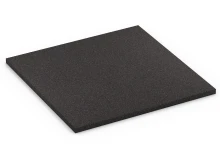
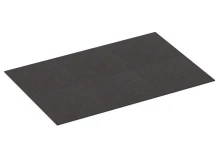
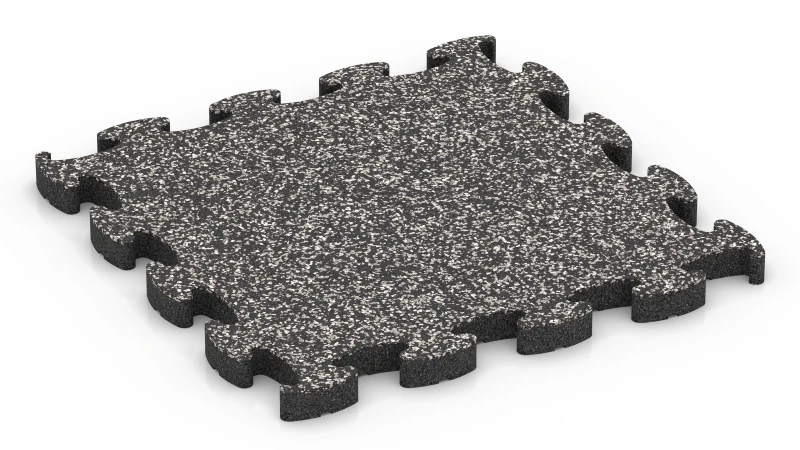
Rubber patio tile XT "Dark grey granite"
- /
-
Ready to ship
in approx. 3-4 weeks – production yet to start - €113.57 / 5.03 Piece / m²
- (4.87 kg / Piece)
EAN: 4251469369405 | Item no.: 6940
Type XT patio tiles are 2.8 cm thick and precision-cut. Once laid, the tiles look like a poured surface because only fine, tight joints remain between them. The wearing layer is made from through-coloured EPDM rubber granules, while the base layer is made from recycled tyre rubber granules (ELT). On patios, roof terraces and garden seating areas, the surface is pleasantly resilient underfoot, hard-wearing and long-lasting, and retains its colour as it wears.
How do rubber patio tiles feel?
The surface feels warm under bare feet. Children can sit and play directly on it. Even after rain, it remains slip-resistant. If someone trips, the resilient flooring cushions the fall. This provides comfort and safety for children, older people and pets. It also muffles noise from footsteps, moving garden furniture and rolling toys almost completely.
What are rubber patio tiles made of?
The tiles have two layers with different functions. The upper wearing layer comes into contact with hands and feet. It is made from newly manufactured, fully through-coloured EPDM rubber granules. This means the tiles retain their colour even as the surface wears over time. The base layer consists of ELT granules made from recycled end-of-life tyres. It carries the weight and absorbs impacts, so garden furniture does not normally leave permanent indentations. The tiles weigh around 24.5 kg per square metre. When first unpacked, they may still smell of rubber, but the smell soon fades outdoors.
Can I lay rubber patio tiles myself?
Yes, you do not need a tradesperson. Concrete, paving, tiles and roof waterproofing are generally suitable substrates. Firmly bonded tiles can stay in place. Hollow-sounding tiles should be removed first. The substrate must remain stable, largely level and able to bear the load over the long term. In a garden, gravel grids filled with stone chippings form the base. The tiles are simply laid in place without drilling, adhesive or screws. The rounded jigsaw interlock joins each tile to its neighbours and keeps the edges from lifting. Edge restraint is generally not needed. At the perimeter, cut the tiles with a jigsaw or circular saw. Along a lawn or flower bed, the edge can remain uncut.
Are the tiles weatherproof and easy to clean?
Rain passes through the tiles. On an impermeable substrate, water runs along drainage channels on the underside and follows the gradient. On a water-permeable sub-base, such as gravel grids filled with stone chippings, rainwater soaks naturally into the ground. This prevents puddles and allows the patio to dry quickly. Frost does not damage the tiles, so they can remain in place throughout winter. In direct sunlight, the surface warms up like any floor covering. Light and mottled colours stay cooler than dark ones. A broom or garden hose is enough for cleaning.
Can I raise the surface or order tiles cut to size?
The patio tiles do not need an additional supporting structure. Type XX functional tiles placed under the covering increase the build-up height and reduce impact sound further. To avoid cutting the tiles yourself, use the laying planner on the WARCO website to create a drawing of the patio. Based on the generated DXF file, WARCO can supply the tiles cut to size and ready to lay for an extra charge. They then only need to be laid on the patio in the correct order.


Discount
Product Highlights
Characteristics
Product Details – Material and Structure


Comparative values
An XT tile can be laid directly as a floor covering or on an underlay of XX functional tiles. Depending on the configuration, the floor build-up is single-layer, two-layer or multi-layer.
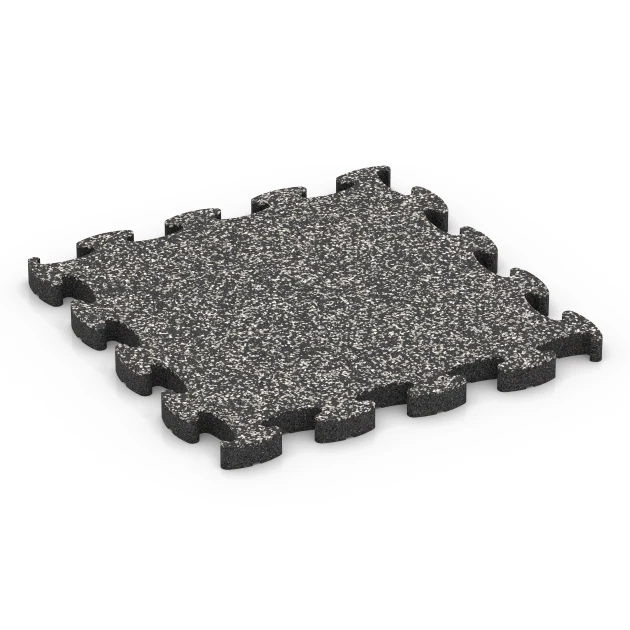
The XT tile is made entirely from recycled tyre rubber granules (ELT), or has a body of these granules with a permanently bonded top layer of coloured EPDM rubber granules. A three-dimensional interlock is cut into the tile edges: during installation, the teeth of one tile engage in the matching recesses of the next, creating a continuous tiled surface. XT tiles are 1.8 or 2.8 cm thick and come in three density grades: elastic, standard and stable.
The XX functional tile is also made from recycled tyre rubber granules (ELT). Beneath the XT tile, it spreads point loads, damps vibrations and impact sound, increases shock absorption and adds to the overall build-up height. It is likewise 1.8 or 2.8 cm thick and is offered in three damping classes. The functional tiles are laid edge to edge. In a multi-layer construction, the tiles should be offset from one layer to the next so that the joints do not align.
An XT tile combined with one or more functional tiles forms a sandwich construction. The thickness and density of the XT tile are selected for the intended application. In a sandwich construction, the thickness and damping class of the functional tiles are selected as well. Tiles of different densities can also be combined in a multi-layer construction to match the properties of the floor build-up to the application.
A calibrated puzzle interlock without a bevelled edge is produced by cutting each rubber tile precisely to size from a larger blank. The blank is left to cure for several days before cutting.
Without a bevelled edge means that the tile edges are vertical rather than chamfered. The finished tile has only a minimal height tolerance.
In the usual pressing process, a rubber tile receives a bevelled edge, causing each joint to appear as a dark line across the surface. With vertical edges and minimal height tolerance, the tiles butt together accurately, leaving only a hairline joint. This hairline joint is visible in the laid surface only on close inspection, so the floor covering appears almost seamless.
Patio tiles made from PU-bound rubber granules change over time in colour and surface appearance, while their elastic properties change more slowly. The extent of these changes depends on the type of granules, sunlight at the installation site and the use of the area. Patio tiles pass through a bedding-in phase during the first few weeks. With coloured recycled tyre rubber granules (ELT), the pigmented PU binder initially becomes slightly darker in sunlight; because individual patio tiles receive differing amounts of light, the surface can temporarily appear uneven. A freshly cut EPDM wearing layer may take on a slightly warmer tone during its first days in sunlight.
In sunlight, a patio tile may temporarily become darker because of the PU binder rather than the EPDM rubber granules. This change is reversible: the colour subsequently becomes lighter again and the appearance will generally even out. With UV-stabilised tiles, UV radiation affects the tile more slowly; this does not refer to colour shade and is not a promise that the colour will remain unchanged.
Over the longer term, the colour appearance changes for different reasons depending on the type of granules. Natural black ELT rubber granules are deep black when new, gradually developing an anthracite tone under UV exposure, similar to the colour change seen in car tyres. In coloured ELT, the PU binder is pigmented and forms a coloured coating around the black rubber granules. The colour is held in this coating rather than in the granules themselves, so use on walked-on areas can abrade the coating and reveal the black rubber granules beneath. An EPDM wearing layer is coloured throughout, colour-stable and UV-resistant.
Deposits can also alter the appearance. Dust, pollen and fine sand can settle in the surface structure, making the area appear duller; these residues can be removed, while the slip-resistant properties remain. This should be distinguished from the long-term behaviour of pure ELT under sustained intense sunlight: it slowly loses elasticity and becomes more brittle near the surface, a process that develops more slowly than visible colour changes.
Outdoor rubber tiles made from polyurethane-bound rubber granules are frost-resistant and suitable for use throughout the winter. Their porous structure absorbs precipitation and allows it to pass downwards; water remaining in the pores has space to expand when it freezes, while the rubber granules and polyurethane binder remain elastic at sub-zero temperatures. The sub-base must also be constructed to withstand frost.
On bound sub-bases, water flows beneath and between the tiles in the direction of the fall towards the drainage system. On chippings or crushed stone, it drains vertically through the construction. If water collects beneath the tiles, a frost-susceptible sub-base may rise and then settle again after thawing. The tiles themselves remain unaffected, but the surface may become more uneven.
For winter maintenance, use a snow shovel with a smooth edge and avoid catching the tile edges. Salt used in normal quantities to melt ice does not harm the rubber granules.
Patio tiles made from rubber granules achieve slip resistance class R10 under BS EN 16165. The test uses standard test footwear on an oil-wetted ramp, in accordance with Annex B of BS EN 16165 (formerly DIN 51130). Depending on the product range, the mean overall acceptance angle lies between 12 and 17 degrees, so every range achieves R10. The tiles are described as slip-resistant rather than slip-proof because the classification applies only to the conditions tested.
Most of this slip resistance comes from hysteresis friction: the sole of the shoe deforms as it moulds around the individual rubber granules, and it is that deformation that generates most of the friction. Outdoors in rain, the permeable surface also helps, as rainwater drains through the tiles and a continuous film of water does not normally build up. The oil ramp test does not capture this effect.
The tiles have not been rated for barefoot areas under Annex A of BS EN 16165 (classes A, B or C), so no slip resistance rating can be given for barefoot use. Wet leaves, algae, ice, frost, compacted snow, oil, grease and cleaning residues can reduce slip resistance or remove it altogether. Keep the surface clear, sweep it and remove any oil promptly. Slip resistance may also decline over the service life, as abrasion can gradually smooth the surface of the granules.
Which patio surface heats up least in the sun depends more on sun exposure and surface colour than on the material itself. A shaded patio remains coolest; trees, awnings or a shade sail keep direct sunlight off the surface, while air movement supports surface cooling.
In direct sun, light-coloured surfaces heat up less than dark ones. Light surfaces reflect a greater proportion of solar radiation, whereas dark surfaces absorb more radiation and convert it into heat. This applies to wood, WPC, stone, ceramic and rubber granules.
Alongside surface temperature, the material affects how hot a patio surface feels underfoot. Dense stone, ceramic or concrete surfaces transfer stored heat to the sole of the foot quickly. Patio tiles made from PU-bound rubber granules have a porous grain structure and low density, transferring less heat to the skin during brief contact and cooling down quickly once direct sunlight has ended.
WARCO rubber patio tiles start at around €36 (about £31) per square metre. At that price, the tiles are 3 cm thick and measure 50 × 50 cm, so four tiles cover one square metre. All prices include VAT.
The cost of patio slabs varies by product range, thickness and surface. Slabs with a coloured EPDM surface are among the more expensive options, at up to around €110 (about £94) per square metre. You can find the price of each option on its product page in the online shop.
The price per square metre is for the tiles alone. On a firm base such as concrete, asphalt, concrete block paving or natural stone paving slabs, the tiles can be laid loose without mortar or adhesive (dry-laid), making installation a DIY job. If there is no firm base, you also need to allow for the cost of a sub-base, such as one built from gravel grids.
After installation, the visibility of joints between rubber tiles depends on the joint type, edge profile, tile format and colour design.
Tiles with a jigsaw interlock retain narrow joints. Square and rectangular tiles with straight edges produce a regular grid. Calibrated tiles with a cut jigsaw interlock form an almost seamless surface.
Unchamfered edges make the joint pattern less conspicuous, whereas chamfered and straight-cut edges accentuate it. In multi-coloured designs, fine joints recede visually and generally appear only as a slight shadow. With single-colour coverings, the joint pattern is more pronounced, depending on tile type. When walked on barefoot, a narrow joint between unchamfered edges is scarcely noticeable.
For the most visually uniform surface possible, calibrated tiles with a cut interlock and colour designs made from differently coloured EPDM granules are suitable.
Installation of rubber tiles requires a load-bearing substrate designed to drain water. The tiles are water-permeable, so rainwater passing through them must infiltrate into the substrate or, alternatively, be discharged by a fall.
In central Europe, the suitable installation temperature is between 5 and 17 °C. Direct sunlight should be avoided, as it can cause tiles to heat up to differing degrees; throughout installation, all tiles should have an even temperature. Rain during installation does not harm the tiles, but soaked tiles must dry completely before installation.
General installation instructions must be followed, along with the requirements for the relevant product and installation system.
New rubber tiles may carry harmless release-agent residues from manufacture. Weathering washes these residues away; if required, they can be removed with water and a brush or with a pressure washer. The typical rubber smell of new tiles is harmless and reduces noticeably after a short time outdoors.
Rubber flooring tiles can be installed directly over concrete, screed, asphalt or tiled floors as a loose-laid covering, without an additional sub-base.
With no additional sub-base required, the substrate must still be load-bearing, clean and sufficiently level. Remove loose material, oil and other contamination before laying. Larger irregularities, depressions and changes in level must be levelled out so that the tiles lie stably and do not create obtrusive edges.
The starting point and laying direction depend on the shape of the area and the required pattern. In many cases, starting in the centre helps to align the pattern evenly and produce similar cuts at opposite edges. For other areas, a straight boundary may provide the appropriate starting point.
Lay the tiles according to the chosen layout and join them firmly. Depending on the product, this is done using puzzle joints, dovetail joints or separate connectors. Measure the edge tiles, cut them to fit and then insert them.
Bonding is generally not required. Small cut pieces, stair treads and very small areas may require bonding.
Patio tiles made from PU-bound rubber granules are loose laid on a bitumen membrane, roofing felt or flat-roof membranes: they are simply placed in position, without adhesive or screws. This keeps the waterproofing on a balcony, terrace, roof terrace, flat roof or carport intact and allows individual tiles to be lifted at any time. Damaged waterproofing must be repaired before installation.
For plastic flat-roof membranes, it must be established before installation whether they contain plasticiser; the membrane manufacturer or a roofing contractor can provide this information. Roofing felt and bitumen membranes contain no plasticiser, so the tiles may rest directly on them; EPDM flat-roof membranes are also plasticiser-free. PVC or FPO plastic membranes can contain plasticiser, which may migrate into the rubber tiles on direct contact and cause the membrane to become brittle over time. Where a plastic membrane contains plasticiser, a thin separation layer of polyester or glass fibres is placed between the membrane and the rubber-granule covering. Plasticiser migration does not harm the rubber tiles.
The water-permeable rubber-granule covering allows rainwater to pass through the tiles onto the waterproofing, where it follows the existing fall to the outlet. On most ranges, drainage channels on the underside of the tiles carry the water onwards. A fall of 1 to 2 % has proved effective. Before installation, check the waterproofing for irregularities or depressions where water may collect, and level these areas with accurately cut pieces of roofing felt during installation.
Outdoor rubber tiles should be cleared of leaves, soil and sand regularly.
Loose dirt can be swept away with a rubber broom or rinsed off with a hose. Rain also washes much of the dust and pollen away through water-permeable tiles.
Regular maintenance reduces the work required for more thorough cleaning.
For thorough outdoor cleaning, a pressure washer is suitable. The water jet loosens dirt from the textured surface and removes more persistent residues such as dog mess or food residue.
Where clean water is not sufficient, use either a neutral cleaner suitable for rubber or a mildly acidic cleaner. A specialist rubber cleaner is not required. Biodegradable Sonett WC Cleaner Mint is particularly suitable and has a pH value of around 5 to 6.
Apply the cleaner evenly, either neat or slightly diluted. After 10 to 15 minutes, work it in with a brush, then rinse the area thoroughly with clean water.
When brushing, use moderate pressure only. Excessive pressure can loosen granules from the bonded matrix.
Strongly alkaline cleaners, abrasive products and solvent-based cleaning products are unsuitable, as they can attack the surface of the rubber tiles.
Good design made easy.