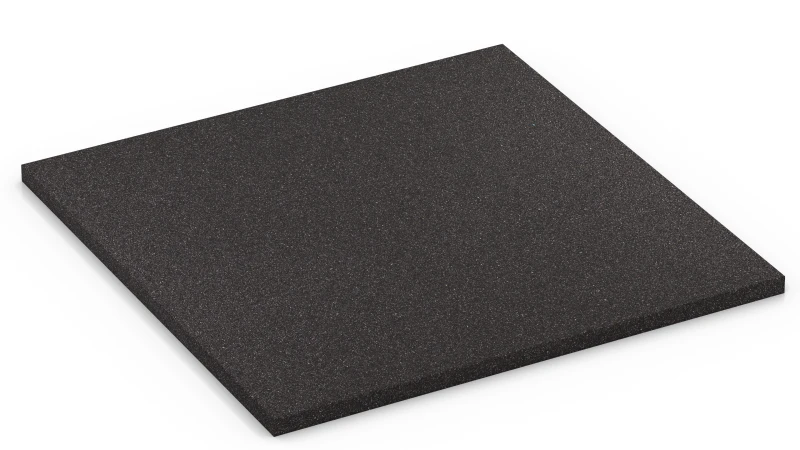
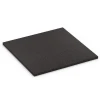
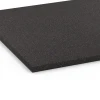
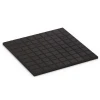
Base Layer CL 3 XX "Anthracite"
- /
-
Ready to ship
in approx. 2-3 weeks - €31.85 / 3.70 Piece / m²
- (3.16 kg / Piece)
EAN: 4251469364813 | Item no.: 6481
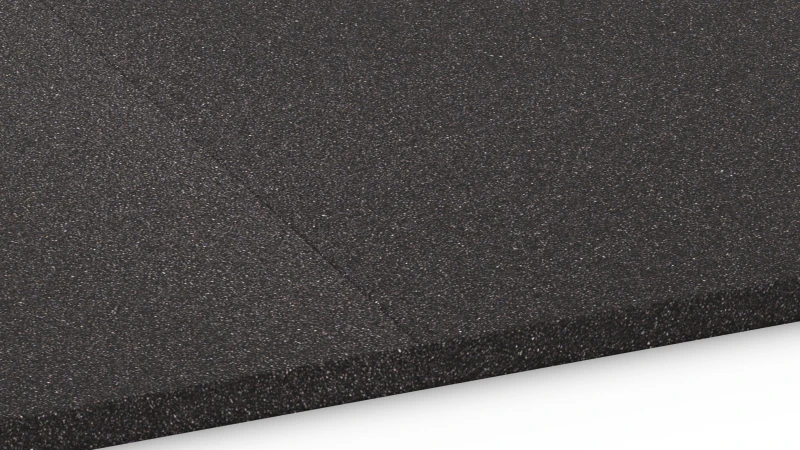
Base Layer CL 3 is a resilient underlay made from PU-bound rubber granules, developed for applications where controlled deformation and effective impact absorption are required. Used beneath a surface layer, it forms part of a modular system that can be adapted to different load scenarios in both indoor and outdoor environments.
Resilient and shock-absorbing
With its comparatively low density, this layer provides pronounced elasticity under load. It absorbs impact energy and reduces transmitted forces into the substrate. The material compresses under point loads and recovers after unloading, supporting a balanced interaction between surface layer and substructure.
Build height as required
The system height can be configured by stacking individual layers. This allows the overall construction to be adapted to installation conditions, transition heights or specific functional requirements. Each additional layer increases deformation capacity while maintaining a stable, continuous surface when combined with the top layer.
Combining damping classes
Different damping classes can be combined within one construction. This enables targeted adjustment of mechanical behaviour across an area, for example where varying levels of compliance are required. The interaction of layers creates a defined response under load without changing the surface material.
Staggered installation
Installation is carried out in a staggered pattern. The panels are laid butt jointed on a prepared substrate without mechanical fixing or adhesive. Offsetting the joints distributes loads and supports an even surface. The system remains demountable and can be adjusted or extended if required.
Advantages of sandwich construction
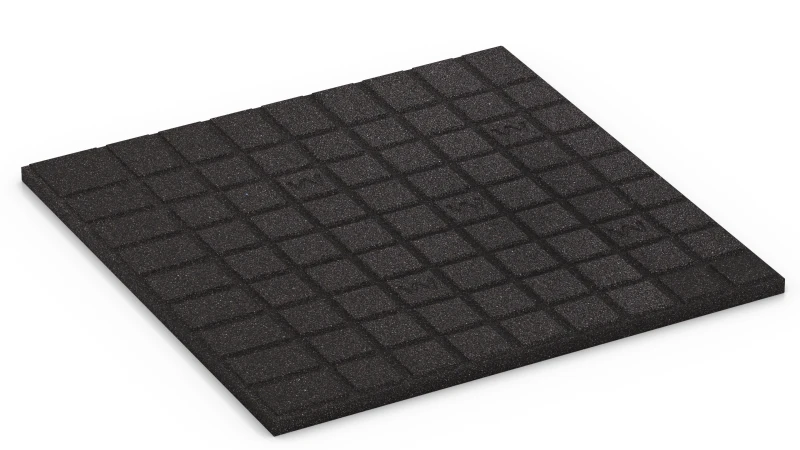
In a sandwich configuration, the damping layer works together with the surface layer to separate functional requirements. The upper layer defines wear behaviour and surface characteristics, while the base layer controls deformation and energy absorption. This separation allows each layer to perform its function consistently within the system.
System depths
1.8 cm – surface layer 1.8 cm
2.8 cm – surface layer 2.8 cm
3.6 cm – surface layer 1.8 cm + UL 1.8 cm
4.6 cm – surface layer 2.8 cm + UL 1.8 cm
5.6 cm – surface layer 2.8 cm + UL 2.8 cm
6.4 cm – surface layer 1.8 cm + UL 2.8 + UL 1.8 cm
7.4 cm – surface layer 1.8 cm + UL 2.8 + UL 2.8 cm
8.4 cm – surface layer 2.8 cm + UL 2.8 + UL 2.8 cm
9.2 cm – surface layer 1.8 cm + UL 2.8 + UL 2.8 + UL 1.8 cm
10.2 cm – surface layer 1.8 cm + UL 2.8 + UL 2.8 + UL 2.8 cm
11.2 cm – surface layer 2.8 cm + UL 2.8 + UL 2.8 + UL 2.8 cm
The modular structure allows system heights to be configured in defined increments. This ensures compatibility with adjacent constructions and enables consistent performance across different installation scenarios.



Discount