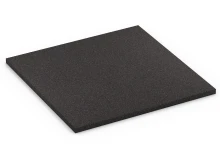
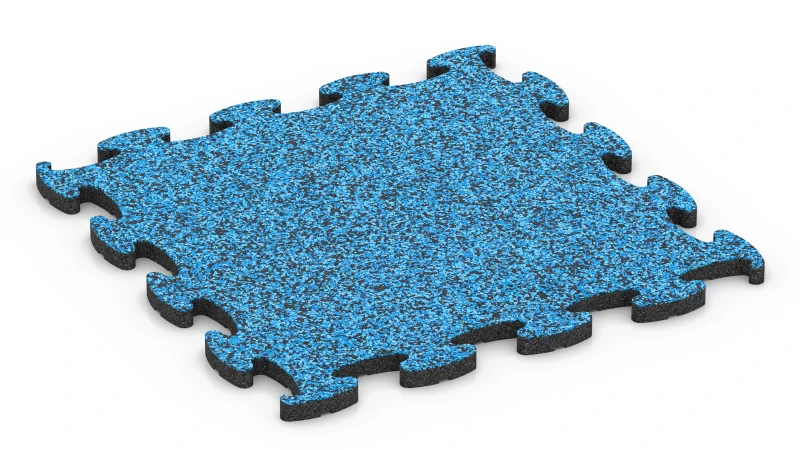
Exhibition Click Floor Tile XT "Atlantic"
- /
-
Ready to ship
in approx. 3-4 weeks – production yet to start - €90.95 / 5.03 Piece / m²
- (3.65 kg / Piece)
EAN: 4251469369207 | Item no.: 6920
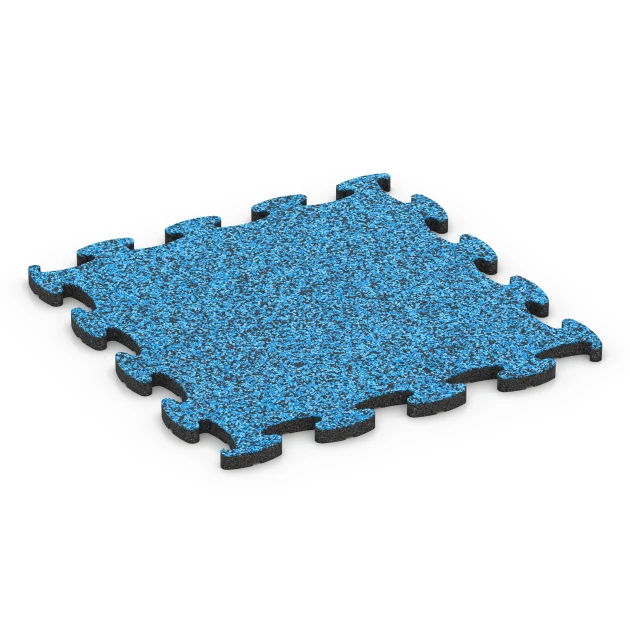
The Exhibition Click Floor Tile Type XT consists of precision-cut, 1.8 cm thick tiles with a closed wearing layer made from through-coloured EPDM rubber granules. The wearing layer retains its colour even as the surface wears. Only a tight joint remains between the tiles, so the stand floor looks like a poured surface. The flooring is compression-resistant, abrasion-resistant and slip-resistant. It can be laid and lifted again many times.
How does the flooring perform on a stand?
Whether on an exhibition stand, in a showroom or at an exhibition, visitors often stop and talk for a long time. Suitcases and transport trolleys roll across the surface from time to time. For stand staff who spend many hours standing, the flooring is more pleasant than the bare hall floor. Footsteps and rolling noise are quieter on it. Display cases, poseur tables and exhibits do not leave permanent indentations in normal use. Spreader plates are required beneath the feet of trusses and stages.
What are the exhibition flooring tiles made from?
The tiles have two layers. The wearing layer on top is made from newly produced, through-coloured EPDM rubber granules. It is densely compacted and retains its colour even as the surface wears. Spilt drinks do not penetrate the tiles and can simply be wiped up. With the EPDM wearing layer, the tiles achieve a reaction-to-fire classification of Cfl-s1 in accordance with BS EN 13501-1. Underneath is a base layer made from ELT granules, which are rubber granules from recycled end-of-life tyres. It carries the load and cushions impacts. The flooring weighs around 18 kg per square metre. Freshly unpacked tiles sometimes smell of rubber, but the smell soon disappears with good ventilation.
How can the stand floor be designed?
The tiles are available in several flecked colour designs. Dirt from shoes is hardly noticeable on these speckled finishes. Two or more colours can be used to distinguish walkways, the reception area and the meeting area. Plain-coloured tiles are also available on request for larger areas. For an extra charge, WARCO cuts the tiles to match the stand layout, including curves and colour zones, so that they are ready for laying. WARCO needs a drawing of the area as a DXF file. For areas with straight edges, you can easily create the drawing using the laying planner in the WARCO shop.
How is the flooring laid with the interlocking system?
The tiles are simply laid in place without adhesive, tape or screws. The substrate must be load-bearing, stable and largely level. The optimised jigsaw interlock joins the tiles so that their edges do not lift. Edge tiles are cut with a jigsaw or circular saw. If required, WARCO can bevel the open edges facing the aisle so that the flooring tapers down to it. The exhibition flooring is suitable for halls and for outdoor events.
What happens to the flooring after the event?
When the stand is dismantled, the tiles are lifted by hand, cleaned and stacked for the next use. At the next event, the tiles can be arranged in a new layout. If a tile is damaged, it can be replaced individually. A vacuum cleaner, mop or cleaning machine is sufficient for cleaning. For damp mopping, use warm water and a neutral cleaner.


Discount
Product Highlights
Characteristics
Product Details – Material and Structure


Comparative values
A calibrated puzzle interlock without a bevelled edge is produced by cutting each rubber tile precisely to size from a larger blank. The blank is left to cure for several days before cutting.
Without a bevelled edge means that the tile edges are vertical rather than chamfered. The finished tile has only a minimal height tolerance.
In the usual pressing process, a rubber tile receives a bevelled edge, causing each joint to appear as a dark line across the surface. With vertical edges and minimal height tolerance, the tiles butt together accurately, leaving only a hairline joint. This hairline joint is visible in the laid surface only on close inspection, so the floor covering appears almost seamless.
Rubber flooring made from rubber granules is classified as Efl or Cfl-s1 under BS EN 13501-1, depending on its construction. Tiles made from recycled tyre rubber granules achieve Efl, while tiles with an EPDM top layer generally achieve Cfl-s1. The s1 suffix indicates low smoke production in the event of fire.
Certain single-layer gym flooring products made from recycled tyre rubber granules can be ordered in a Cfl-s1 version at extra cost; the standard version is Efl. The classification applies to the product variant tested, including its construction and thickness.
Cfl-s1 is considered flame-retardant for the purposes of building regulations and corresponds to the same level of requirement as B1 under DIN 4102-1. However, a B1 test certificate and a classification report under BS EN 13501-1 are not interchangeable. The technical guidelines issued by exhibition organisers generally require Cfl-s1 under BS EN 13501-1 or B1 under DIN 4102-1 for exhibition stands.
Rubber flooring for temporary event areas must be selected according to the location, intended use, substrate, load capacity, weather resistance, fire performance and installation method. The floor covering must suit its intended use: areas for standing audiences, catering and exhibition stands have different requirements from temporary sports areas or zones with stages, platforms and trusses. Where wheelchairs, transport trolleys and other wheeled equipment are used, the covering must be sufficiently level and firm for unobstructed movement. In sports areas, elasticity, slip resistance and surface texture must be matched to the sport concerned.
These use requirements also determine the loads to be considered. Furniture, sales stands and technical structures may transfer loads through small contact areas, so the load capacity, deformation behaviour and load distribution of the event floor covering must be checked. Stage, platform and truss feet require suitable spreader plates and a load-bearing substrate. An elastic event floor covering is neither a substitute for a foundation nor for any required structural verification.
A load-bearing substrate does not remove the need to consider comfort: during longer stays, the resilience of an elastic event floor covering can increase comfort for visitors and staff. Fire-performance requirements arise from the applicable regulations and the conditions imposed for the individual event. Escape routes may be subject to stricter requirements than the rest of the event area. For tents, the relevant approval governing their erection applies; for exhibitions, the organiser’s technical regulations apply.
These event-specific requirements also apply where surfaces may become wet. Outdoors and in areas where drinks may be spilled, the surface must be sufficiently slip-resistant when wet. Water-permeable event tiles allow liquid to drain through, but the substrate must then absorb or drain away that liquid.
Once liquid has drained away, the event floor covering must still stay in place. Edges, entrances, cable crossings and transitions must be finished without trip hazards using suitable ramps or edge profiles. A loose-laid event floor covering with an integrated interlocking system can be removed after the event without leaving adhesive residue or drill holes.
Where the substrate is sensitive, a suitable protective layer or separation layer may be required. On grass, the period of use should be kept short, as lack of light, pressure, heat and moisture can damage the turf.
Flooring suitable for an exhibition stand depends on how often the stand will be set up, how long staff and visitors will be standing, and how even the substrate is. The organiser’s technical regulations specify the required fire classification.
Evidence of the required classification should be available before an order is placed. Exhibition carpet is the most common and lowest-cost option; ribbed, needle-punch and velour carpets are available in many colours, installed with double-sided tape and removed without residue. After the event, the covering is usually discarded.
Carpet tiles can be laid loose without adhesive and used more than once. A thin carpet covering provides limited walking comfort, and irregularities in the substrate can show through it.
PVC floor coverings, commonly sold as vinyl flooring, are abrasion-resistant, easy to clean and available in many designs. Click vinyl flooring is laid without adhesive, but PVC floor coverings require an even, clean substrate and remain hard without resilience.
Where the substrate is uneven or cables need to be concealed, a raised floor system is used. The platform can be covered with laminate, exhibition carpet or vinyl flooring, but requires a substructure, installation time and edge ramps.
WARCO click tiles made from PU-bound rubber granules are laid loose without adhesive, directly on the exhibition-hall floor without a substructure. Outdoors, they can also be laid on paving, gravel or natural ground. Their dovetail-shaped edge teeth engage to form a continuous surface without tools.
The elastic structure yields slightly underfoot when walking or standing, which becomes noticeable over several exhibition days. The tiles are water-permeable and weather-resistant, making them suitable for outdoor areas. After the event, they can be lifted by hand and kept ready for the next occasion.
Versions with an EPDM wear layer achieve Cfl-s1 under BS EN 13501-1. For a one-off exhibition, exhibition carpet remains the straightforward choice; for repeated exhibitions during the year, outdoor installations or long hours at the stand, click tiles made from rubber granules are the more suitable option. The required fire classification is usually B1 under DIN 4102-1 or Cfl-s1 under BS EN 13501-1.
Event flooring that can be laid quickly is a mobile system of modular tiles with an integrated interlocking system. The tiles require neither adhesive nor screws.
Event tiles made from PU-bound rubber granules have puzzle-shaped interlocking edges. During installation, dovetail-shaped teeth mesh together, joining the individual tiles into a continuous surface that stays in place. No subframe or special tools are required to connect the tiles.
After the event, the connections can be released by hand and each tile lifted individually. The floor can be installed or dismantled in sections, allowing several people to work on installation or dismantling at the same time. This modular flooring system is particularly suited to events with tight time windows.
Exhibition flooring affects acoustics at an exhibition stand by reducing footfall noise and absorbing some incident sound when click tiles made from rubber granules are used. It acts in two ways: walking and rolling create noise directly on the exhibition flooring surface, while sound from conversations, music and announcements reaches the floor, where it is partly reflected and partly absorbed. The flooring acts directly on footfall and rolling noise, whereas its effect on reflections depends on the other surfaces within the exhibition stand.
On a hard floor covering, each step is audible as a short impact, while wheeled cases and transport trolleys can produce a rattling sound throughout the exhibition stand. An elastic exhibition flooring layer yields slightly beneath a heel or wheel, spreading the impact over a longer period; the peak force falls and the hard, high-frequency elements of the noise are less pronounced. With rolling noise, the effect also depends on the wheels and the substrate. Footfall and rolling noise occur alongside conversations and can be particularly noticeable at an exhibition stand.
Smooth, dense floor coverings reflect most incident sound. A porous floor covering made from rubber granules can absorb part of that sound: air movement is slowed in the connected pores, converting part of the sound energy into heat. Further sound passes through the layer and is reflected again by the solid substrate. The extent of this effect cannot be stated without measurement. Furniture, exhibits and people cover parts of the floor area and scatter sound; for conversations at an exhibition stand, noise arriving from aisles, announcements and neighbouring stands is usually more significant than reverberation time.
Stand construction should address that noise first. Enclosed stand walls hold back part of the sound, absorbent surfaces inside the stand reduce reflections, and a meeting area away from the aisle creates distance from sound sources. Suspended acoustic rafts and baffles require approval from the event organiser and venue. Exhibition flooring complements these measures but does not replace them.
The substructure also affects noise generation. System platforms and components able to vibrate can move with footfall and rolling traffic, producing audible drumming. Exhibition flooring laid directly on the hall floor has no such void. Click tiles made from PU-bound rubber granules are installed without a supporting structure; their elastic, porous structure reduces footfall noise and can also ease leg strain during prolonged standing.
Reusable alternatives to exhibition carpet include modular exhibition flooring that can be lifted and relaid. Carpet tiles, plastic click and interlocking systems, and click tiles made from rubber granules have become established replacements for single-use carpet on an exhibition stand. Rental systems supplied through a stand builder are also an alternative, as the same flooring area is used by several exhibitors.
These alternatives also differ in the raw materials used. Carpet tiles are available with recycled plastic fibres, while resilient flooring can be made from recycled rubber granules, including recycled tyre rubber granules (ELT) from tyre recycling. For waste prevention, the decisive factor is how often exhibition flooring is used: at ten exhibitions, the same exhibition flooring is used ten times, avoiding waste through repeated use compared with a single-use product made from recycled fibres.
WARCO exhibition flooring consists of click tiles made from PU-bound rubber granules. The base layer is predominantly made from ELT rubber granules, and a colour-fast EPDM wear layer forms the surface. The tiles are installed without adhesive, lifted without damage after the exhibition and relaid at the next venue. They can be used indoors and outdoors; the rubber tiles can be damp-cleaned, and rain and frost do not damage them.
Exhibition flooring can be reused and recycled, although single-use exhibition carpet and tiles made from PU-bound rubber granules differ substantially in their recycling potential. Single-use exhibition carpet is discarded after only a few days at an exhibition. Less than three per cent of carpet waste generated in Europe each year is recycled; the remainder is sent to landfill or incinerated.
Take-back schemes are now available for some certified exhibition carpets. These require the carpet to be clean, dry and free from contamination.
Exhibition flooring made from PU-bound rubber granules follows a different route, beginning with the raw material: ELT rubber granules come from tyre recycling. The tiles are laid loose and can be lifted without tools after the exhibition, cleaned, stacked and stored. Their puzzle interlock retains its shape and fit over many installations, allowing the same tiles to form a continuous surface on changing exhibition stands without creating waste during dismantling. At the end of their service life, used tiles can be shredded and recycled into secondary granulate where regional collection routes are available; otherwise, energy recovery remains the option.
Whether to hire or buy exhibition flooring depends mainly on how often you exhibit. For a company that takes part in trade shows or exhibitions only occasionally, buying its own flooring rarely makes financial sense. Hiring it is the practical alternative.
For regular exhibitors, flexible, reusable flooring is a sound long-term investment.
When assessing that investment, look at how the flooring is made. It should be modular and easy to adapt to stands of different sizes. Flooring that can be used indoors and outdoors, and is easy to lay even on uneven surfaces, suits a much wider range of venues. Comfort underfoot matters too: a surface that stays comfortable to walk and stand on for hours makes long hours on the stand more pleasant.
WARCO exhibition flooring meets these requirements. Its modular rubber tiles are easy to handle and interlock to form a stable surface without the need for extra tools. The tiles are durable and can be reused many times. Their elasticity makes them comfortable underfoot: walking on them feels much like walking on a forest floor.
For exhibition stands, this makes the flooring an economical, sustainable and practical choice.
At the lower end of the price scale, exhibition flooring consists of single-use carpet supplied in rolls or as tiles for exhibition stands. A 3 mm cord or needlepunch carpet starts at around €3/m² (about £3/m²). Reusable carpet tiles start at around €25/m² (about £21/m²). Both take considerable time and effort to lay and offer little comfort.
A more economical alternative is WARCO's exhibition click tiles, which can be laid again and again. After two or three events these tough, resilient and stable tiles, with a minimum thickness of 1.8 cm, prove a worthwhile investment. They are comfortable to stand and walk on, modular in construction and readily adapted to different stand sizes. They suit halls as well as open-air sites.
They are laid without adhesive. The connection system keeps the tiles together as a continuous surface, so they remain stable throughout the show and do not drift apart.
Before fitting rubber flooring indoors, the tiles should be cleaned, dried completely and aired. The substrate must be level, load-bearing, clean and dry.
New tiles made from rubber granules may carry residues of manufacturing release agents and fine rubber dust. Before installation, it is advisable to clean the tiles outdoors with warm water; a mildly acidic cleaner suitable for rubber and a scrubbing brush can assist with cleaning. A pressure washer may be used from a sufficient distance. The tiles must then dry completely.
If cleaning before installation is not possible, the residues can be removed after fitting by repeatedly damp-mopping with warm water. New tiles have a characteristic odour which decreases over time; airing them outdoors for several days and regularly ventilating the room during the first few weeks will help it dissipate more quickly.
Before installation, the tiles should have reached room temperature. The installation instructions for the relevant product and installation system must be followed.
The appropriate cleaning method for rubber tiles within buildings depends on the area in which they are used and the surface texture.
In private homes, rubber brooms, vacuum cleaners or mops are usually sufficient for regular maintenance. A neutral cleaner suitable for rubber should be used. A mildly acidic cleaner may be used for mineral deposits.
Water-permeable rubber floor coverings must not be flooded where the substrate does not provide suitable drainage.
For larger or commercial areas, a scrubber dryer with a cylindrical brush is recommended. The brush type and contact pressure of the scrubber dryer must be matched to the floor covering.
Within buildings, a pressure washer is only suitable for stables or appropriately equipped halls where adequate drainage is available. It can also remove stubborn dirt from the textured tile surface.