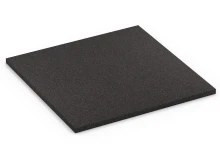
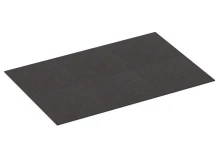
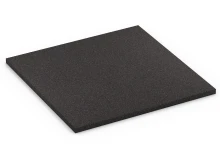
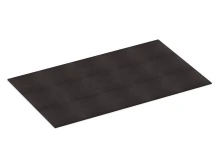
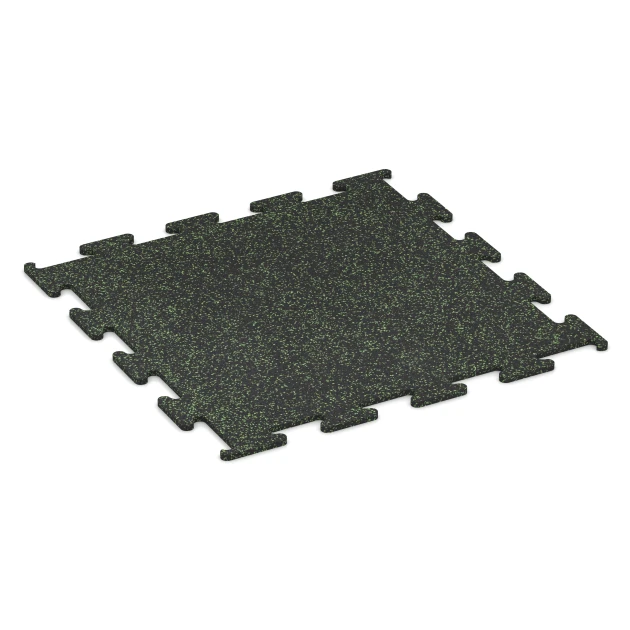
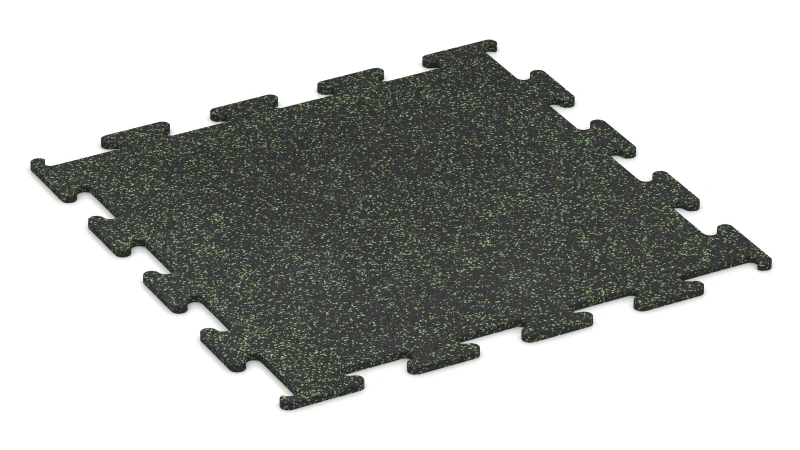
Fitness Performance Elite Speckled Rubber Gym Flooring 100 × 100 DZ "Lightly speckled green"
- /
-
Ready to ship
in approx. 3-4 weeks – production yet to start - €44.10 / 1 Piece / m²
- (15.00 kg / Piece)
EAN: 4251469337596 | Item no.: 3759
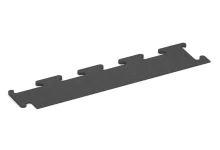
Fitness Performance Elite Speckled Rubber Gym Flooring 100 × 100 is designed for training areas subject to regular, intensive use in gyms, CrossFit boxes, HYROX studios, sports clubs and serious home gyms. The tiles are compression-resistant, highly abrasion-resistant and grippy. Shock absorption can be increased as required by installing Type XX base layer tiles underneath. Fine coloured speckles define the appearance.
What is the flooring made from?
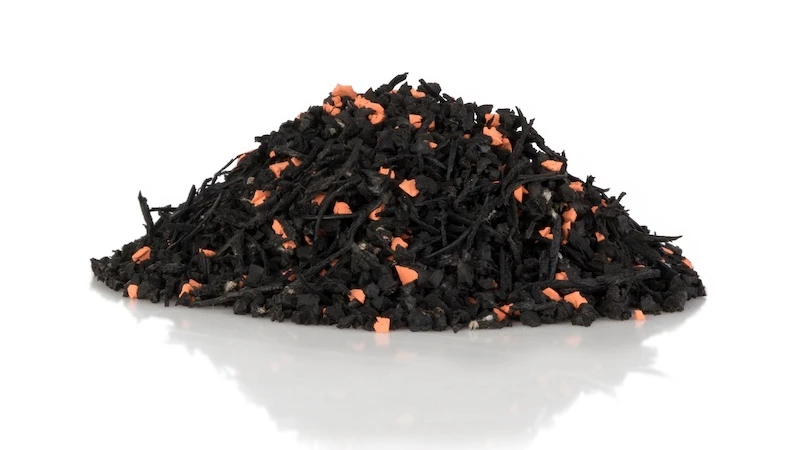
Fitness Performance Elite Speckled Rubber Gym Flooring 100 × 100 is made from a mixture of black recycled tyre rubber granules (ELT) and coloured EPDM rubber granules bonded with polyurethane. ELT granules are produced from end-of-life tyres. EPDM is a newly manufactured rubber coloured throughout.
How accurate are the tile dimensions?
Fitness Performance Elite Speckled Rubber Gym Flooring 100 × 100 tiles are first pressed as oversized blanks. After a sufficiently long cooling and curing period, each tile is precision-cut on all sides to its target dimensions. This ensures that all the tiles are the same size. The jigsaw interlock is cut precisely, and the tiles have square edges. The tiles fit tightly together, and the surface looks almost like a single piece.
How does the flooring perform during training?
Fitness Performance Elite Speckled Rubber Gym Flooring 100 × 100 is firm but gives slightly underfoot. During sprints, jumps, burpees and lunges, feet plant firmly. Push-offs and landings are therefore easy to control. Its high density also allows the flooring to support heavy racks and strength equipment.
How can shock absorption be increased?
Fitness Performance Elite Speckled Rubber Gym Flooring 100 × 100 already provides a basic level of shock absorption and reduces noise and vibrations. The thicker the tile, the greater the shock absorption. Where greater shock absorption or vibration reduction is required, Type XX base layer tiles are installed underneath. These are available in various thicknesses and densities. This makes it possible to select the right level of shock absorption for each area of the gym and each installation site.
How is the flooring installed and cleaned?
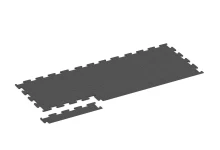
Fitness Performance Elite Speckled Rubber Gym Flooring 100 × 100 is loose laid indoors without adhesive. The jigsaw interlock holds the tiles together across the floor. If the space is refurbished, the flooring can be lifted without damage. Edge tiles are cut with a circular saw or jigsaw. On request, the tiles can also be factory-cut to fit the floor area. They then only need to be laid on site. A vacuum cleaner and damp mop are all that is needed for daily cleaning. Gyms can also use a floor-cleaning machine.


Discount
Product Highlights
Characteristics
Product Details – Material and Structure


Comparative values
Where rubber tiles are laid in several layers, the load-bearing capacity, shock absorption and overall thickness of the floor can be tailored to the intended use. The XT surface tile forms the top, visible layer and determines abrasion resistance. One or more XX functional tiles sit beneath it. Both XT surface tiles and XX functional tiles are made from PU-bound rubber granules and are available in a range of thicknesses and densities.
The choice and combination of the two tile types sets the overall thickness, load-bearing capacity and shock absorption of the system, allowing it to be tailored to the application. Systems of the same overall thickness can offer different levels of shock absorption. In playgrounds, a system designed for shock absorption can offer a higher critical fall height.
In weight-training areas, a shock-absorbing system can dissipate some of the impact energy. Indoors, it can improve impact sound insulation and reduce the transmission of structure-borne sound. It can also improve vibration damping beneath machinery and plant, or in vibration-sensitive areas.
Different rubber tiles can be combined in a layered system. Type XX tiles are available in three cushioning grades; any number can be used in any order beneath the surface tile. Each of these layers can have its own cushioning grade, density and thickness. The visible surface is formed by a type XT surface tile or another surface tile, whose density and elasticity need not match those of the tiles beneath it.
The order of the layers depends on how the area will be used and the performance required of the layered system. The layers are selected and arranged to balance shock absorption, load-bearing capacity and how point loads are spread. Two systems of the same overall height can therefore differ in load-bearing capacity, elasticity and damping.
Where rubber tiles are laid in more than one layer, the joints in each layer should be staggered rather than positioned directly above one another. In a multi-layer build-up, each layer is offset from the one below so that the tiles in the upper layer bridge the joints in the layer beneath.
Staggering the joints in this way avoids joint lines running straight through the build-up and helps to keep the finished surface even. Outdoors, it also leaves no continuous path for vegetation to grow up from the ground beneath.
Different tile sizes can be combined in a floor with more than one layer. Surface tiles and functional tiles are designed to be used together in this way, rather than stacked with their joints aligned.
Allowing for joints, each surface tile occupies 44.6 × 44.6 cm or 97.1 × 97.1 cm. Functional tiles, by contrast, come in 52 × 52 cm or 104 × 104 cm sizes and are laid with butt joints, without interlocking edges. Their nominal dimensions are therefore also the dimensions used to calculate coverage.
The layers are laid to different grids so that their joints are offset as intended. Joints in the upper and lower layers never align to form a continuous joint through the floor.
The number of tiles must therefore be calculated separately for each layer. The floor area to be covered is the same for both, but the number of tiles required depends on the coverage dimensions of each tile type.
Impact-absorbing flooring made from PU-bound rubber granules reduces impact sound and the structure-borne sound it generates. The elastic floor covering absorbs impacts and reduces their transfer to the substrate.
Impact sound occurs when walking, jumping, moving furniture or setting down weights cause a floor or storey slab to vibrate. These vibrations travel through solid building components as structure-borne sound and can become audible as airborne sound in other rooms.
Structure-borne sound can also be caused by machinery and by installations fixed to the building. It may have causes and transmission paths other than impact sound, so it cannot be reduced by a floor covering alone.
Under load, a floor covering made from rubber granules deforms elastically. This deformation transfers the load to the substrate less abruptly, reduces the peak force and, through the covering’s internal damping, further weakens the remaining vibrations.
Sound-insulation tiles reduce excitation of the substrate from footsteps, jumps and impacting objects. Where higher requirements apply, multi-layer flooring systems with functional layers of differing elasticity can further reduce impact transmission. Their effectiveness depends on the properties of each layer, the load applied, and the existing floor or slab structure.
The number of tiles required for an irregular area can be calculated manually or determined using the digital laying planner.
For irregular areas, a scaled laying plan on graph paper is recommended. For the manual calculation method, draw the area on graph paper at a scale of 1:100, where 1 cm corresponds to 1 m. Place the tile grid over the drawing and draw the tiles within the area according to their laying dimensions. The drawing shows where offcuts will be required and allows the required number of tiles to be counted.
The online laying planner determines the quantity required more quickly than the manual calculation method. It is available for every product in the online shop. Once the area dimensions have been entered, the tool automatically calculates the number of tiles required and displays a suitable laying pattern. On the product page, simply click ‘Plan installation’. The planner works directly in the browser, is free of charge and does not require registration.
Installation of many WARCO rubber tiles can be carried out without a specialist contractor.
WARCO rubber tiles can be used as flooring for patios and balconies, as fitness flooring and as playground safety surfacing. This requires the product, substrate and build-up to be appropriate for the intended application.
The tiles are loose-laid. Depending on the range, they are joined using a puzzle-style interlock or plastic connectors.
Preparation of the substrate and any necessary edge cutting can be managed with practical DIY skills.