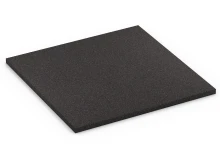
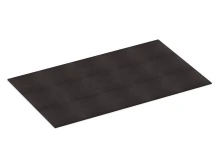
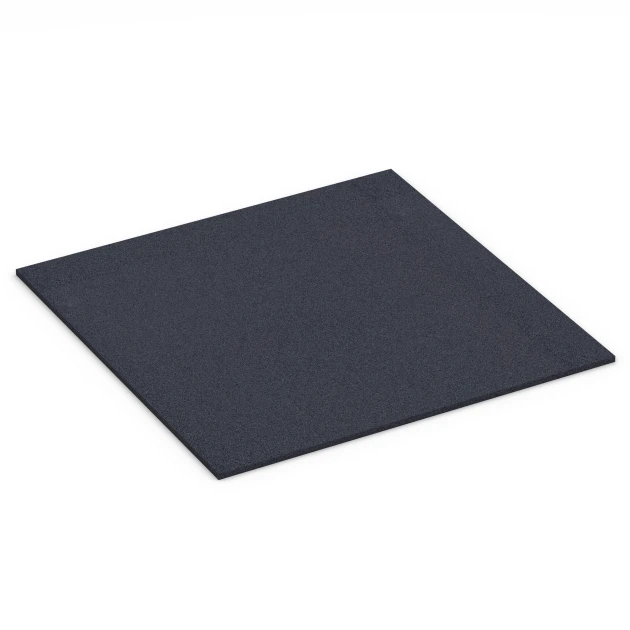
Fitness Performance Elite Rubber Gym Flooring 100 × 100 DP "Anthracite"
- /
-
Ready to ship
in approx. 3-4 weeks – production yet to start - €34.00 / 1 Piece / m²
- (15.00 kg / Piece)
EAN: 4251469361751 | Item no.: 6175
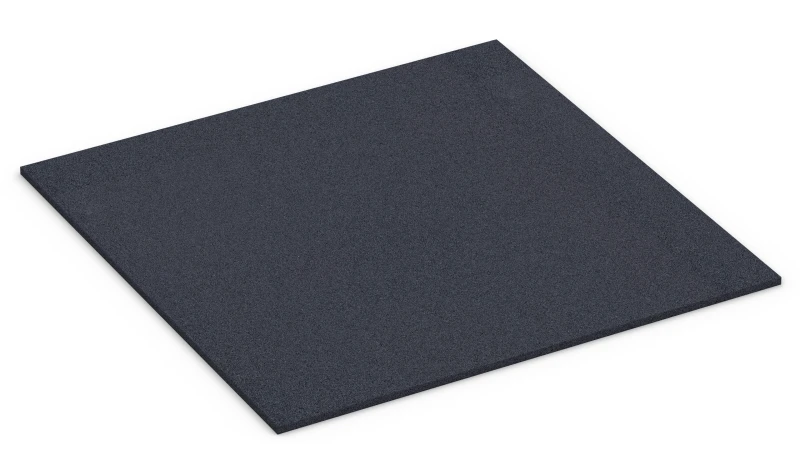
Free-weight training, HIIT circuits, functional training and HYROX workouts place different demands on the floor than conventional machine-based training. Fitness Performance Elite Rubber Gym Flooring 100 × 100 is made for this type of training. The precision-cut tiles combine good grip, a resilient feel underfoot and a clean, uniform appearance for day-to-day gym use.
How are the precision-cut gym tiles made?
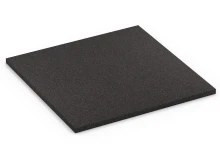
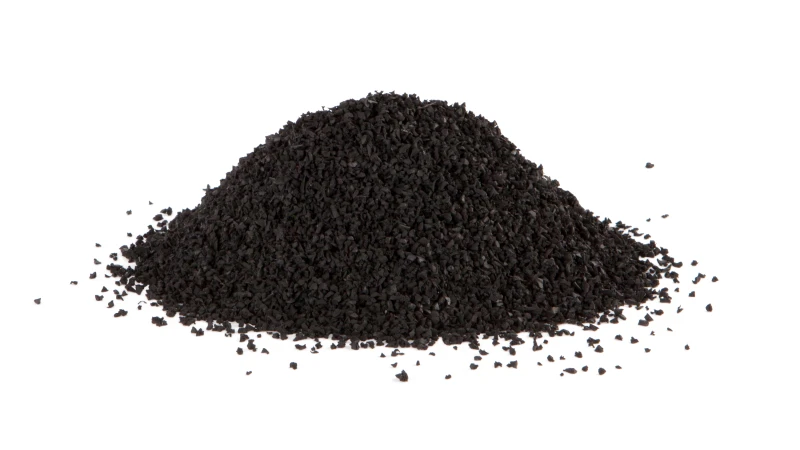
Fitness Performance Elite Rubber Gym Flooring 100 × 100 is made from ELT granules bonded with polyurethane. ELT stands for end-of-life tyres and refers to granules made from recycled tyre rubber. The granules undergo several cleaning stages before being pressed into oversized blanks. After a cooling and conditioning phase, the tiles are cut precisely from the blanks using CNC machinery. This produces precision-cut tiles with tight dimensional tolerances and a consistent thickness. On large training floors, this creates a uniform joint pattern and a consistent feel underfoot across cardio zones, free-weight areas and functional areas.
Why does the finished floor look almost continuous?
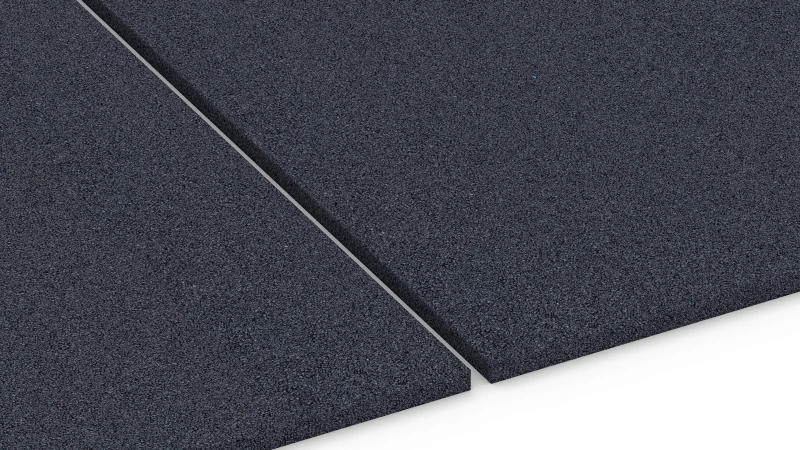
Fitness Performance Elite Rubber Gym Flooring 100 × 100 has square edges with no bevel. The tiles are laid in a staggered pattern, with each row offset from the previous one. This gives the training area an orderly, uniform appearance. Only a narrow hairline joint remains between the tiles, so the surface appears almost continuous. In open-plan gyms with long walkways and large training zones, this creates a clear, professional look. Racks, equipment areas and transitions to turf can be incorporated neatly.
What does the surface offer during training?
Fitness Performance Elite Rubber Gym Flooring 100 × 100 provides good grip during quick changes of direction, lunges, sprints and dynamic strength exercises. The resilient surface gives a controlled feel under load. The highly abrasion-resistant surface remains stable and presentable even with intensive daily use over long periods.
How is the training floor installed and cleaned?
Fitness Performance Elite Rubber Gym Flooring 100 × 100 is loose-laid across the full area. Exposed edges are finished with edging. The tiles can be rearranged when the layout changes or new training zones are added. The tiles are cut with a circular saw or jigsaw. This allows precise fitting around rigs, columns and equipment bases, as well as at wall junctions. Water, standard cleaning products or a floor cleaning machine are sufficient for daily cleaning.
How can the cushioning be tailored?
Fitness Performance Elite Rubber Gym Flooring 100 × 100 inherently reduces noise and vibration. It can be laid over Type XX base layer tiles in different thicknesses and densities. This allows the cushioning to be adjusted for each area. A deadlift zone can have a different level of cushioning from a mobility area, group fitness room or functional area. The surface remains uniform in appearance.



Discount
Product Highlights
Characteristics
Product Details – Material and Structure

Comparative values
Rubber mats made from PU-bound rubber granules can have a characteristic rubber smell, particularly when new. Whether and how strongly it is noticed depends on the material composition and on individual sensitivity to odours.
With WARCO rubber coverings, the inherent smell decreases over time. On well-ventilated outdoor areas such as balconies and terraces, it dissipates quickly. Heat may temporarily make the smell more noticeable.
The smell can remain noticeable for longer in indoor areas, conservatories and other poorly ventilated spaces where ventilation is limited. To reduce the initial inherent smell, rubber tiles may be stored for several days before installation in a dry, well-ventilated place. During storage, air should reach as many tile surfaces as possible.
After installation, regular brief periods of thorough ventilation or cross-ventilation support air exchange. With correct use, no adverse health effects from WARCO rubber coverings are known.
Impact-absorbing flooring made from PU-bound rubber granules reduces impact sound and the structure-borne sound it generates. The elastic floor covering absorbs impacts and reduces their transfer to the substrate.
Impact sound occurs when walking, jumping, moving furniture or setting down weights cause a floor or storey slab to vibrate. These vibrations travel through solid building components as structure-borne sound and can become audible as airborne sound in other rooms.
Structure-borne sound can also be caused by machinery and by installations fixed to the building. It may have causes and transmission paths other than impact sound, so it cannot be reduced by a floor covering alone.
Under load, a floor covering made from rubber granules deforms elastically. This deformation transfers the load to the substrate less abruptly, reduces the peak force and, through the covering’s internal damping, further weakens the remaining vibrations.
Sound-insulation tiles reduce excitation of the substrate from footsteps, jumps and impacting objects. Where higher requirements apply, multi-layer flooring systems with functional layers of differing elasticity can further reduce impact transmission. Their effectiveness depends on the properties of each layer, the load applied, and the existing floor or slab structure.
Rubber gym floor coverings made from rubber granules can be used for cardio, classes, equipment-based training, functional training, HYROX, boxing, gymnastics, free-weight training and strength training.
Their suitability depends on the thickness, elasticity and shock absorption being matched to the intended use. For cardio, classes and permanently installed training equipment, gym tiles at least 1 cm thick are suitable under normal use. For dynamic exercises, higher loads or greater requirements for elasticity and shock absorption, tiles at least 2 cm thick are recommended.
In functional training and HYROX, the covering is subjected to running, jumping, moving weights and sled exercises. For jumps and intensive contact with the surface, it must absorb shocks effectively while providing a stable training surface. Pulling and pushing sleds requires a firm, abrasion-resistant and durable surface.
For boxing and gymnastics, rubber gym floor coverings are available with elasticity and shock absorption matched to the respective movement patterns. Under permanently installed strength equipment, compressive strength, slip resistance and stable support are the main considerations.
In free-weight areas, thicker tiles or multilayer systems are required. These cushion the impact of weights being set down or dropped, distribute loads, reduce peak loads and limit the transfer of vibrations.
Multilayer systems combine different properties within a single floor covering. A dense top layer provides a firm, abrasion-resistant training surface, while a more elastic, shock-absorbing layer beneath it improves impact and vibration absorption. Density, rubber granule particle size, compaction and shock absorption are selected for each layer according to its function.
Within a comparable construction, a thicker tile allows greater deformation, resulting in greater shock absorption. There is no single gym floor covering for every application: single-layer and multilayer systems can be matched to the type of training, equipment and weights, potential drop heights, intensity of use and building conditions.
Gym equipment flooring made from PU-bound rubber granules is generally suitable for cardio equipment and HIIT areas.
The thickness and material strength of the gym flooring tiles must be matched to the type of training, the cardio equipment in use and the existing substrate. The elastic rubber flooring protects the substrate, cushions impact loads and can reduce the transmission of noise and vibration.
Under treadmills and spinning bikes, gym flooring tiles with a thickness of 10 mm or more are often suitable. HIIT creates higher impact and shear loads through jumping and rapid changes of direction, so thicker gym flooring tiles are appropriate for HIIT training areas. These tiles must also be sufficiently dimensionally stable to provide a stable stance. A slip-resistant surface helps maintain traction during rapid movements.
Calibrated gym flooring tiles with a cut puzzle interlock can be joined to form a level, close-fitting training surface. The interlock stabilises the tile assembly and allows individual gym flooring tiles to be replaced.
Whether the gym flooring can be loose laid depends on the manufacturer’s instructions. The manufacturer’s instructions also determine whether alcohol-based cleaning or disinfecting products may be used.
A suitable room for a home gym is dry, can be well ventilated, provides enough space for movement, has sufficient ceiling height and has a suspended floor or ground-bearing slab with adequate load-bearing capacity.
The space required depends on the intended training equipment and exercises. In addition to equipment footprints, adequate freedom of movement and safe clearances from walls, windows, radiators and other equipment should be allowed for.
Ceiling height must also accommodate overhead movements, pull-ups, skipping and jumps.
The suspended floor or ground-bearing slab must safely carry the static loads of training equipment, racks and weights, as well as the dynamic loads generated during training. Where heavy equipment or free weights are used, a structural engineer should check the load-bearing capacity if there is any doubt.
Effective ventilation allows heat, moisture and odours to escape. Particularly in rooms that are only lightly heated, the floor, walls and ceiling must remain permanently dry.
A basement can be used as a gym if it is dry and can be adequately ventilated.
Before conversion, damp patches, salt efflorescence, flaking plaster or mould should be investigated from a building physics perspective rather than relying on ventilation. Depending on the findings, the cause may be defective external waterproofing, a leaking pipe or condensation on cold surfaces. The measures required depend on those findings.
Drying through ventilation is only possible where the absolute humidity of the outdoor air is lower than that of the basement air. On warm, humid summer days, prolonged ventilation can increase moisture levels in the basement. Humidity-controlled ventilation or a dehumidifier can stabilise the indoor climate.
The required room height depends on the exercises and equipment planned. It must accommodate the height of the equipment, the maximum height reached during exercise and the necessary safety clearance to the ceiling. Equipment should be planned with the movement and safety areas specified by its manufacturer.
Before installing a rack, a heavy weight set or several strength machines, the basement floor should be checked for its capacity to carry the total load and the concentrated loads at machine feet or weight-storage racks.
Flooring should be selected for the actual level of use. Under cardio equipment, flooring made from 1 cm-thick gym mats is generally sufficient for vibration damping. Free-weight areas require thicker, shock-absorbing gym flooring: at least 2.5 cm, preferably 4 cm.
Where weights are dropped, the complete floor build-up must be designed to withstand the resulting impacts and vibration and to provide the necessary sound insulation.
A home gym needs a specialist gym floor covering designed for point loads and dynamic loads from training equipment, free weights, jumps and other movement-intensive exercises.
For these loads, a gym floor covering made from PU-bound rubber granules is slip-resistant, protects the substrate, absorbs part of the impact energy and reduces impacts and vibrations.
For effective basic cushioning, the gym floor covering should be at least 10 mm thick. The greater the equipment weight, impact load or potential drop height of weights, the higher-performing the gym floor covering must be. Damping cannot be determined from covering thickness alone: the relevant factors are the performance values of the specific gym floor covering, such as force reduction and impact sound reduction. Density and granule fraction are particularly significant for these performance values.
Where weights are dropped, the gym floor covering must be matched to their weight and drop height. Construction protection mats and comparable makeshift measures are not designed for use as gym floor coverings.
Slip-resistant fitness tiles made from PU-bound rubber granules can be used as flooring beneath gym equipment. The tiles attenuate impacts, reduce noise and structure-borne sound, and protect the floor from abrasion and pressure marks.
To protect the floor, the tiles must be installed on a firm, level substrate. All equipment feet must bear evenly and must not rest on a tile joint. Any unevenness must be levelled before installation.
For cardio equipment, fitness tiles with a thickness of about 1 cm or more are used. Heavy strength stations, racks and weight benches require thicker tiles.
For small or narrow equipment feet, an additional metal plate spreads the point load across a larger area.
For dropped weights, a simple equipment mat is not sufficient. The low-frequency vibrations created by dropped weights require a thicker or multi-layered flooring system for the training area.
The cost of setting up a home gym, also known as a home fitness room, ranges from around €500 to €15,000 (about £425 to £13,000), depending on the fitness equipment, room size and fit-out.
Fitness equipment is usually the main cost driver, while room size and the extent of the fit-out also affect the budget.
A basic set-up with dumbbells, a weight bench and a pull-up bar costs considerably less than a training area with a rack, cable machine or cardio equipment. Delivery and installation costs often need to be added.
Second-hand fitness equipment can reduce initial purchase costs, provided that its condition, operation and transport are checked before purchase.
The flooring must also be included in the calculation. Slip-resistant fitness flooring made from PU-bound rubber granules dampens noise and vibrations and protects the substrate.
Flooring costs depend on the size of the training area, the thickness of the tiles and the preparation of the substrate. With suitable tile systems, the area can be extended later.
Rubber granules are used to make tiles. The main laying patterns are stack bond, diagonal bond, half bond (often called brick bond) and random bond. Which patterns are possible depends on the type of tile and its interlocking system.
In stack bond, the joints line up in both directions. Using tiles in different colours creates a chequerboard effect. Diagonal bond uses the same grid, but at an angle to the edges of the area. In half bond, each row is offset by half a tile length; in random bond, the offset changes from row to row.
Tiles without interlocks or connectors can generally be laid in any of these patterns. Tiles with push-fit connectors are usually designed for half bond, while tiles with an open or concealed jigsaw interlock are generally laid in stack or diagonal bond. Some ranges also allow tiles to be offset by half or a third of their length.
The specifications for the tile system always take precedence. A stable surface depends above all on tiles being properly connected, a suitable substrate and correct installation.
Before fitting rubber flooring indoors, the tiles should be cleaned, dried completely and aired. The substrate must be level, load-bearing, clean and dry.
New tiles made from rubber granules may carry residues of manufacturing release agents and fine rubber dust. Before installation, it is advisable to clean the tiles outdoors with warm water; a mildly acidic cleaner suitable for rubber and a scrubbing brush can assist with cleaning. A pressure washer may be used from a sufficient distance. The tiles must then dry completely.
If cleaning before installation is not possible, the residues can be removed after fitting by repeatedly damp-mopping with warm water. New tiles have a characteristic odour which decreases over time; airing them outdoors for several days and regularly ventilating the room during the first few weeks will help it dissipate more quickly.
Before installation, the tiles should have reached room temperature. The installation instructions for the relevant product and installation system must be followed.
The appropriate cleaning method for rubber tiles within buildings depends on the area in which they are used and the surface texture.
In private homes, rubber brooms, vacuum cleaners or mops are usually sufficient for regular maintenance. A neutral cleaner suitable for rubber should be used. A mildly acidic cleaner may be used for mineral deposits.
Water-permeable rubber floor coverings must not be flooded where the substrate does not provide suitable drainage.
For larger or commercial areas, a scrubber dryer with a cylindrical brush is recommended. The brush type and contact pressure of the scrubber dryer must be matched to the floor covering.
Within buildings, a pressure washer is only suitable for stables or appropriately equipped halls where adequate drainage is available. It can also remove stubborn dirt from the textured tile surface.