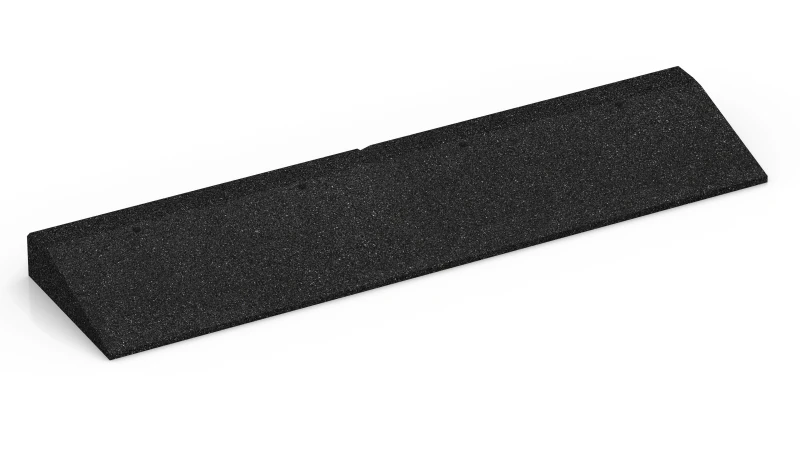
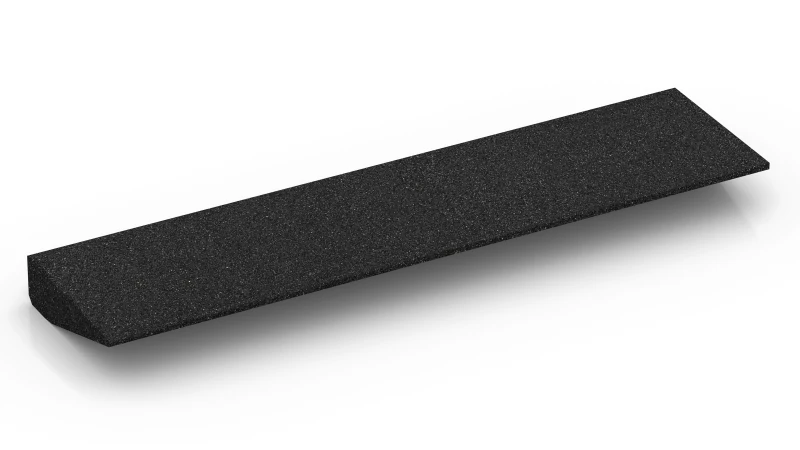
Threshold Ramp RM "Anthracite"
- /
-
Ready to ship
from stock in 1-3 days - €26.10 / 1 Piece / lin. m.
- (8.80 kg / Piece)
EAN: 4251469366008 | Item no.: 6600
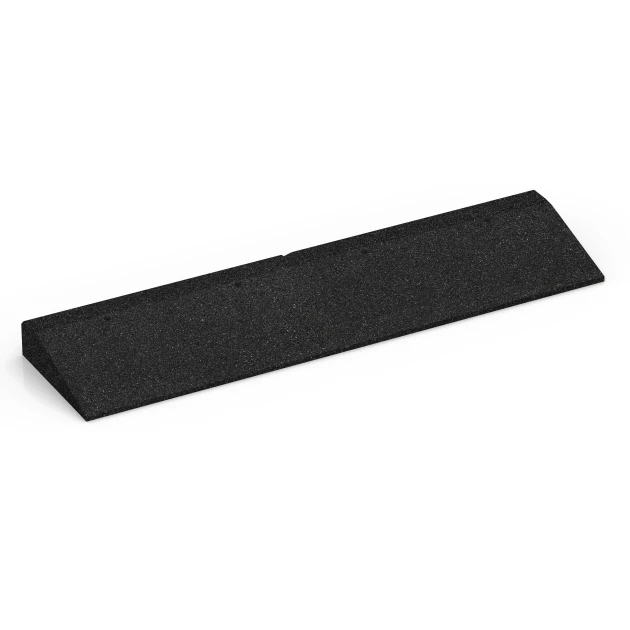
The Threshold Ramp is made from rubber granules bound with polyurethane. It levels differences in height between two surfaces and turns an edge that poses a trip hazard into a gentle slope. It makes it easier for people using a wheelchair, rollator or pushchair to get over door thresholds and dropped kerbs. As a transition ramp, it also creates an accessible route onto safety mats or fitness mats laid on a hard surface.
Where can the Threshold Ramp help?
The Threshold Ramp can be used as a door threshold ramp or door ramp wherever a threshold or shallow step interrupts the route, such as at a front door, patio door or balcony door. It also works at a dropped kerb. Such an edge can obstruct a wheelchair, rollator or pushchair. It is also easy to trip over on foot. The ramp is placed in front of the edge and has a wedge-shaped profile that rises to the same height. Wheels roll up more easily, and the edge becomes less of a trip hazard. At a garage entrance or kerb, the ramp can also be driven over by a car. The ramp can be used outdoors and indoors.
How does the Threshold Ramp provide access to safety mats?
The Threshold Ramp works as a transition ramp at the edge of an area of safety mats or fitness mats. These mats are often laid as a separate area on a hard surface, such as a play area on an asphalt school playground or a training area indoors. This leaves an exposed edge as high as the mats are thick. The ramp is placed against this edge and provides a gentle slope up onto the area. Several ramps are placed end to end along a longer edge.
What height of Threshold Ramp do I need?
The Threshold Ramp is available in several fixed heights. Measure from the surface below to the top of the threshold or mat. A ramp of the same height finishes flush with the edge. If the edge is lower than the lowest available height, trim a strip off the high end of the lowest ramp until it finishes flush with the edge. Use a circular saw or jigsaw for cutting.
What is the Threshold Ramp made from?
The Threshold Ramp is made from recycled tyre rubber granules (ELT), produced from end-of-life tyres and bound with polyurethane. The surface provides grip and is slip-resistant even when wet. The elastic material reduces rolling noise and cushions the impact when a wheel hits the front edge. Rainwater drains through the porous structure. The material is frost-resistant and weatherproof.
Should the Threshold Ramp be laid loose or fixed down?
The Threshold Ramp is simply laid in place for short-term use. If it is to remain permanently in one place, the ramp is bonded to the surface with PU adhesive.


Discount
Product Highlights
Characteristics
Product Details – Material and Structure
Comparative values
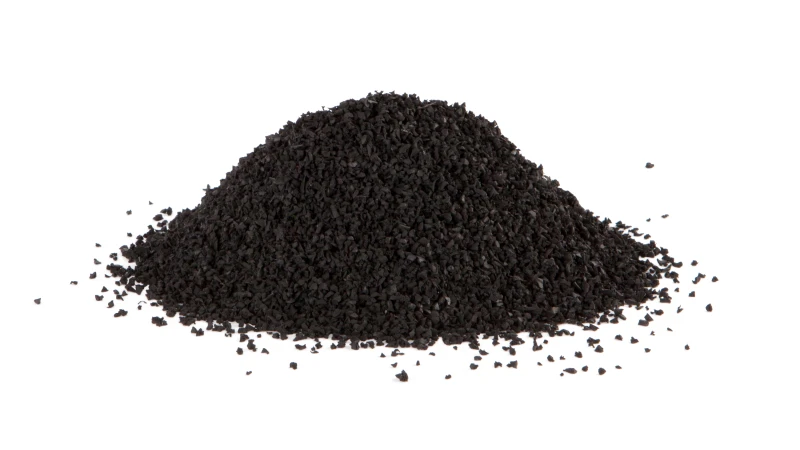
Rubber granules from end-of-life tyres are produced from tyres that are no longer in service. ELT stands for End-of-Life Tyres, the established term for tyres that have reached the end of their usable life. The resulting granules are a recycled raw material.
Collected car and lorry tyres provide the feedstock for processing. The tyres are shredded before the steel and textile fibres are separated. The remaining rubber is processed into black granules with a range of particle sizes, then separated into defined grades.
Tyres contain mainly styrene-butadiene rubber (SBR) and natural rubber (NR), so both types of rubber are present in the recovered granules. The term SBR rubber granules is common in the trade, but it does not make the origin clear, because SBR can also be newly produced and processed directly. By contrast, the term rubber granules from end-of-life tyres explicitly identifies granules recovered from used tyres.
ELT rubber granules are used in floor coverings, including sports flooring and safety tiles, as well as in road construction, building products and technical rubber goods. They are also used as the feedstock for WARCO tiles made from rubber granules bound with polyurethane. Recycling keeps the rubber in use for longer and can reduce demand for newly produced rubber.
A ramp wedge is needed as perimeter edging for a balcony or terrace only where there is a difference in level between surfaces. It is not needed for edge restraint alone.
That edge restraint is provided on balconies and terraces by existing structural boundaries such as walls and balustrades, which contain the floor covering. A difference in level may occur at a doorway threshold; in that case, the ramp wedge forms a sloping, walkable transition ramp.
Threshold ramps made from recycled tyre rubber granules (ELT) are anthracite to black. For orders of 100 pieces or more, they can also be made from coloured EPDM rubber granules. The ELT version is produced with a clear binder.
Rubber mats and moulded items made from rubber granules, including rubber granule mats, are best cut with a circular saw fitted with either a wood-cutting blade or a rubber saw blade. The most appropriate tool depends on the product, the shape of the cut and the installer’s experience. The circular saw should have sufficient power, while blade speed should not be too high.
Where a utility knife is used, this method is generally more appropriate for experienced installers. The knife needs a sharp blade and a firm handle, and it should be guided along a metal straightedge or rail to maintain a straight cut edge. Several passes with moderate pressure will cut through the rubber mat. When guiding the knife along the straightedge, the hand can slip towards the blade; the guiding hand must therefore remain behind the straightedge and never in front of the blade, where the risk of injury is greatest.
For internal cuts or curved lines, a jigsaw is appropriate, using rubber saw blades made for jigsaws. Metal-cutting saws, blades intended for metal or stone, cutting discs and very high-speed saws are unsuitable because heat generated by friction can melt the rubber granules bound within the moulded item and smear the cut edge. This applies equally to rubber mats, safety surfacing tiles, fitness tiles, patio tiles and edging blocks made from rubber granules.
Rubber granule mats of any thickness can be cut with a jigsaw or a circular saw. A circular saw is suited to straight cuts, while a jigsaw is suited to curved cuts and cut-outs. PU-bound rubber granules can be worked in much the same way as wood, provided both saws are guided steadily with an even feed rate.
For particularly thick rubber mats or large sections to be cut, a reciprocating saw or chainsaw may be easier to handle than a guided circular saw. Thick impact-absorbing surfacing tiles also do not require a special machine: a coarse-toothed wood saw blade or a rubber saw blade is suitable. A coarse tooth pattern and moderate speed keep frictional heat low, allowing fitness tiles and patio tiles made from rubber granules to be cut cleanly.
Rubber tiles made from bound rubber granules are generally loose-laid and held together by a puzzle interlock or connectors; bonding is used where this arrangement does not provide sufficient restraint against movement, lifting or unauthorised removal.
Threshold ramps are bonded to a suitable substrate. On steps, the step covering is bonded to the existing steps. Impact protection is bonded to walls or pillars in garages, car parks and work areas used by industrial trucks. A permanently flexible PU adhesive is suitable for bonding impact protection. Where the fixing needs to remain easily removable later, strongly adhesive carpet tape may be used instead, depending on the substrate and loading.
Small cut pieces and unsecured edge pieces are edge-bonded to adjacent tiles. On small areas, point fixing may be necessary. It may also be necessary for raised corners of tiles with a concealed puzzle interlock or where there is a higher risk of displacement. In publicly accessible areas, point fixing makes individual tiles harder to lift or remove.
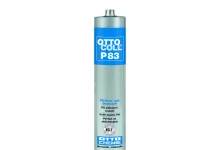
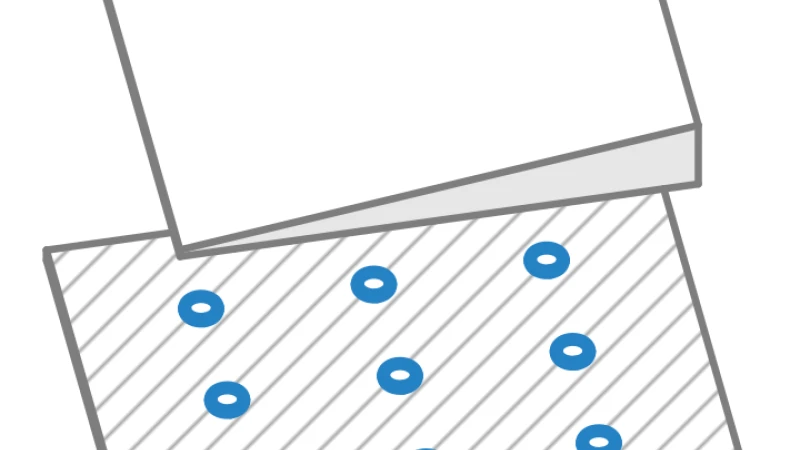
For bonding rubber tiles or rubber flooring, one cartridge of PU adhesive OP83 provides around 310 dots of adhesive when approximately 1 ml is applied to each dot. Actual consumption depends on the laying conditions and on the condition of both the rubber tiles and the substrate.
The adhesive is applied to one of the surfaces to be bonded in pea- to hazelnut-sized dots. Smoother, flatter surfaces require less adhesive, whereas rough and porous surfaces require more adhesive for a lasting bond.