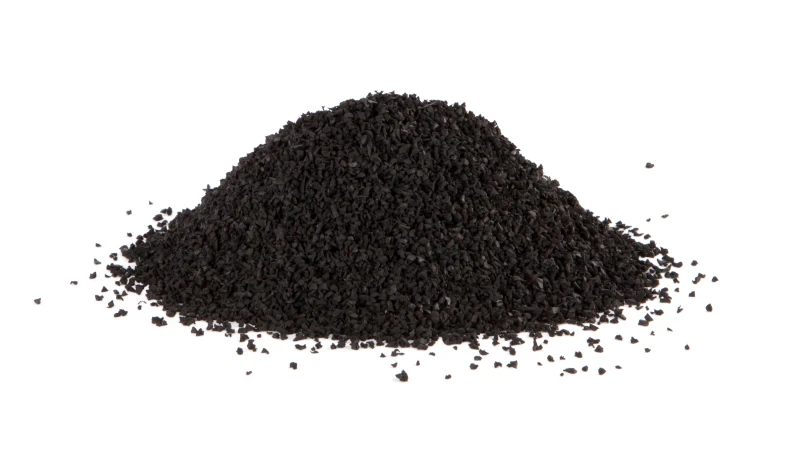
Apparent density is the ratio of mass to total volume, including all pores and voids. It differs from true density, which refers only to the solid substance itself and excludes voids. For comparison, water at 4 °C has a density of 1,000 kg/m³. Recycled tyre rubber granules (ELT), consisting mainly of SBR and natural rubber, have a true density of around 1,200 kg/m³. EPDM rubber granules have a true density of around 1,600 kg/m³.
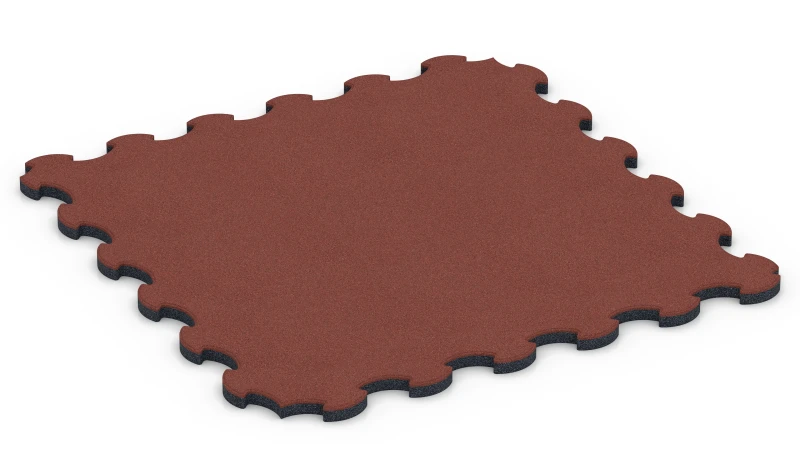
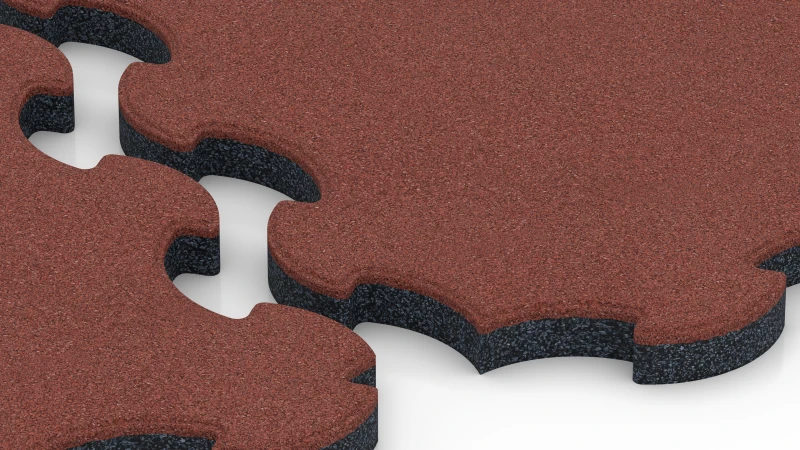
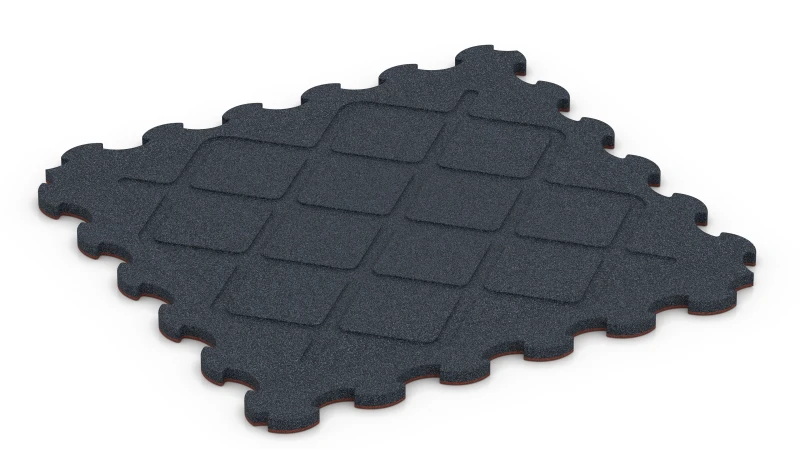
For a moulded component made from rubber granules bonded with polyurethane, apparent density is calculated from its mass and external dimensions: length, width and overall height. This volume includes two types of void. The first consists of pores between the granules that remain after pressing during manufacture. Their proportion depends on moulding pressure, granule size, granule shape and the proportion of binder. As a simplified example, a uniformly compacted tile with a flat underside and an apparent density of 800 kg/m³ has a pore volume of around one third, assuming a granule true density of 1,200 kg/m³ and disregarding the binder proportion.
The second type consists of moulded voids created by a structured underside. Drainage channels, studs, drainage feet or pedestal feet leave open spaces beneath the wearing layer. These spaces form part of the overall height but contain no rubber granules. A moulded component with a pronounced underside profile can therefore have a low apparent density even where its wearing layer is densely pressed. Apparent density describes the complete moulded component, not the constituent substance alone. At WARCO, apparent density ranges from around 600 to 1,250 kg/m³.
The compaction of the wearing layer shapes the properties of the floor covering.
• Surface: the higher the density, the less open and more resistant the surface becomes.
• Water permeability: lower density means more open pores and, in most cases, greater water permeability.
• Elasticity: lower density makes the floor covering more yielding and elastic, while higher density makes it harder and stiffer.
• Weight: together with overall height, apparent density determines dry weight per square metre. When wet, water held in the pores adds to this weight. This matters for transport, installation and the load-bearing capacity of balconies, terraces and roof areas.
The scale runs from Rating 1 to Rating 5. Each rating represents a density range, for example Rating 2 for 780 to 840 kg/m³. For moulded components with a structured underside, the rating says less about the wearing layer than it does for a tile with a flat underside.