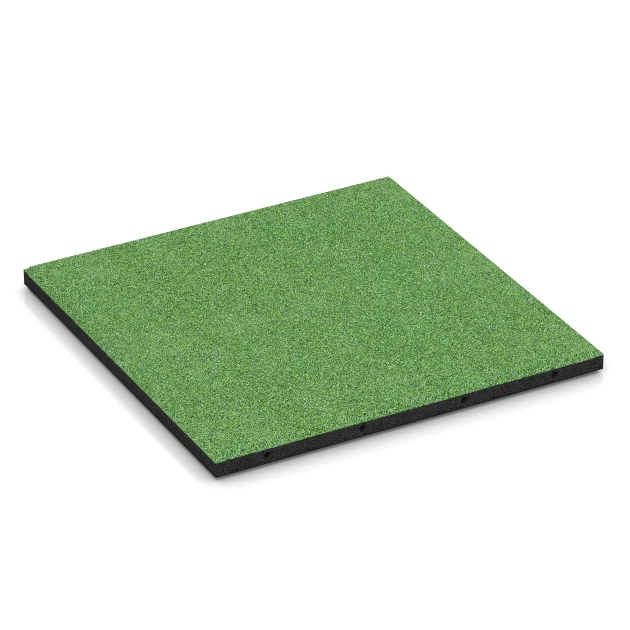
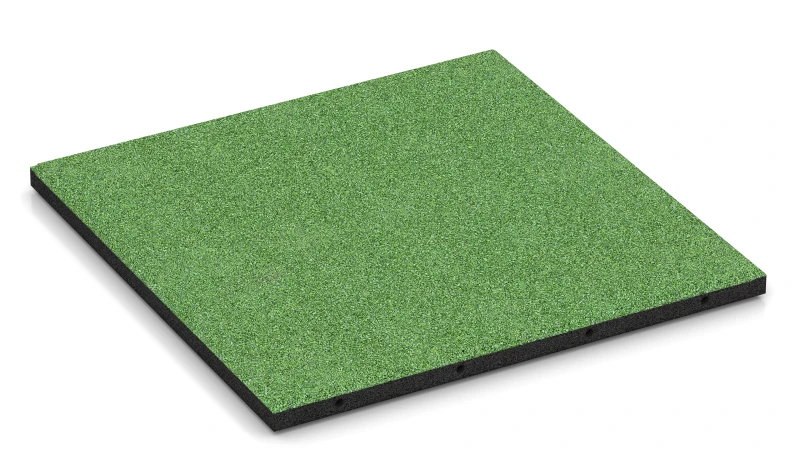
Rubber Kennel Mat FP "Linden green"
- /
-
Ready to ship
from stock in 1-3 days - €56.00 / 4 Piece / m²
- (5.32 kg / Piece)
EAN: 4251469361843 | Item no.: 6184
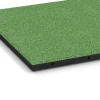
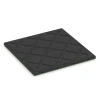
The Type FP Rubber Kennel Mat consists of rubber granule tiles with hollow feet underneath. The mat is slightly resilient and provides good insulation against cold from below. Water and urine drain through the tiles. This gives dogs a drier, warmer place to lie than concrete, tiled floors or bare ground.
Where can the Rubber Kennel Mat be used?
The Rubber Kennel Mat can be used wherever dogs need a dry, warm place to lie. It is suitable for garden kennels and kennel facilities at animal shelters, boarding kennels and breeding establishments. It is also used in kennels for police and military working dogs, including protection dogs. The mat can also provide a resting area on a patio or beneath an outdoor dog shelter. When used indoors, the Rubber Kennel Mat needs a moisture-resistant base because water and urine pass through the tiles.
How does the Rubber Kennel Mat keep dogs warm?
The Rubber Kennel Mat helps keep a resting dog warm on cold concrete or wet ground, where the dog could otherwise quickly become cold. It insulates in two ways. Small pockets of air between the granules in each tile provide insulation. The hollow feet also create an insulating cushion of air beneath the surface. The tiles give slightly when a dog lies down or gets up.
What is the Rubber Kennel Mat made from?
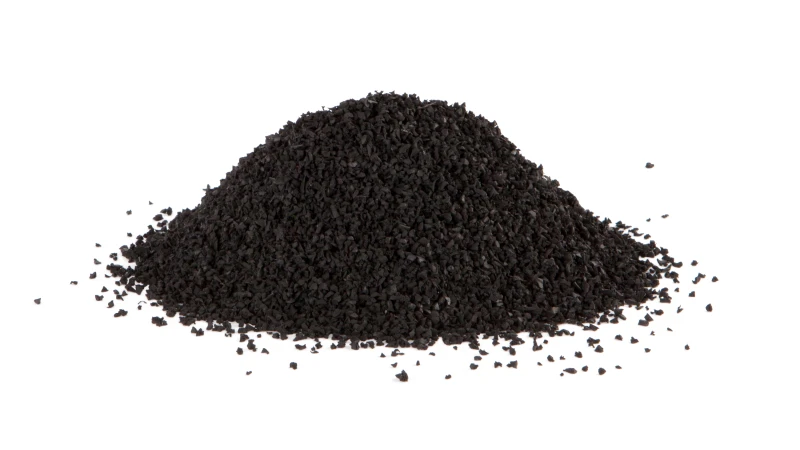
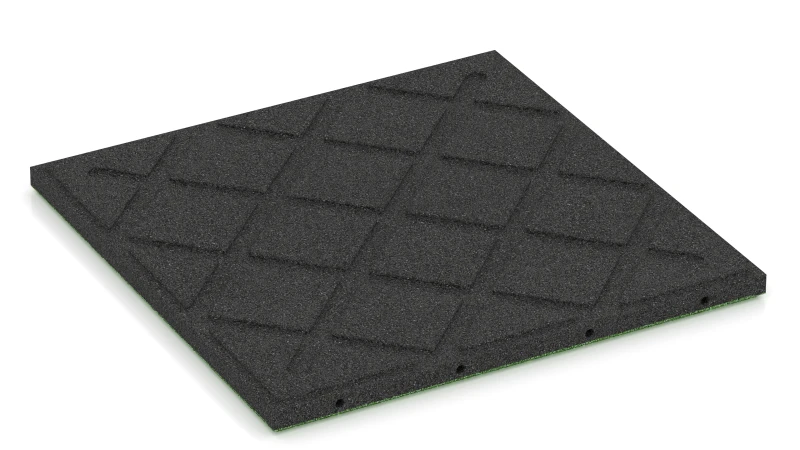
The Rubber Kennel Mat is made from ELT granules. These are rubber granules from recycled end-of-life tyres bonded with polyurethane. The grippy surface is slip-resistant even when wet. Narrow ribs connect the hollow square feet on the underside of each tile. The feet flex under load. The material does not rot or splinter and is frost-resistant. New tiles may initially have a rubber smell. The smell soon fades, especially outdoors.
How is the Rubber Kennel Mat installed?
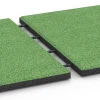
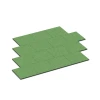
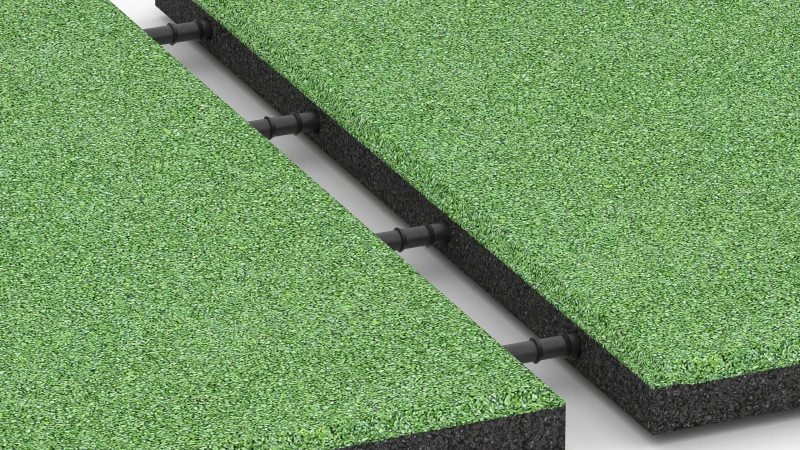
The Rubber Kennel Mat needs a stable, largely level base that will remain load-bearing over time. Suitable surfaces include concrete, paving, asphalt and vinyl. On grass, soil or gravel, gravel grids filled with chippings form the sub-base. The tiles are joined with plastic push-fit connectors. These fit into holes along two opposite edges of each tile and connect it to tiles in the next row. The tiles are therefore laid in half bond, with each row offset by half a tile. Each tile is connected to two tiles in the row before it and two in the row after it. Every other row starts and ends with half a tile to keep the sides straight. A circular saw is the best tool for cutting the tiles. A firm edge restraint around the whole area holds the tiles together so that they do not move apart.
How does the resting area stay clean and dry?
The Rubber Kennel Mat allows rain and urine to run through the tiles. On an impermeable base, water follows the gradient through the cavities beneath the tiles. On gravel grids, it drains into the ground. This prevents puddles and allows the resting area to dry quickly after rain. A broom, garden hose or pressure washer is enough for cleaning. Areas where a dog regularly relieves itself should be rinsed more often with plenty of water. The tiles can be disinfected when needed because the material is resistant to disinfectants.


Discount
Product Highlights
Characteristics
Product Details – Material and Structure
Comparative values
Rubber mats made from PU-bound rubber granules can have a characteristic rubber smell, particularly when new. Whether and how strongly it is noticed depends on the material composition and on individual sensitivity to odours.
With WARCO rubber coverings, the inherent smell decreases over time. On well-ventilated outdoor areas such as balconies and terraces, it dissipates quickly. Heat may temporarily make the smell more noticeable.
The smell can remain noticeable for longer in indoor areas, conservatories and other poorly ventilated spaces where ventilation is limited. To reduce the initial inherent smell, rubber tiles may be stored for several days before installation in a dry, well-ventilated place. During storage, air should reach as many tile surfaces as possible.
After installation, regular brief periods of thorough ventilation or cross-ventilation support air exchange. With correct use, no adverse health effects from WARCO rubber coverings are known.
Rubber tiles and rubber mats from WARCO are not harmful to health when used as intended. They are made from rubber granules bound with PU; the solvent-free PU binder cures fully during manufacture.
The rubber granules are predominantly recycled from end-of-life tyres (ELTs). The PAH content of ELT rubber granules may vary according to origin and batch; PAH means polycyclic aromatic hydrocarbons. Black ELT rubber granules contain carbon black, a fine industrial soot that gives the rubber its black colour. Surface abrasion may occur during use of rubber mats.
In two-layer versions, the wearing layer is made from newly manufactured EPDM, which is coloured throughout and free from harmful substances. The possible PAH variations associated with ELT rubber granules do not occur with EPDM. Versions with an EPDM wearing layer are particularly suitable for prolonged or intensive skin contact and for areas intended for babies. The relevant product description states whether a product has a two-layer construction.
Outdoor rubber tiles made from polyurethane-bound rubber granules are frost-resistant and suitable for use throughout the winter. Their porous structure absorbs precipitation and allows it to pass downwards; water remaining in the pores has space to expand when it freezes, while the rubber granules and polyurethane binder remain elastic at sub-zero temperatures. The sub-base must also be constructed to withstand frost.
On bound sub-bases, water flows beneath and between the tiles in the direction of the fall towards the drainage system. On chippings or crushed stone, it drains vertically through the construction. If water collects beneath the tiles, a frost-susceptible sub-base may rise and then settle again after thawing. The tiles themselves remain unaffected, but the surface may become more uneven.
For winter maintenance, use a snow shovel with a smooth edge and avoid catching the tile edges. Salt used in normal quantities to melt ice does not harm the rubber granules.
Rubber tiles can be water-permeable at rates ranging from nearly zero to more than 1,100 litres per square metre per hour. Water permeability depends on the particle-size fraction of the rubber granules used and on the pressing pressure applied during manufacture. The tiles are made from PU-bound rubber granules and have an open-pored structure.
Within this porous structure, water does not pass through the rubber itself but through the voids between the bonded granules. The more tightly the granules are compacted, the less water a rubber tile allows through. At low pressing pressure, the irregularly shaped granules sit loosely beside one another, leaving interconnected pores and fine channels through which water flows vertically downwards. An accredited institute measured more than 1,100 litres per square metre per hour in accordance with BS EN 12616, even after four weeks of weathering.
The respective water permeability value is stated as a comparative value in the product description. Rubber tiles made under high pressing pressure have an almost void-free granule structure and allow hardly any water through. A newly laid area absorbs water more slowly during its first days than the measured value may suggest, because the granule surfaces initially resist wetting, much like a new rain jacket. After several days of use, the floor covering reaches its full water permeability; scrubbing it with a little washing-up liquid speeds up this process.
The test report can be submitted to building authorities as evidence of water permeability. How an area is classified depends on the overall system build-up: precipitation can drain through the floor covering into the ground only if the sub-base beneath the rubber tiles also absorbs water.
Thermal insulation from floor coverings made from rubber granules is supplementary and varies with the product design and thickness; it does not replace the thermal insulation required within the building structure. Across the WARCO range, thermal conductivity is approximately 0.07 to 0.16 W/(m·K), depending on the product line. By comparison, EPS insulation materials achieve approximately 0.032 to 0.040 W/(m·K), so they provide substantially greater insulation than floor coverings made from rubber granules at the same thickness.
Thermal conductivity and thickness determine the thermal resistance of a floor covering: lower thermal conductivity produces greater thermal resistance, as does a thicker covering. On a cool mineral substrate, a dry covering made from rubber granules draws heat from the foot more slowly and therefore feels less cold. With porous outdoor coverings, thermal insulation decreases when wet because water conducts heat more readily than the air within the pores.
For the thermal insulation of flat roofs and ceilings, the performance of the complete roof or ceiling build-up is decisive. With underfloor heating, the thermal resistance of the covering slows heat output into the room; the thicker the floor covering, the greater this slowing effect.
Before fitting rubber flooring indoors, the tiles should be cleaned, dried completely and aired. The substrate must be level, load-bearing, clean and dry.
New tiles made from rubber granules may carry residues of manufacturing release agents and fine rubber dust. Before installation, it is advisable to clean the tiles outdoors with warm water; a mildly acidic cleaner suitable for rubber and a scrubbing brush can assist with cleaning. A pressure washer may be used from a sufficient distance. The tiles must then dry completely.
If cleaning before installation is not possible, the residues can be removed after fitting by repeatedly damp-mopping with warm water. New tiles have a characteristic odour which decreases over time; airing them outdoors for several days and regularly ventilating the room during the first few weeks will help it dissipate more quickly.
Before installation, the tiles should have reached room temperature. The installation instructions for the relevant product and installation system must be followed.
Plastic connectors, also known as connector pins or plastic connecting pins, are cylindrical plastic pins with a profiled surface. They fit into factory drilled holes along the sides of the tiles and connect rubber tiles in adjacent rows. Perpendicular to the connector axis, they prevent the tiles from shifting relative to one another. Along the connector axis, the tiles remain free to move.
The tiles are laid row by row in half bond. The plastic connectors are first inserted into the holes along one side of the tile being positioned. With the connectors leading, this tile is then pressed into the holes in the two adjoining tiles in the row already laid. The connectors are designed to fit tightly, so noticeable force during insertion and when pressing the tiles together is normal. If required, the connectors may be glued in place, which prevents the tiles from drifting apart along the connector axis.
Outdoor rubber tiles should be cleared of leaves, soil and sand regularly.
Loose dirt can be swept away with a rubber broom or rinsed off with a hose. Rain also washes much of the dust and pollen away through water-permeable tiles.
Regular maintenance reduces the work required for more thorough cleaning.
For thorough outdoor cleaning, a pressure washer is suitable. The water jet loosens dirt from the textured surface and removes more persistent residues such as dog mess or food residue.
Where clean water is not sufficient, use either a neutral cleaner suitable for rubber or a mildly acidic cleaner. A specialist rubber cleaner is not required. Biodegradable Sonett WC Cleaner Mint is particularly suitable and has a pH value of around 5 to 6.
Apply the cleaner evenly, either neat or slightly diluted. After 10 to 15 minutes, work it in with a brush, then rinse the area thoroughly with clean water.
When brushing, use moderate pressure only. Excessive pressure can loosen granules from the bonded matrix.
Strongly alkaline cleaners, abrasive products and solvent-based cleaning products are unsuitable, as they can attack the surface of the rubber tiles.
The appropriate cleaning method for rubber tiles within buildings depends on the area in which they are used and the surface texture.
In private homes, rubber brooms, vacuum cleaners or mops are usually sufficient for regular maintenance. A neutral cleaner suitable for rubber should be used. A mildly acidic cleaner may be used for mineral deposits.
Water-permeable rubber floor coverings must not be flooded where the substrate does not provide suitable drainage.
For larger or commercial areas, a scrubber dryer with a cylindrical brush is recommended. The brush type and contact pressure of the scrubber dryer must be matched to the floor covering.
Within buildings, a pressure washer is only suitable for stables or appropriately equipped halls where adequate drainage is available. It can also remove stubborn dirt from the textured tile surface.