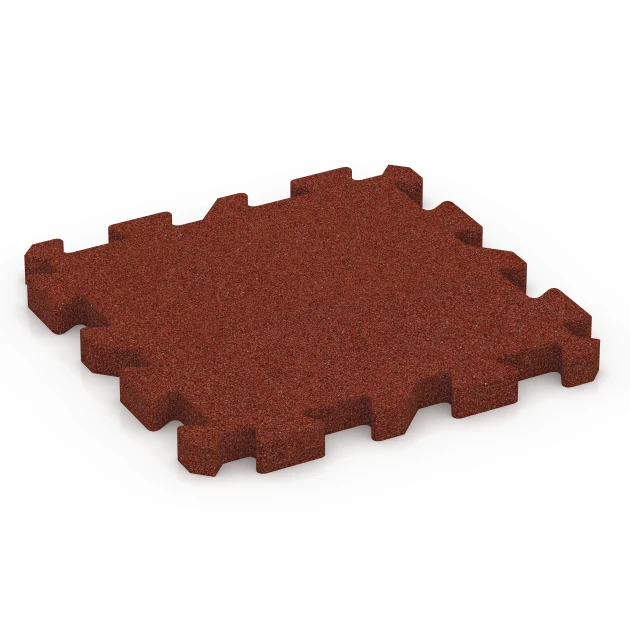
Interlocking Rubber Gym Mat UZ "Brick red"
- /
-
Ready to ship
from stock in 1-3 days - €78.40 / 4 Piece / m²
- (10.20 kg / Piece)
EAN: 4251469369948 | Item no.: 6994
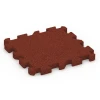
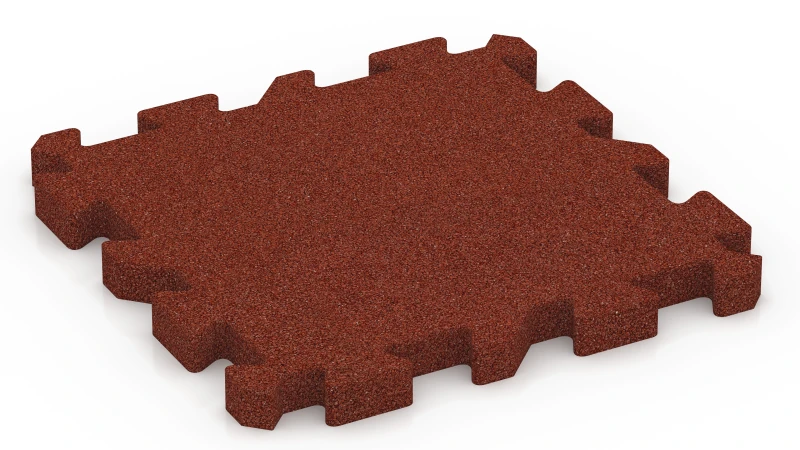
The Interlocking Rubber Gym Mat type UZ is easy to handle. Its jigsaw interlock connects it to neighbouring mats. This quickly forms a continuous training area. The area can be extended or taken up at any time. Its rubber surface is grippy and cushions impacts during training.
Where can the mat be used?
The Interlocking Rubber Gym Mat creates a safe training area without much effort wherever one is needed. It can be used in a basement home gym, a training corner in the garage or a group exercise room at a sports club. In a commercial gym, it can cover the area used for kettlebells and dumbbells. The mat can also be used for outdoor training.
What is the mat like to train on?
The Interlocking Rubber Gym Mat has a comfortable amount of give underfoot and still provides good grip during lunges, jumps and press-ups. When weights are set down, the rubber cushions the impact. This protects the floor and keeps noise low for housemates and neighbours. The thicker the mat, the greater the cushioning.
What is the mat made from?
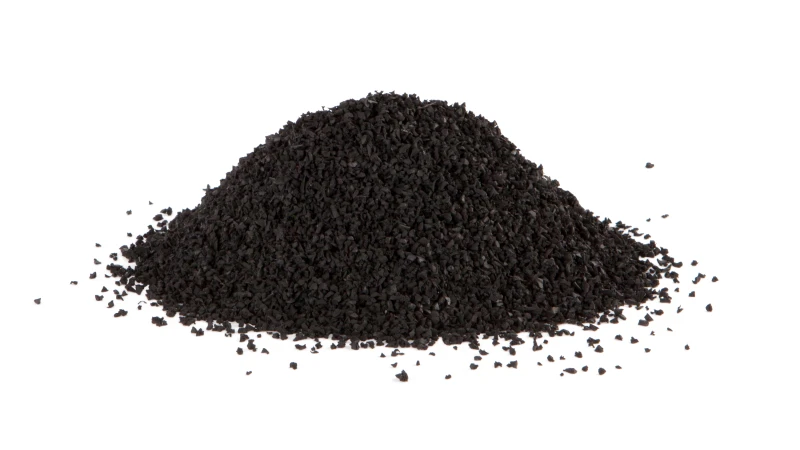
The Interlocking Rubber Gym Mat is made from ELT granules. These rubber granules come from recycled end-of-life tyres and are bonded with polyurethane. New mats may have a rubber smell at first. With good ventilation, the smell fades after a while.
How are the mats laid?
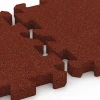
The Interlocking Rubber Gym Mats are laid without adhesive on a load-bearing, largely level base such as screed, concrete or tiles. Press the teeth of the jigsaw interlock together from above. Edging is not usually needed. Lay the mats in a chequerboard pattern or use a half-bond installation. For a straight edge, cut one mat in half for each row. Place the two halves at the beginning and end of the row with the straight cut edge facing outwards. Make the cuts with a circular saw or jigsaw fitted with a suitable saw blade.
How easy are the mats to clean?
The Interlocking Rubber Gym Mat can be cleaned with a vacuum cleaner, broom or damp mop. The material is resistant to disinfectants. The training area can therefore be disinfected when needed. For a thorough clean, remove individual mats and rinse them off.



Discount
Product Highlights
Characteristics
Product Details – Material and Structure

Comparative values
Rubber mats made from PU-bound rubber granules can have a characteristic rubber smell, particularly when new. Whether and how strongly it is noticed depends on the material composition and on individual sensitivity to odours.
With WARCO rubber coverings, the inherent smell decreases over time. On well-ventilated outdoor areas such as balconies and terraces, it dissipates quickly. Heat may temporarily make the smell more noticeable.
The smell can remain noticeable for longer in indoor areas, conservatories and other poorly ventilated spaces where ventilation is limited. To reduce the initial inherent smell, rubber tiles may be stored for several days before installation in a dry, well-ventilated place. During storage, air should reach as many tile surfaces as possible.
After installation, regular brief periods of thorough ventilation or cross-ventilation support air exchange. With correct use, no adverse health effects from WARCO rubber coverings are known.
Impact-absorbing flooring made from PU-bound rubber granules reduces impact sound and the structure-borne sound it generates. The elastic floor covering absorbs impacts and reduces their transfer to the substrate.
Impact sound occurs when walking, jumping, moving furniture or setting down weights cause a floor or storey slab to vibrate. These vibrations travel through solid building components as structure-borne sound and can become audible as airborne sound in other rooms.
Structure-borne sound can also be caused by machinery and by installations fixed to the building. It may have causes and transmission paths other than impact sound, so it cannot be reduced by a floor covering alone.
Under load, a floor covering made from rubber granules deforms elastically. This deformation transfers the load to the substrate less abruptly, reduces the peak force and, through the covering’s internal damping, further weakens the remaining vibrations.
Sound-insulation tiles reduce excitation of the substrate from footsteps, jumps and impacting objects. Where higher requirements apply, multi-layer flooring systems with functional layers of differing elasticity can further reduce impact transmission. Their effectiveness depends on the properties of each layer, the load applied, and the existing floor or slab structure.
Rubber gym floor coverings made from rubber granules can be used for cardio, classes, equipment-based training, functional training, HYROX, boxing, gymnastics, free-weight training and strength training.
Their suitability depends on the thickness, elasticity and shock absorption being matched to the intended use. For cardio, classes and permanently installed training equipment, gym tiles at least 1 cm thick are suitable under normal use. For dynamic exercises, higher loads or greater requirements for elasticity and shock absorption, tiles at least 2 cm thick are recommended.
In functional training and HYROX, the covering is subjected to running, jumping, moving weights and sled exercises. For jumps and intensive contact with the surface, it must absorb shocks effectively while providing a stable training surface. Pulling and pushing sleds requires a firm, abrasion-resistant and durable surface.
For boxing and gymnastics, rubber gym floor coverings are available with elasticity and shock absorption matched to the respective movement patterns. Under permanently installed strength equipment, compressive strength, slip resistance and stable support are the main considerations.
In free-weight areas, thicker tiles or multilayer systems are required. These cushion the impact of weights being set down or dropped, distribute loads, reduce peak loads and limit the transfer of vibrations.
Multilayer systems combine different properties within a single floor covering. A dense top layer provides a firm, abrasion-resistant training surface, while a more elastic, shock-absorbing layer beneath it improves impact and vibration absorption. Density, rubber granule particle size, compaction and shock absorption are selected for each layer according to its function.
Within a comparable construction, a thicker tile allows greater deformation, resulting in greater shock absorption. There is no single gym floor covering for every application: single-layer and multilayer systems can be matched to the type of training, equipment and weights, potential drop heights, intensity of use and building conditions.
Rubber flooring for exercise equipment in an outdoor gym can be made from PU-bound rubber granules. It is slip-resistant, shock-absorbing, weather-resistant and frost-resistant.
For outdoor use, porous, water-permeable gym tiles are used. Rainwater passes through the tiles across their entire area, while the surface provides stable footing when wet.
Thickness and construction depend on the intended types of training. For calisthenics, equipment training and functional training, a balance between stability and shock absorption is required. Tiles of about 3 cm are suitable for many of these applications.
As well as thickness, density and construction affect the properties of rubber flooring. For kettlebells, barbells and other heavy weights, thicker tiles or multilayer surfacing systems are appropriate.
Where impact-absorbing surfacing is required around training equipment, the critical fall height determined in accordance with BS EN 1177 must be at least equal to the required free height of fall.
A suitable room for a home gym is dry, can be well ventilated, provides enough space for movement, has sufficient ceiling height and has a suspended floor or ground-bearing slab with adequate load-bearing capacity.
The space required depends on the intended training equipment and exercises. In addition to equipment footprints, adequate freedom of movement and safe clearances from walls, windows, radiators and other equipment should be allowed for.
Ceiling height must also accommodate overhead movements, pull-ups, skipping and jumps.
The suspended floor or ground-bearing slab must safely carry the static loads of training equipment, racks and weights, as well as the dynamic loads generated during training. Where heavy equipment or free weights are used, a structural engineer should check the load-bearing capacity if there is any doubt.
Effective ventilation allows heat, moisture and odours to escape. Particularly in rooms that are only lightly heated, the floor, walls and ceiling must remain permanently dry.
A basement can be used as a gym if it is dry and can be adequately ventilated.
Before conversion, damp patches, salt efflorescence, flaking plaster or mould should be investigated from a building physics perspective rather than relying on ventilation. Depending on the findings, the cause may be defective external waterproofing, a leaking pipe or condensation on cold surfaces. The measures required depend on those findings.
Drying through ventilation is only possible where the absolute humidity of the outdoor air is lower than that of the basement air. On warm, humid summer days, prolonged ventilation can increase moisture levels in the basement. Humidity-controlled ventilation or a dehumidifier can stabilise the indoor climate.
The required room height depends on the exercises and equipment planned. It must accommodate the height of the equipment, the maximum height reached during exercise and the necessary safety clearance to the ceiling. Equipment should be planned with the movement and safety areas specified by its manufacturer.
Before installing a rack, a heavy weight set or several strength machines, the basement floor should be checked for its capacity to carry the total load and the concentrated loads at machine feet or weight-storage racks.
Flooring should be selected for the actual level of use. Under cardio equipment, flooring made from 1 cm-thick gym mats is generally sufficient for vibration damping. Free-weight areas require thicker, shock-absorbing gym flooring: at least 2.5 cm, preferably 4 cm.
Where weights are dropped, the complete floor build-up must be designed to withstand the resulting impacts and vibration and to provide the necessary sound insulation.
A home gym needs a specialist gym floor covering designed for point loads and dynamic loads from training equipment, free weights, jumps and other movement-intensive exercises.
For these loads, a gym floor covering made from PU-bound rubber granules is slip-resistant, protects the substrate, absorbs part of the impact energy and reduces impacts and vibrations.
For effective basic cushioning, the gym floor covering should be at least 10 mm thick. The greater the equipment weight, impact load or potential drop height of weights, the higher-performing the gym floor covering must be. Damping cannot be determined from covering thickness alone: the relevant factors are the performance values of the specific gym floor covering, such as force reduction and impact sound reduction. Density and granule fraction are particularly significant for these performance values.
Where weights are dropped, the gym floor covering must be matched to their weight and drop height. Construction protection mats and comparable makeshift measures are not designed for use as gym floor coverings.
Slip-resistant fitness tiles made from PU-bound rubber granules can be used as flooring beneath gym equipment. The tiles attenuate impacts, reduce noise and structure-borne sound, and protect the floor from abrasion and pressure marks.
To protect the floor, the tiles must be installed on a firm, level substrate. All equipment feet must bear evenly and must not rest on a tile joint. Any unevenness must be levelled before installation.
For cardio equipment, fitness tiles with a thickness of about 1 cm or more are used. Heavy strength stations, racks and weight benches require thicker tiles.
For small or narrow equipment feet, an additional metal plate spreads the point load across a larger area.
For dropped weights, a simple equipment mat is not sufficient. The low-frequency vibrations created by dropped weights require a thicker or multi-layered flooring system for the training area.
Before fitting rubber flooring indoors, the tiles should be cleaned, dried completely and aired. The substrate must be level, load-bearing, clean and dry.
New tiles made from rubber granules may carry residues of manufacturing release agents and fine rubber dust. Before installation, it is advisable to clean the tiles outdoors with warm water; a mildly acidic cleaner suitable for rubber and a scrubbing brush can assist with cleaning. A pressure washer may be used from a sufficient distance. The tiles must then dry completely.
If cleaning before installation is not possible, the residues can be removed after fitting by repeatedly damp-mopping with warm water. New tiles have a characteristic odour which decreases over time; airing them outdoors for several days and regularly ventilating the room during the first few weeks will help it dissipate more quickly.
Before installation, the tiles should have reached room temperature. The installation instructions for the relevant product and installation system must be followed.
Installation of rubber tiles requires a load-bearing substrate designed to drain water. The tiles are water-permeable, so rainwater passing through them must infiltrate into the substrate or, alternatively, be discharged by a fall.
In central Europe, the suitable installation temperature is between 5 and 17 °C. Direct sunlight should be avoided, as it can cause tiles to heat up to differing degrees; throughout installation, all tiles should have an even temperature. Rain during installation does not harm the tiles, but soaked tiles must dry completely before installation.
General installation instructions must be followed, along with the requirements for the relevant product and installation system.
New rubber tiles may carry harmless release-agent residues from manufacture. Weathering washes these residues away; if required, they can be removed with water and a brush or with a pressure washer. The typical rubber smell of new tiles is harmless and reduces noticeably after a short time outdoors.
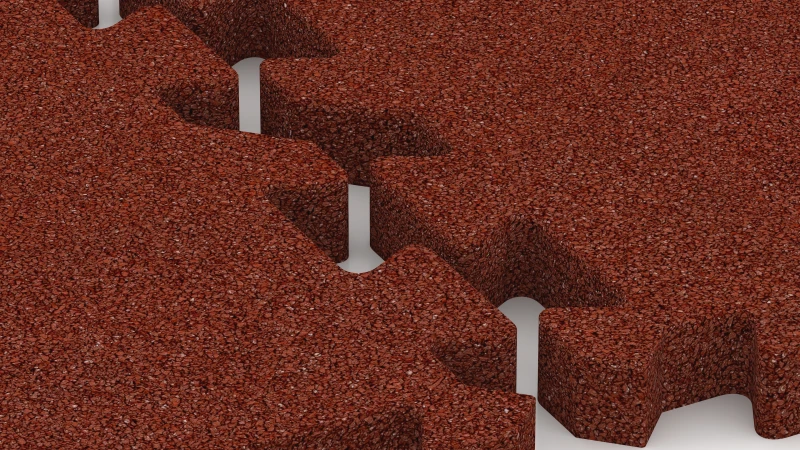
The jigsaw interlock between rubber tiles is formed by alternating projections and matching recesses along each tile edge: the projections on one tile engage with the recesses in the adjoining tile, creating an edge profile similar to a jigsaw. Depending on the range, the projections are dovetail-shaped or rounded. In both cases, the head is wider than the neck, and the profile extends through the full tile thickness.
To lay the tiles, each tile is pressed down from above into the jigsaw interlock of the adjoining tiles already in place. The wider head prevents the tiles from being pulled apart across the surface; the interlock can be released only by lifting a tile vertically and holds the laid tiles together through their full thickness.
Where all four tile edges carry the same profile, the rubber tiles can be placed together from any side. Otherwise, the laying direction is specified by the profile. Bonding and perimeter edging are generally not required.
The appropriate cleaning method for rubber tiles within buildings depends on the area in which they are used and the surface texture.
In private homes, rubber brooms, vacuum cleaners or mops are usually sufficient for regular maintenance. A neutral cleaner suitable for rubber should be used. A mildly acidic cleaner may be used for mineral deposits.
Water-permeable rubber floor coverings must not be flooded where the substrate does not provide suitable drainage.
For larger or commercial areas, a scrubber dryer with a cylindrical brush is recommended. The brush type and contact pressure of the scrubber dryer must be matched to the floor covering.
Within buildings, a pressure washer is only suitable for stables or appropriately equipped halls where adequate drainage is available. It can also remove stubborn dirt from the textured tile surface.