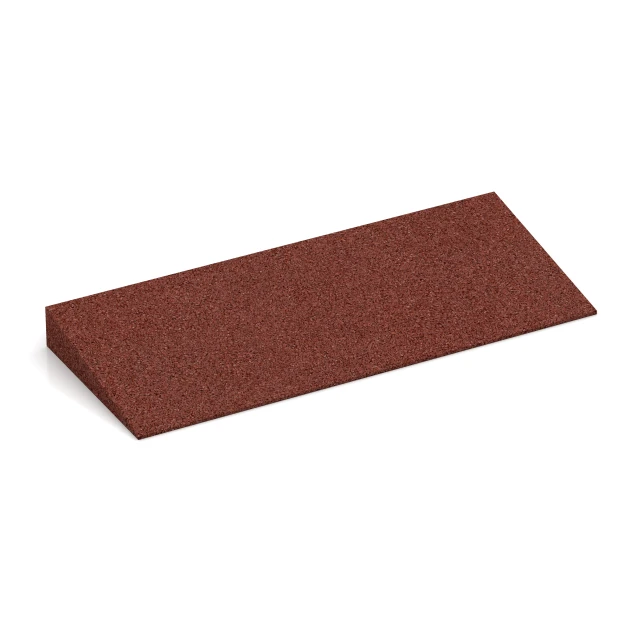
Threshold ramp 50 × 4.3 cm RK "Brick red"
-
This product is currently unavailable.
/ - 2 Piece / lin. m.
- (2.50 kg / Piece)
EAN: 4251469322431 | Item no.: 2243
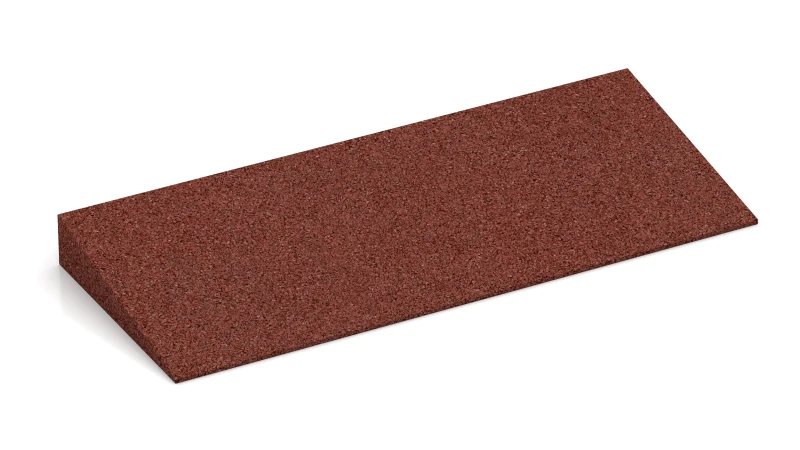
This compact threshold ramp, made from rubber granules bonded with polyurethane, bridges an edge 4.3 cm high. It helps people using a wheelchair, rollator or pushchair cross low door thresholds and dropped kerbs more easily. It also creates a barrier-free transition onto an area of rubber tiles laid on an existing substrate.
Where can I use the threshold ramp?
Low edges are common at front doors, balcony doors, garage doors and dropped kerbs. They can be an obstacle for a wheelchair, rollator, pushchair or hand trolley. You can also easily catch your foot on them when walking. The threshold ramp is placed in front of the edge and rises gently to its height. Its compact size means it can be used in different places as needed.
How is the ramp used with rubber tiles?
Rubber tiles are often laid as an island or peninsula on an existing substrate. They can form a play corner, training area or small terrace. This leaves an exposed edge as high as the thickness of the tiles. The threshold ramp is placed against this edge and leads gently up onto the tiled area. It sits flush with the tiles when they are as thick as the ramp is high. For a longer edge, several ramps can be placed side by side.
What edge height does the threshold ramp fit?
Measure from the substrate to the top edge of the threshold or tile. When the edge is 4.3 cm high, the top of the ramp sits flush with it. If the edge is lower, the ramp projects above it. A different edge height needs a ramp of the corresponding height. At its thin end, the ramp is about 8 mm thick.
What is the threshold ramp made from?
The ramp is made from rubber granules bonded with polyurethane. Its surface remains slip-resistant when wet. The elastic ramp cushions the impact when a wheel hits its front edge. It is suitable for indoor and outdoor use.
How do I fix the threshold ramp in place?
For mobile use, simply place the ramp where it is needed. If it is to remain in one place for longer, it can be fixed with PU adhesive or double-sided carpet tape. When fixed with carpet tape, it can be removed again later.


Product Highlights
Characteristics
Product Details – Material and Structure



Comparative values
A ramp wedge is needed as perimeter edging for a balcony or terrace only where there is a difference in level between surfaces. It is not needed for edge restraint alone.
That edge restraint is provided on balconies and terraces by existing structural boundaries such as walls and balustrades, which contain the floor covering. A difference in level may occur at a doorway threshold; in that case, the ramp wedge forms a sloping, walkable transition ramp.