
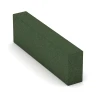
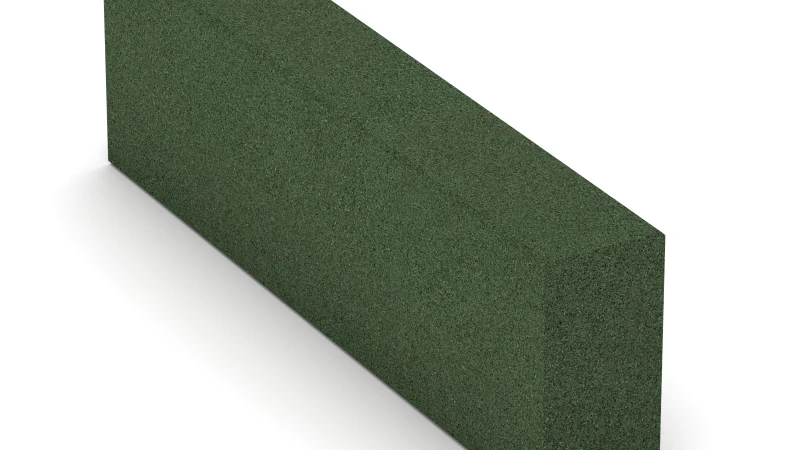
Rubber granulate block step RV "Grass green"
- /
-
Ready to ship
from stock in 1-3 days - €103.70 / 1 Piece / lin. m.
- (33.00 kg / Piece)
EAN: 4251469370302 | Item no.: 7030
The rubber granulate block step is a solid, wide rectangular block made from rubber granules bound with polyurethane (PU). Its edges are slightly bevelled to protect them from chipping. Outdoors, it can be used as a standalone step or as part of an outdoor staircase, as a kerb or boundary between areas, for slope retention or as vehicle impact protection. Unlike a concrete step, the block step is elastic and shock-absorbing, which helps prevent accidents, injuries and damage.
How do you build outdoor steps with block steps?
The rubber granulate block step can be installed on its own as an outdoor step or laid one after another to form a flight of outdoor steps. Block steps can be used for garden steps, steps outside a patio door or garden steps on a slope. They are suitable for private gardens as well as parks and green spaces. The grippy surface remains slip-resistant when wet. This also makes outdoor steps built from block steps suitable for playgrounds and nurseries.
How is the block step installed?
The rubber granulate block step is wide and heavy enough that it usually needs no concrete haunching. It is laid on a load-bearing bed of sand or grit or set in a concrete foundation. It can be partly embedded in concrete where needed. If concrete haunching is required, it is added while the foundation is still fresh. Adjacent block steps can be connected in a suitable way. The block step can be cut with a circular saw or jigsaw.
How is the block step used for vehicle impact protection?
The rubber granulate block step cushions bumps from vehicles and protects vehicles, walls and fittings from damage. In car parks, on access roads and in loading areas, it is placed on the ground as a freestanding block. In underground car parks and warehouses, it is bonded to walls, columns or plinths with PU adhesive. How far it projects from the wall depends on whether it is fitted flat or on edge.
Where else can the block step be used?
The rubber granulate block step can also serve as a kerb or raised boundary for paths, beds, access roads and lawns. For slope retention, it supports the soil on embankments and slopes.
What is the block step made from?
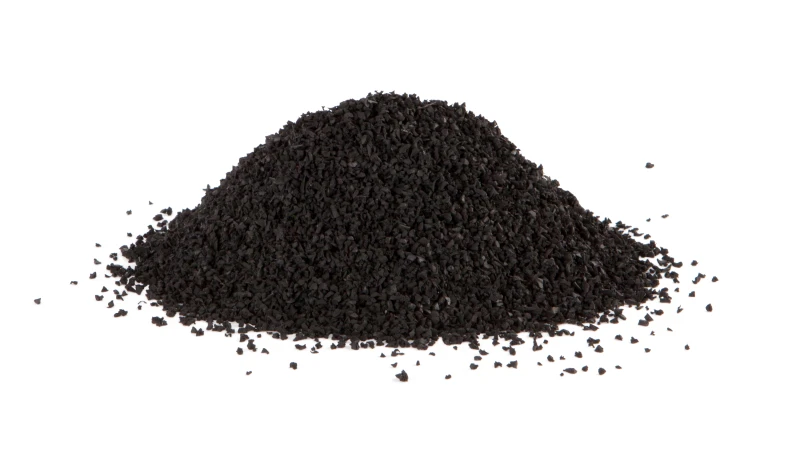
The rubber granulate block step is made from recycled tyre rubber granules (ELT) bound with polyurethane. The granules come from recycled end-of-life tyres. The material is frost-resistant and weather-resistant. The block step needs very little care. Rain washes off dirt, while more stubborn dirt can be removed with a pressure washer.



Discount
Product Highlights
Characteristics
Product Details – Material and Structure


Comparative values
Outdoor rubber tiles made from polyurethane-bound rubber granules are frost-resistant and suitable for use throughout the winter. Their porous structure absorbs precipitation and allows it to pass downwards; water remaining in the pores has space to expand when it freezes, while the rubber granules and polyurethane binder remain elastic at sub-zero temperatures. The sub-base must also be constructed to withstand frost.
On bound sub-bases, water flows beneath and between the tiles in the direction of the fall towards the drainage system. On chippings or crushed stone, it drains vertically through the construction. If water collects beneath the tiles, a frost-susceptible sub-base may rise and then settle again after thawing. The tiles themselves remain unaffected, but the surface may become more uneven.
For winter maintenance, use a snow shovel with a smooth edge and avoid catching the tile edges. Salt used in normal quantities to melt ice does not harm the rubber granules.
Patio tiles made from rubber granules require an edge restraint where lateral movement is possible. Where the tiles are firmly connected to each other, an edge restraint may be omitted. The same applies where the tiles are permanently bonded to the substrate.
Existing lateral boundaries can replace an additional edge restraint. If a wall, balustrade, parapet or kerb adjoins the edge tiles directly, no further restraint is needed. No further restraint is needed where a lawn meets the edge tiles flush and at the same level.
Turf rooted in the ground provides lateral support for the tiles and prevents them from shifting. Bonded tiles generally do not require an edge restraint. Designs with a fixed puzzle interlock generally do not require an edge restraint.
Rubber mats and moulded items made from rubber granules, including rubber granule mats, are best cut with a circular saw fitted with either a wood-cutting blade or a rubber saw blade. The most appropriate tool depends on the product, the shape of the cut and the installer’s experience. The circular saw should have sufficient power, while blade speed should not be too high.
Where a utility knife is used, this method is generally more appropriate for experienced installers. The knife needs a sharp blade and a firm handle, and it should be guided along a metal straightedge or rail to maintain a straight cut edge. Several passes with moderate pressure will cut through the rubber mat. When guiding the knife along the straightedge, the hand can slip towards the blade; the guiding hand must therefore remain behind the straightedge and never in front of the blade, where the risk of injury is greatest.
For internal cuts or curved lines, a jigsaw is appropriate, using rubber saw blades made for jigsaws. Metal-cutting saws, blades intended for metal or stone, cutting discs and very high-speed saws are unsuitable because heat generated by friction can melt the rubber granules bound within the moulded item and smear the cut edge. This applies equally to rubber mats, safety surfacing tiles, fitness tiles, patio tiles and edging blocks made from rubber granules.