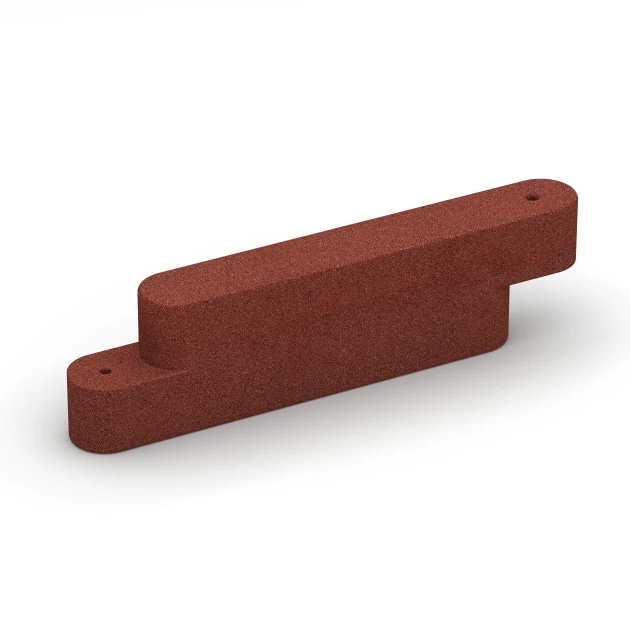
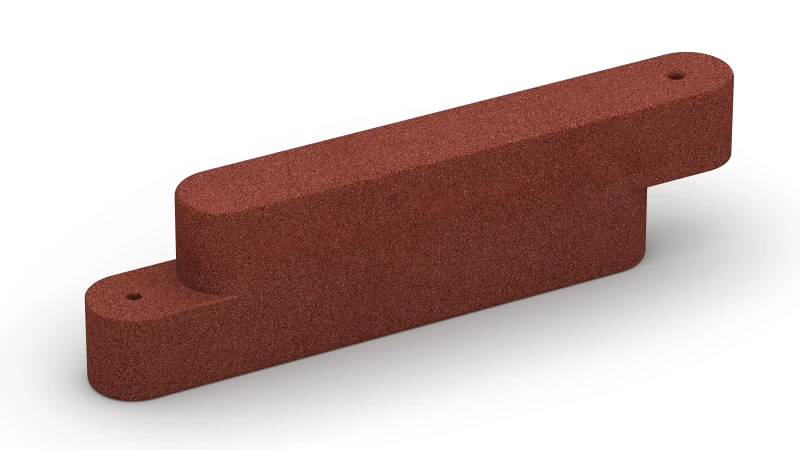
Rubber edge restraint RS "Brick red"
- /
-
Ready to ship
from stock in 1-3 days - €80.60 / 1 Piece / lin. m.
- (32.00 kg / Piece)
EAN: 4251469366404 | Item no.: 6640
The rubber edge restraint is a solid edge block made from rubber granules bonded with polyurethane. It is placed on the ground. A steel tube connects two rubber edge restraints at a hinged joint and anchors the row in the ground. This forms a continuous border used mainly as sandpit edging and around play areas. Unlike a concrete edge block, the rubber edge restraint is elastic and shock-absorbing, which helps prevent accidents and injuries.
Is the rubber edge restraint suitable for sandpit edging?
The rubber edge restraint provides rubber sandpit edging for playgrounds, nurseries and gardens. It keeps the sand in the sandpit and separates it from lawns or paths. Children and parents can also sit on the edge restraint. The hinged joints allow the row to form a four-sided shape, a hexagon or another polygon. As rubber playground edging, it also separates play areas from the surrounding ground.
How are rubber edge restraints anchored?
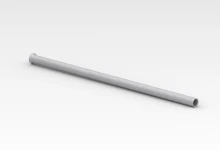
The rubber edge restraint is placed on a prepared base, such as sand or stone chippings. It has a coupling piece at each end. A ground anchor made from galvanised steel tube is passed through the coupling pieces of two adjacent edge restraints and driven into the ground. The ground anchor joins the two edge restraints and stops them shifting. A closed border therefore needs as many ground anchors as edge restraints. An open row needs one additional ground anchor. Ground anchors are ordered separately.
What layouts can be created with the rubber edge restraint?
The rubber edge restraint can pivot at every hinged joint. This allows the row to run straight, turn corners or form steps. The beginning and end of a row can be connected. When stacked in steps, the edge restraints stabilise gentle slopes and divide a bank into terraces.
Where else can the rubber edge restraint be used?
The rubber edge restraint borders parking areas and other areas used by vehicles. If a vehicle hits the edge restraint, the rubber granules absorb the impact and reduce damage to the vehicle.
What is the rubber edge restraint made from?
The rubber edge restraint is made from recycled tyre rubber granules (ELT). These granules come from end-of-life tyres and are bonded with polyurethane. The surface is grippy and slip-resistant even when wet. The material is frost-resistant and weather-resistant. The edge restraint needs little care because rain washes away loose dirt and debris.


Discount
Product Highlights
Characteristics
Product Details – Material and Structure


Comparative values
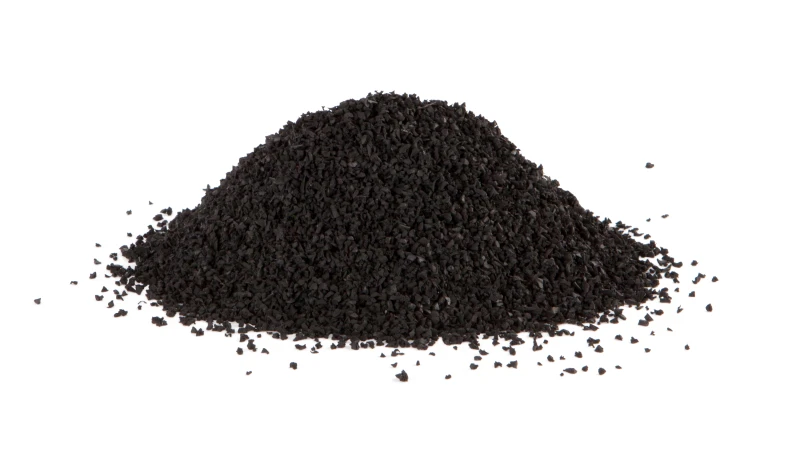
Rubber granules from end-of-life tyres are produced from tyres that are no longer in service. ELT stands for End-of-Life Tyres, the established term for tyres that have reached the end of their usable life. The resulting granules are a recycled raw material.
Collected car and lorry tyres provide the feedstock for processing. The tyres are shredded before the steel and textile fibres are separated. The remaining rubber is processed into black granules with a range of particle sizes, then separated into defined grades.
Tyres contain mainly styrene-butadiene rubber (SBR) and natural rubber (NR), so both types of rubber are present in the recovered granules. The term SBR rubber granules is common in the trade, but it does not make the origin clear, because SBR can also be newly produced and processed directly. By contrast, the term rubber granules from end-of-life tyres explicitly identifies granules recovered from used tyres.
ELT rubber granules are used in floor coverings, including sports flooring and safety tiles, as well as in road construction, building products and technical rubber goods. They are also used as the feedstock for WARCO tiles made from rubber granules bound with polyurethane. Recycling keeps the rubber in use for longer and can reduce demand for newly produced rubber.
Outdoor rubber tiles made from polyurethane-bound rubber granules are frost-resistant and suitable for use throughout the winter. Their porous structure absorbs precipitation and allows it to pass downwards; water remaining in the pores has space to expand when it freezes, while the rubber granules and polyurethane binder remain elastic at sub-zero temperatures. The sub-base must also be constructed to withstand frost.
On bound sub-bases, water flows beneath and between the tiles in the direction of the fall towards the drainage system. On chippings or crushed stone, it drains vertically through the construction. If water collects beneath the tiles, a frost-susceptible sub-base may rise and then settle again after thawing. The tiles themselves remain unaffected, but the surface may become more uneven.
For winter maintenance, use a snow shovel with a smooth edge and avoid catching the tile edges. Salt used in normal quantities to melt ice does not harm the rubber granules.
Patio tiles made from rubber granules require an edge restraint where lateral movement is possible. Where the tiles are firmly connected to each other, an edge restraint may be omitted. The same applies where the tiles are permanently bonded to the substrate.
Existing lateral boundaries can replace an additional edge restraint. If a wall, balustrade, parapet or kerb adjoins the edge tiles directly, no further restraint is needed. No further restraint is needed where a lawn meets the edge tiles flush and at the same level.
Turf rooted in the ground provides lateral support for the tiles and prevents them from shifting. Bonded tiles generally do not require an edge restraint. Designs with a fixed puzzle interlock generally do not require an edge restraint.
An edge restraint is needed to prevent lateral movement at the free edges of an area laid on an unbound sub-base.
An edging kerb, also known as a kerbstone or edging stone, provides this restraint. It is particularly relevant for block paving, paving slabs and rubber paving tiles with interlocking connectors. Existing firm boundaries can also provide lateral restraint.
The edge restraint forms the lateral abutment for the surfacing. It absorbs horizontal forces arising from use and movements caused by temperature changes. This keeps the outer blocks or tiles in their intended position, stabilises the joint pattern and prevents movement at the edges.
No additional edge restraint is required where the surfacing is already permanently bounded by an adjoining concrete area, a wall or a fixed building edge.
Independently of its structural function, an edging kerb can provide a clean separation between paths or surfaced areas and grass, garden beds or sand areas. Typical applications include garden-bed edging and the perimeter of beach volleyball courts.
The edging kerb is installed upright on a concrete bed and secured laterally with a concrete haunch. Approximately 65% of its height is below finished ground level. A load-bearing, adequately drained substrate that is not susceptible to frost is required for a permanently stable edge.
Flexible edging kerbs are suitable for both straight and curved edges.
Rubber mats and moulded items made from rubber granules, including rubber granule mats, are best cut with a circular saw fitted with either a wood-cutting blade or a rubber saw blade. The most appropriate tool depends on the product, the shape of the cut and the installer’s experience. The circular saw should have sufficient power, while blade speed should not be too high.
Where a utility knife is used, this method is generally more appropriate for experienced installers. The knife needs a sharp blade and a firm handle, and it should be guided along a metal straightedge or rail to maintain a straight cut edge. Several passes with moderate pressure will cut through the rubber mat. When guiding the knife along the straightedge, the hand can slip towards the blade; the guiding hand must therefore remain behind the straightedge and never in front of the blade, where the risk of injury is greatest.
For internal cuts or curved lines, a jigsaw is appropriate, using rubber saw blades made for jigsaws. Metal-cutting saws, blades intended for metal or stone, cutting discs and very high-speed saws are unsuitable because heat generated by friction can melt the rubber granules bound within the moulded item and smear the cut edge. This applies equally to rubber mats, safety surfacing tiles, fitness tiles, patio tiles and edging blocks made from rubber granules.
Rubber granule mats of any thickness can be cut with a jigsaw or a circular saw. A circular saw is suited to straight cuts, while a jigsaw is suited to curved cuts and cut-outs. PU-bound rubber granules can be worked in much the same way as wood, provided both saws are guided steadily with an even feed rate.
For particularly thick rubber mats or large sections to be cut, a reciprocating saw or chainsaw may be easier to handle than a guided circular saw. Thick impact-absorbing surfacing tiles also do not require a special machine: a coarse-toothed wood saw blade or a rubber saw blade is suitable. A coarse tooth pattern and moderate speed keep frictional heat low, allowing fitness tiles and patio tiles made from rubber granules to be cut cleanly.