
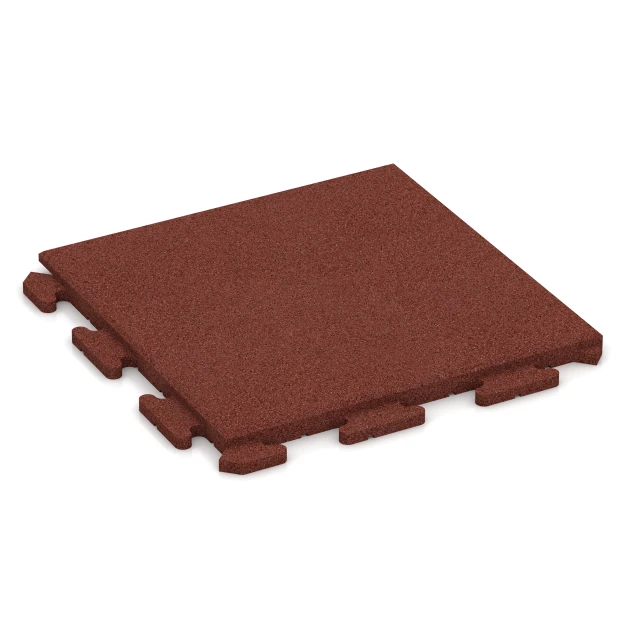
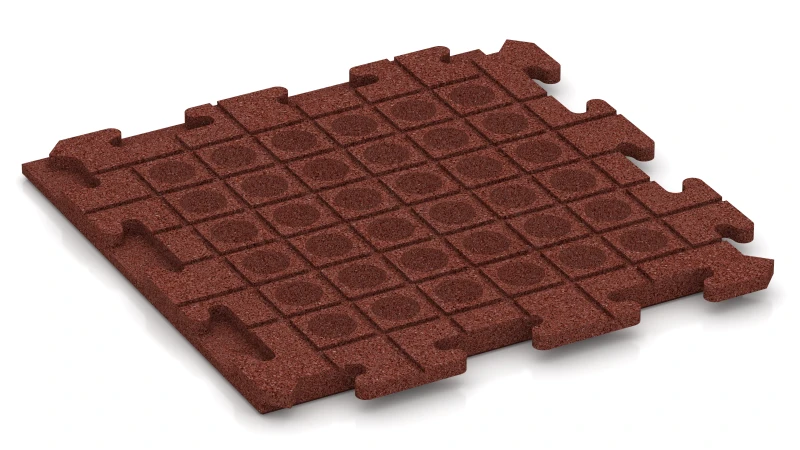
Outdoor Tile Classic HZ "Brick red"
- /
-
Delivery in approx.
2-3 weeks - €56.00 / 4 Piece / m²
- (5.60 kg / Piece)
EAN: 4251469312470 | Item no.: 1247
The Outdoor Tile Classic is a high-quality surface for patios, balconies and loggias, combining timeless styling with modern performance. With its 50 × 50 cm format and thickness options of 3, 4 and 5 cm, it is ideal for outdoor areas of up to 150 square metres that should appear calm, refined and easy to care for in the long term.
Traditional cross-joint appearance with concealed interlock
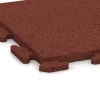
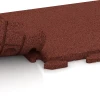
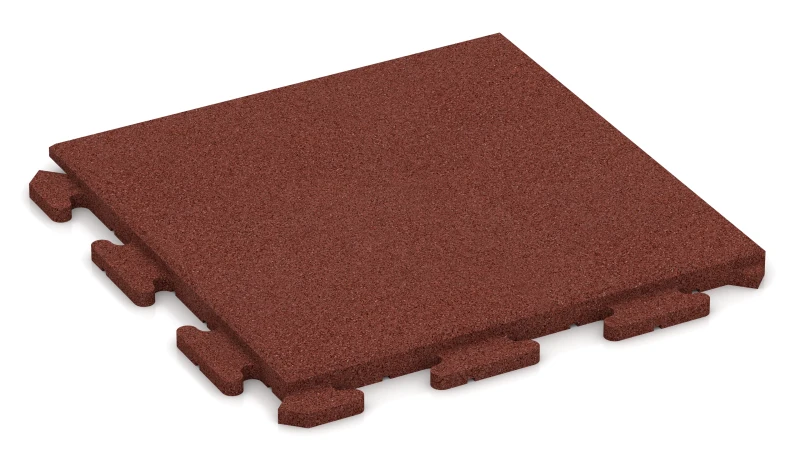
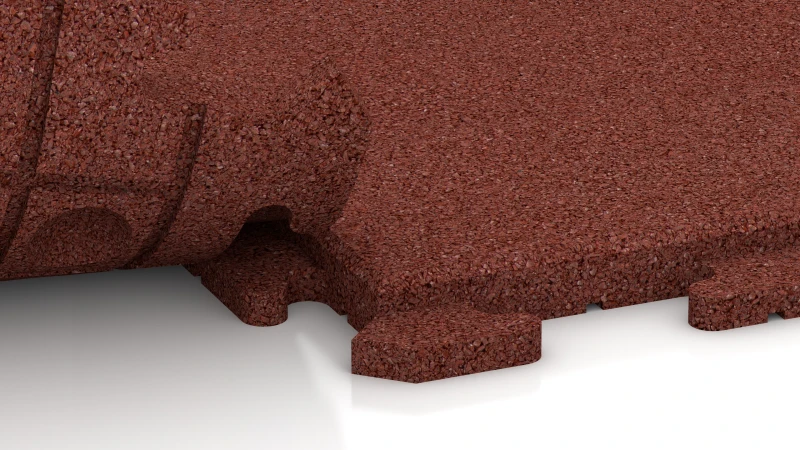
The precisely engineered, concealed interlock keeps the tiles securely aligned while remaining invisible from above. The finished surface features a clean, traditional cross-joint layout, reminiscent of classic stone or ceramic paving, allowing the design to blend seamlessly into a wide range of outdoor styles.
Floating installation without adhesives or screws
The tiles are installed floating on a suitable base, with no bonding or mechanical fixings required. The interlock aligns each tile accurately, creating a stable and reliable patio surface. Edge cuts around walls, posts or boundaries can be made neatly with a jigsaw or circular saw. If required, the tiles can be lifted and relaid at any time.
Comfortable & safe underfoot
The lightly elastic construction provides a comfortably cushioned feel underfoot and helps reduce noise from footsteps, movement and rolling items. The slip-resistant surface ensures secure footing in both wet and dry conditions. Thanks to its natural shock-absorbing properties, the tile offers effective fall protection – valuable for families with children or for senior-friendly outdoor spaces.
Quick-drying, low-maintenance surface
The open-pored structure allows rainwater to drain quickly through the tile, preventing standing water and helping the surface dry fast. Fine dirt is washed away by the draining water, while larger debris can be easily removed with a broom or hose. No sanding, sealing or regular surface treatment is required.
Frost-resistant & weather-resistant
The Outdoor Tile Classic is designed for year-round outdoor use. Compared with many other patio coverings, visible ageing is minor and does not affect functionality. Its slip resistance, cushioned feel and characteristic cross-joint layout remain reliable over time.


Discount
Product Highlights
Characteristics
Product Details – Material and Structure
Comparative values
The number of tiles required can be determined in two ways: by calculation or with the digital laying planner.
For the calculation method, the area is measured in length and width (in cm). Both values are divided by the effective dimensions of a tile and rounded up to the next whole number. The two rounded results are then multiplied together – the outcome is the minimum number of tiles needed. For irregular areas, a laying plan drawn to scale on graph paper is recommended.
A quicker approach is the online laying planner, which is available for every WARCO product in the web shop. After entering the area dimensions, the tool automatically calculates the tile requirement and displays a suitable laying pattern. A click on “Plan your laying” on the product page is all it takes – the application works directly in the browser, free of charge and without registration.
All WARCO tiles designed for outdoor use are permanently weather-resistant and highly durable. They do not rot, decay or develop mould, and they cannot come loose from the ground, as they are installed without adhesive. Even under frost or intense sunlight, the tiles do not crack or break.
As with wood and other materials, rubber granulate tiles can undergo slight dimensional changes. Due to temperature fluctuations or temporary moisture absorption, the material may expand or contract slightly – a natural effect.
Thanks to their open-pored structure, WARCO tiles are water-permeable. Rainwater can drain evenly through the tiles into the ground, preventing puddles from forming. The water either flows through the integrated drainage structure beneath the tiles or seeps naturally into the soil. This ensures that the surface remains usable even in wet conditions and dries quickly.
WARCO tiles also feature a slip-resistant surface that provides secure footing even when wet. No additional surface treatment is required, as the tiles are low-maintenance, long-lasting and perfectly suited for continuous outdoor use.
Yes, that is the standard approach. The vast majority of our customers – whether private, municipal, or commercial – install the delivered WARCO tiles themselves or with their own staff. The installation is simple and requires no special skills. Only fitting the curb into a concrete foundation with back support demands a little extra craftsmanship. Cutting the elements to size and laying them on a suitable substrate is not challenging. You can find all essential installation information in our Expert Advice – FAQ section on our website.
WARCO offers several connection systems for rubber floor tiles. They differ in their construction, the way neighbouring tiles are joined and how visible the joint remains once the floor has been laid. The key differences are explained below.
Puzzle joint (visible)
With this system, the tile edges are shaped as a puzzle joint with mushroom-shaped connectors. During installation, the matching profiles interlock to form a continuous connection through the full thickness of the tile. The joint is either formed during pressing or precision-cut after the tile has cured. Whether the joint pattern remains visible on the finished floor depends on the edge finish, with or without a chamfer, and on the colour of the surface. The symmetrical geometry distributes loads evenly, making this the most stable type of connection of the three systems.
Plug-in connectors (plastic dowels)
This system uses separate connectors, usually round plastic dowels, which are inserted sideways into pre-drilled holes in the tiles. The tiles themselves have smooth, straight edges similar to a concrete slab. They are laid in a half-bond (stretcher bond), so each tile is connected by dowels to two tiles in the previous row and two in the following row. This prevents sideways movement while still allowing movement in line with the dowels. For that reason, the finished area is normally provided with edge restraint. It need not be purpose-built, as an existing parapet, a wall or an adjoining lawn at the same level can serve the same purpose.
Concealed puzzle joint
This design is based on the classic puzzle joint but is designed so that the joint stays hidden once the floor has been laid. The joint is positioned on the underside of the tile and integrated into a stepped rebate. Two sides of each tile carry the interlocking teeth, the other two the matching recesses. When installed, the tiles lock together from below to create a stable connection. From above, only a closed joint pattern with clean right-angled lines is visible, typically giving the appearance of a chessboard pattern.
Patio tiles must be installed on a suitable sub-floor to ensure long-term stability and safety. The choice of substrate will depend on the type of decking being used. For tiled decks, a concrete slab is generally required, over which a sloping screed is laid to facilitate proper drainage; the tiles are then glued and grouted.
However, there are variations that do not require a concrete base. For example, rubber granules, wood tiles or thick slabs of concrete or natural stone can be laid on a base of plastic grass grid. This method requires minimal earthwork and offers the advantage of permanent water permeability. When planning your patio, choose the most suitable surface first and then create the appropriate sub-base, avoiding concrete wherever possible.


