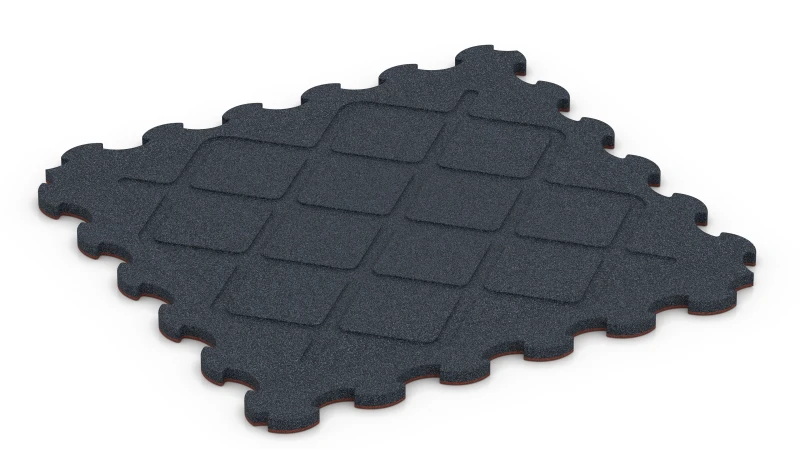
Interlocking Stable Mat RZ "Brick red"
- /
-
Ready to ship
in approx. 7-14 days – production already under way - €57.90 / 0.95 Piece / m²
- (25.50 kg / Piece)
EAN: 4251469363922 | Item no.: 6392
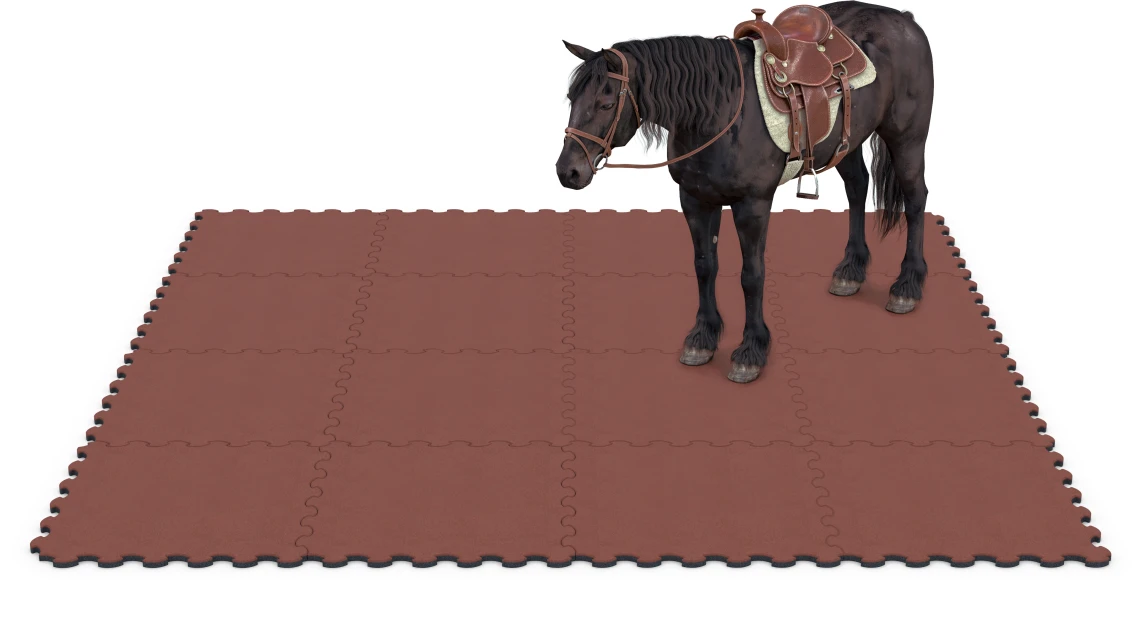
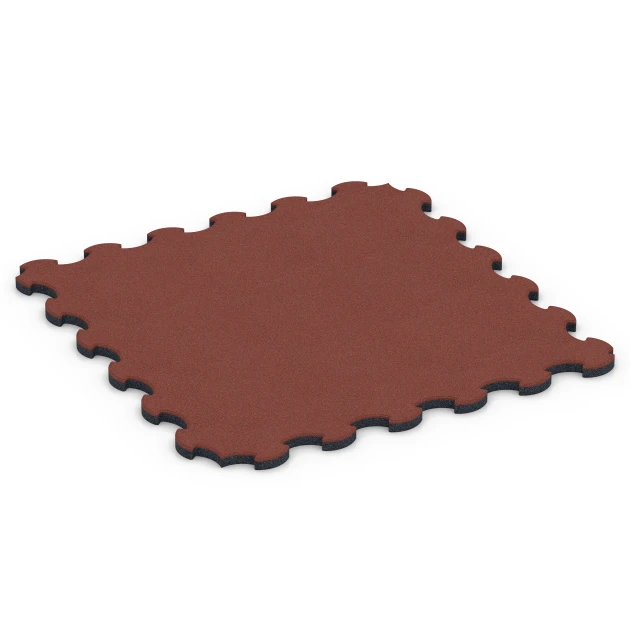
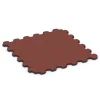
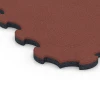
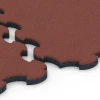
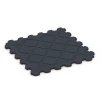
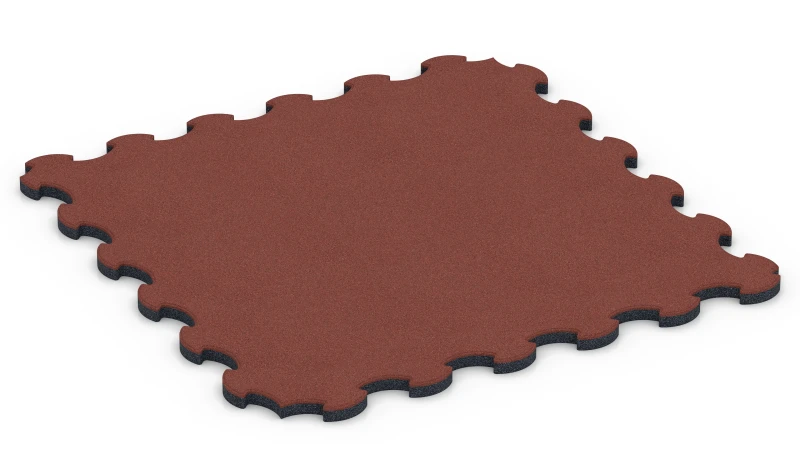
The 3 cm thick Interlocking Stable Mat is made from rubber granules bonded with polyurethane. It is suitable for loose boxes, outdoor loose boxes, open stables, loose housing, stable aisles and paddocks. The square mats have a rounded jigsaw interlock that keeps them firmly joined together.
Why do interlocking mats not need edge restraint?
Stable mats without an interlock gradually move apart. Gaps appear, and bedding and muck fall into them. These mats therefore need edge restraint all round. By contrast, the rounded teeth of the interlocking mats fit together precisely. The mats stay in place without edge restraint, and their corners do not lift. Each mat can still be lifted out separately.
How do rubber mats benefit horses in stables?
The horse is a steppe animal. It spends much of the day standing or walking around. Bare concrete is hard and becomes slippery when wet, so shod horses have little grip on it. The Interlocking Stable Mat yields slightly under the hoof while remaining firm. Its grippy surface is slip-resistant even when damp. This makes it easier for the horse to lie down, get up and turn round.
What are the stable mats made from?
The Interlocking Stable Mat is made from ELT granules. These are rubber granules made from recycled end-of-life tyres. The granules are bonded with polyurethane under high pressure. This produces a compact, very abrasion-resistant rubber mat that withstands daily mucking out with a fork and scraper. The initial rubber smell fades after a while.
Are the stable mats waterproof?
The Interlocking Stable Mat lets very little urine through, but it is not waterproof. Urine that is not absorbed by the bedding passes through the joints and gets beneath the stable mats. As the urea breaks down, ammonia forms beneath the mats. It irritates mucous membranes and airways. The lying area should therefore remain bedded with straw or shavings. Less bedding is often needed than on bare concrete. A bedded toilet area or a freely accessible paddock reduces the chance of horses urinating on the stable mats. Where possible, horses avoid urinating where it will splash.
How are the interlocking mats laid and cleaned?
The interlocking mats are laid without adhesive on sound, reasonably level concrete, asphalt or paving. They are pressed together from above. In a paddock, gravel grids filled with chippings are sufficient as a base. For a straight edge, cut an interlocking mat in half with a circular saw. Place the halves at the beginning and end of the row with the cut edges facing outwards. At a wash bay, the base must slope towards an unobstructed drain. For a thorough clean, lift the stable mats and clean both the mats and the base. Refit the mats once both are dry.


Discount
Product Highlights
Characteristics
Product Details – Material and Structure
Comparative values
Rubber granules from end-of-life tyres are produced from tyres that are no longer in service. ELT stands for End-of-Life Tyres, the established term for tyres that have reached the end of their usable life. The resulting granules are a recycled raw material.
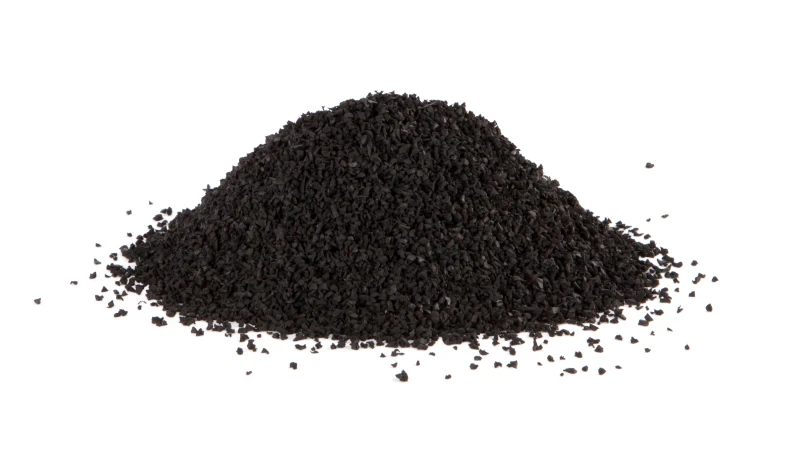
Collected car and lorry tyres provide the feedstock for processing. The tyres are shredded before the steel and textile fibres are separated. The remaining rubber is processed into black granules with a range of particle sizes, then separated into defined grades.
Tyres contain mainly styrene-butadiene rubber (SBR) and natural rubber (NR), so both types of rubber are present in the recovered granules. The term SBR rubber granules is common in the trade, but it does not make the origin clear, because SBR can also be newly produced and processed directly. By contrast, the term rubber granules from end-of-life tyres explicitly identifies granules recovered from used tyres.
ELT rubber granules are used in floor coverings, including sports flooring and safety tiles, as well as in road construction, building products and technical rubber goods. They are also used as the feedstock for WARCO tiles made from rubber granules bound with polyurethane. Recycling keeps the rubber in use for longer and can reduce demand for newly produced rubber.
Rubber tiles and rubber mats from WARCO are not harmful to health when used as intended. They are made from rubber granules bound with PU; the solvent-free PU binder cures fully during manufacture.
The rubber granules are predominantly recycled from end-of-life tyres (ELTs). The PAH content of ELT rubber granules may vary according to origin and batch; PAH means polycyclic aromatic hydrocarbons. Black ELT rubber granules contain carbon black, a fine industrial soot that gives the rubber its black colour. Surface abrasion may occur during use of rubber mats.
In two-layer versions, the wearing layer is made from newly manufactured EPDM, which is coloured throughout and free from harmful substances. The possible PAH variations associated with ELT rubber granules do not occur with EPDM. Versions with an EPDM wearing layer are particularly suitable for prolonged or intensive skin contact and for areas intended for babies. The relevant product description states whether a product has a two-layer construction.
WARCO rubber tiles are made from rubber granules bound with polyurethane. Each granule is coated with polyurethane and held within the binder. The solvent-free binder cures fully during manufacture. Individual granules may remain attached to a tile after manufacture or come loose while the tiles are being laid. Any such manufacturing residue can be swept up or removed with a vacuum cleaner.
Vulcanised rubber and cured polyurethane are insoluble in water. Rainwater passing through the porous tiles does not dissolve these constituents. The same applies to individual granules left on the surface. On this basis, contamination of the soil or groundwater is not expected.
Rubber tiles and rubber mats made from PU-bound rubber granules typically have a service life of around 10 to 15 years, although this can vary substantially with the conditions of use. Some surfaces remain in use for more than 20 years, while others require replacement after only a few years.
The type and intensity of loading determine service life. Friction causes surface wear, while high or sustained compressive loads can affect the material structure. Mechanical loading is generally lower in private settings than in commercial use. Weathering also affects service life, particularly UV radiation, temperature changes and frequent freeze-thaw cycles.
The type of granules influences ageing behaviour. An EPDM wearing layer is UV-resistant and, after an initial acclimatisation period, remains largely colour-stable. ELT granules with a pigmented binder become darker over time.
The data sheet for each WARCO product provides information on UV resistance, colour fastness and abrasion resistance, helping to select the appropriate covering. Correct installation in accordance with the installation guidelines on a level, load-bearing substrate also contributes to a long service life.
Outdoor rubber tiles made from polyurethane-bound rubber granules are frost-resistant and suitable for use throughout the winter. Their porous structure absorbs precipitation and allows it to pass downwards; water remaining in the pores has space to expand when it freezes, while the rubber granules and polyurethane binder remain elastic at sub-zero temperatures. The sub-base must also be constructed to withstand frost.
On bound sub-bases, water flows beneath and between the tiles in the direction of the fall towards the drainage system. On chippings or crushed stone, it drains vertically through the construction. If water collects beneath the tiles, a frost-susceptible sub-base may rise and then settle again after thawing. The tiles themselves remain unaffected, but the surface may become more uneven.
For winter maintenance, use a snow shovel with a smooth edge and avoid catching the tile edges. Salt used in normal quantities to melt ice does not harm the rubber granules.
Thermal insulation from floor coverings made from rubber granules is supplementary and varies with the product design and thickness; it does not replace the thermal insulation required within the building structure. Across the WARCO range, thermal conductivity is approximately 0.07 to 0.16 W/(m·K), depending on the product line. By comparison, EPS insulation materials achieve approximately 0.032 to 0.040 W/(m·K), so they provide substantially greater insulation than floor coverings made from rubber granules at the same thickness.
Thermal conductivity and thickness determine the thermal resistance of a floor covering: lower thermal conductivity produces greater thermal resistance, as does a thicker covering. On a cool mineral substrate, a dry covering made from rubber granules draws heat from the foot more slowly and therefore feels less cold. With porous outdoor coverings, thermal insulation decreases when wet because water conducts heat more readily than the air within the pores.
For the thermal insulation of flat roofs and ceilings, the performance of the complete roof or ceiling build-up is decisive. With underfloor heating, the thermal resistance of the covering slows heat output into the room; the thicker the floor covering, the greater this slowing effect.
Rubber granule mats of any thickness can be cut with a jigsaw or a circular saw. A circular saw is suited to straight cuts, while a jigsaw is suited to curved cuts and cut-outs. PU-bound rubber granules can be worked in much the same way as wood, provided both saws are guided steadily with an even feed rate.
For particularly thick rubber mats or large sections to be cut, a reciprocating saw or chainsaw may be easier to handle than a guided circular saw. Thick impact-absorbing surfacing tiles also do not require a special machine: a coarse-toothed wood saw blade or a rubber saw blade is suitable. A coarse tooth pattern and moderate speed keep frictional heat low, allowing fitness tiles and patio tiles made from rubber granules to be cut cleanly.
An uneven surface only needs to be levelled before laying rubber tiles where larger depressions prevent even support or interfere with water drainage.
Minor unevenness, fine cracks, narrow joints and shallow defects are generally unproblematic. Tiles made from PU-bound rubber granules are elastic and flexible; their compliance depends on tile thickness and density. Thinner rubber tiles conform particularly well to a slightly undulating substrate.
Rubber tiles are suitable as a covering for an uneven surface and remain stable on uneven ground. Rigid concrete or stone slabs may rock on an uneven surface.
Pronounced hollows where water collects should be filled before installation. On a firm sub-base, accurately cut pieces of roofing felt can be used for filling and, where required, laid in several layers.
Sand, grit and gravel are unsuitable for local levelling because loose fill can shift over time.
Rubber flooring tiles can be installed directly over concrete, screed, asphalt or tiled floors as a loose-laid covering, without an additional sub-base.
With no additional sub-base required, the substrate must still be load-bearing, clean and sufficiently level. Remove loose material, oil and other contamination before laying. Larger irregularities, depressions and changes in level must be levelled out so that the tiles lie stably and do not create obtrusive edges.
The starting point and laying direction depend on the shape of the area and the required pattern. In many cases, starting in the centre helps to align the pattern evenly and produce similar cuts at opposite edges. For other areas, a straight boundary may provide the appropriate starting point.
Lay the tiles according to the chosen layout and join them firmly. Depending on the product, this is done using puzzle joints, dovetail joints or separate connectors. Measure the edge tiles, cut them to fit and then insert them.
Bonding is generally not required. Small cut pieces, stair treads and very small areas may require bonding.
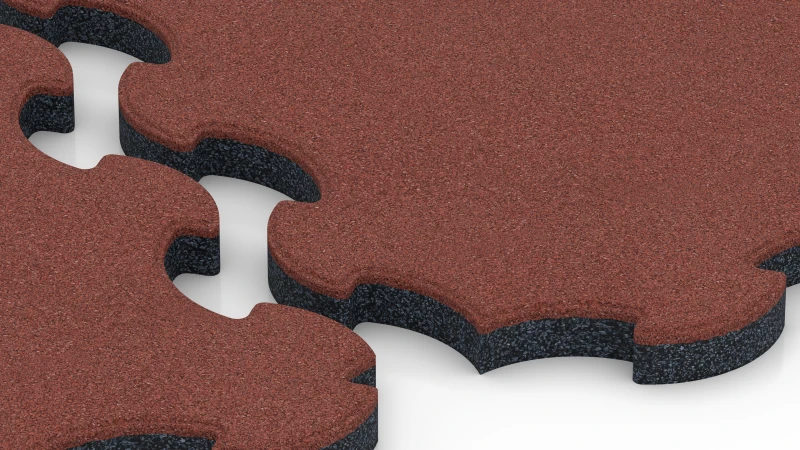
The jigsaw interlock between rubber tiles is formed by alternating projections and matching recesses along each tile edge: the projections on one tile engage with the recesses in the adjoining tile, creating an edge profile similar to a jigsaw. Depending on the range, the projections are dovetail-shaped or rounded. In both cases, the head is wider than the neck, and the profile extends through the full tile thickness.
To lay the tiles, each tile is pressed down from above into the jigsaw interlock of the adjoining tiles already in place. The wider head prevents the tiles from being pulled apart across the surface; the interlock can be released only by lifting a tile vertically and holds the laid tiles together through their full thickness.
Where all four tile edges carry the same profile, the rubber tiles can be placed together from any side. Otherwise, the laying direction is specified by the profile. Bonding and perimeter edging are generally not required.
Outdoor rubber tiles should be cleared of leaves, soil and sand regularly.
Loose dirt can be swept away with a rubber broom or rinsed off with a hose. Rain also washes much of the dust and pollen away through water-permeable tiles.
Regular maintenance reduces the work required for more thorough cleaning.
For thorough outdoor cleaning, a pressure washer is suitable. The water jet loosens dirt from the textured surface and removes more persistent residues such as dog mess or food residue.
Where clean water is not sufficient, use either a neutral cleaner suitable for rubber or a mildly acidic cleaner. A specialist rubber cleaner is not required. Biodegradable Sonett WC Cleaner Mint is particularly suitable and has a pH value of around 5 to 6.
Apply the cleaner evenly, either neat or slightly diluted. After 10 to 15 minutes, work it in with a brush, then rinse the area thoroughly with clean water.
When brushing, use moderate pressure only. Excessive pressure can loosen granules from the bonded matrix.
Strongly alkaline cleaners, abrasive products and solvent-based cleaning products are unsuitable, as they can attack the surface of the rubber tiles.
Good design made easy.