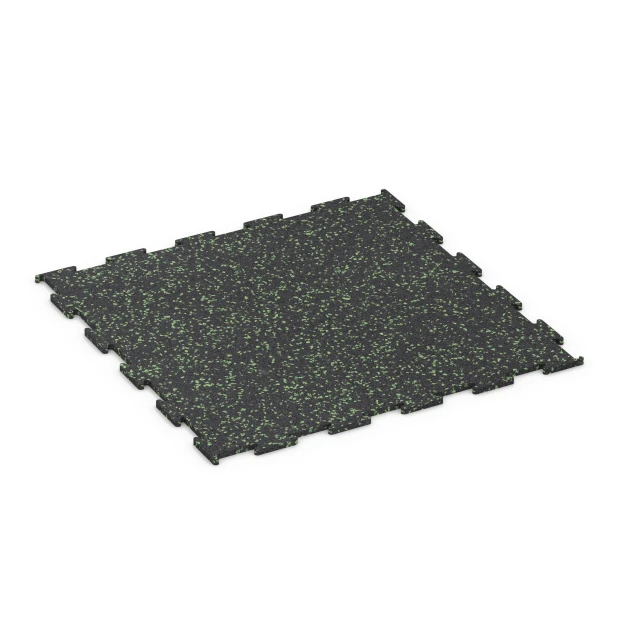
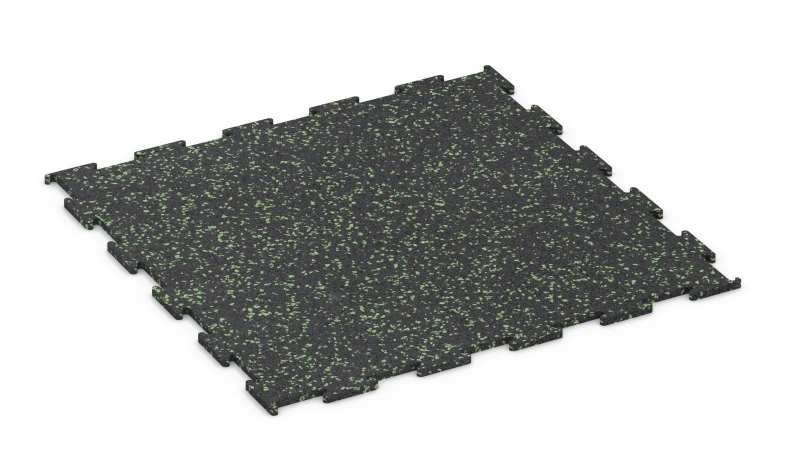
Gym Mat Compact 50 × 50 GZ "Lightly speckled green"
- /
-
Ready to ship
from stock in 1-3 days - €30.80 / 4 Piece / m²
- (2.00 kg / Piece)
EAN: 4251469364592 | Item no.: 6459
Gym Mat Compact 50 × 50 Type GZ is thin, colour-speckled rubber flooring for indoor use. Its tightly compressed rubber tiles have a finely textured, virtually closed surface. They are resilient underfoot and, at 0.8 cm thick, provide appropriate cushioning. The flooring is also robust and abrasion-resistant. The interlocking puzzle profile is cut without a bevel, so only a barely visible hairline joint remains between the tiles. This creates gym flooring that is easy to clean and looks as though it is made from a single piece.
Where can Gym Mat Compact 50 × 50 be used?
Gym Mat Compact 50 × 50 suits areas where a resilient, easy-to-clean surface matters more than a high level of cushioning. Typical uses include cardio areas with treadmills, exercise bikes and cross trainers, group exercise studios used for gymnastics or Pilates, and home gyms set up in guest rooms. The colour speckles add visual interest. Gym Mat Compact 50 × 50 is therefore also well suited to changing rooms and entrance areas in gyms.
Where do the colour speckles come from?
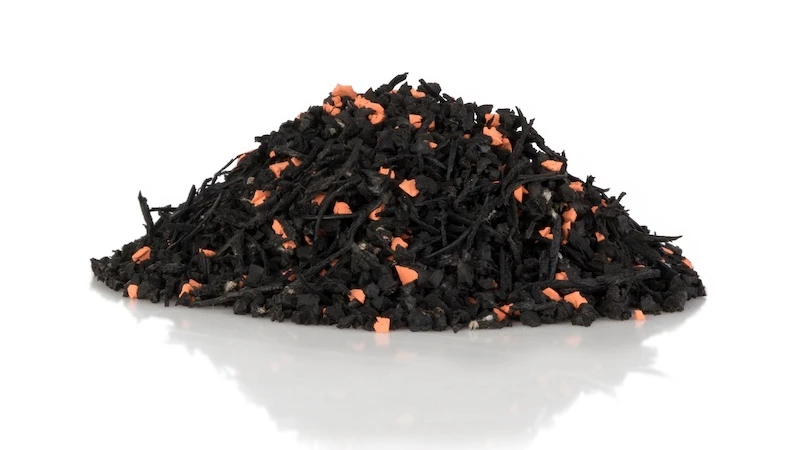
Gym Mat Compact 50 × 50 is made from fine ELT rubber granules from recycled end-of-life tyres, bonded with polyurethane. The material contains 10% coloured EPDM rubber granules mixed into the ELT granules. EPDM is newly manufactured rubber that is coloured throughout. Its granules appear as fine speckles on the surface of the tiles. The tiles are pressed under high pressure, giving them high abrasion resistance. New tiles may smell of rubber at first. With good ventilation, the smell fades over time.
How is Gym Mat Compact 50 × 50 installed?
Gym Mat Compact 50 × 50 is laid without adhesive on a permanently sound, level subfloor, such as screed, tiles or parquet flooring. The tiles are pressed together from above. The interlocking puzzle profile joins the individual tiles to form a stable surface that remains securely in place. Edge tiles are cut to size with a knife or circular saw. If you move, the tiles can be lifted and relaid.
How easy is Gym Mat Compact 50 × 50 to clean?
Gym Mat Compact 50 × 50 absorbs very little moisture and dirt. A vacuum cleaner, broom or damp mop is sufficient for daily cleaning. The rubber granule flooring is resistant to disinfectants. The surface can therefore be disinfected when needed.


Discount
Product Highlights
Characteristics
Product Details – Material and Structure


Comparative values
Rubber mats made from PU-bound rubber granules can have a characteristic rubber smell, particularly when new. Whether and how strongly it is noticed depends on the material composition and on individual sensitivity to odours.
With WARCO rubber coverings, the inherent smell decreases over time. On well-ventilated outdoor areas such as balconies and terraces, it dissipates quickly. Heat may temporarily make the smell more noticeable.
The smell can remain noticeable for longer in indoor areas, conservatories and other poorly ventilated spaces where ventilation is limited. To reduce the initial inherent smell, rubber tiles may be stored for several days before installation in a dry, well-ventilated place. During storage, air should reach as many tile surfaces as possible.
After installation, regular brief periods of thorough ventilation or cross-ventilation support air exchange. With correct use, no adverse health effects from WARCO rubber coverings are known.
In normal use, furniture leaves no visible pressure marks or impressions on rubber tiles, provided the product description specifies that the covering is suitable for furniture and equipment. This includes patio tiles, balcony tiles, fitness tiles and floor coverings for trade fair and exhibition areas. Plant containers and training equipment may also stand on these surfaces.
The decisive factor is the point load, that is the weight in relation to the contact area of the furniture feet. Broad feet distribute the load, while very narrow feet concentrate the same weight over a small area. Patio and balcony tiles also accommodate the concentrated loading created by shoes with high heels. Tables and chairs of conventional design are therefore unlikely to leave marks. The limit is only approached by an exceptionally narrow metal foot carrying a high load.
Compressive strength is assessed under BS 7188. A force of 1000 newtons is applied to a test piece with a contact area of one square centimetre, equivalent to the weight of about 105 kilograms. Residual indentation is measured 24 hours after the load is removed. For patio and balcony tiles it is less than one millimetre. The corresponding rating appears in the technical data. The higher the rating, the smaller the residual indentation.
Rubber mats can be laid over underfloor heating. Mats made from rubber granules increase the thermal resistance of the floor build-up, so heat from the system passes through the covering more slowly. The thicker the mats, the more pronounced this effect becomes; the heat is not lost, but released into the room later.
Underfloor heating systems already respond slowly and are designed for steady operation. During normal operation, the delay caused by rubber mats is barely noticeable, although it takes longer for the new target room temperature to be reached after an adjustment to the setting.
Rubber gym floor coverings made from rubber granules can be used for cardio, classes, equipment-based training, functional training, HYROX, boxing, gymnastics, free-weight training and strength training.
Their suitability depends on the thickness, elasticity and shock absorption being matched to the intended use. For cardio, classes and permanently installed training equipment, gym tiles at least 1 cm thick are suitable under normal use. For dynamic exercises, higher loads or greater requirements for elasticity and shock absorption, tiles at least 2 cm thick are recommended.
In functional training and HYROX, the covering is subjected to running, jumping, moving weights and sled exercises. For jumps and intensive contact with the surface, it must absorb shocks effectively while providing a stable training surface. Pulling and pushing sleds requires a firm, abrasion-resistant and durable surface.
For boxing and gymnastics, rubber gym floor coverings are available with elasticity and shock absorption matched to the respective movement patterns. Under permanently installed strength equipment, compressive strength, slip resistance and stable support are the main considerations.
In free-weight areas, thicker tiles or multilayer systems are required. These cushion the impact of weights being set down or dropped, distribute loads, reduce peak loads and limit the transfer of vibrations.
Multilayer systems combine different properties within a single floor covering. A dense top layer provides a firm, abrasion-resistant training surface, while a more elastic, shock-absorbing layer beneath it improves impact and vibration absorption. Density, rubber granule particle size, compaction and shock absorption are selected for each layer according to its function.
Within a comparable construction, a thicker tile allows greater deformation, resulting in greater shock absorption. There is no single gym floor covering for every application: single-layer and multilayer systems can be matched to the type of training, equipment and weights, potential drop heights, intensity of use and building conditions.
Rubber fitness tiles are well suited to multipurpose training rooms used for different activities from one session to the next, provided the tile thickness, elasticity and cushioning are matched to the training planned for the space. Rubber granules form the basis of multi-layer fitness flooring systems. Depending on the intended use, either these systems or fitness mats can be used.
Both can accommodate a varied programme of group classes, suspension training, kettlebell and sandbag work, athletic conditioning, gymnastics and martial arts. In each case, the flooring cushions impacts, reduces impact noise and vibration, and protects the subfloor from damage caused by mechanical loads.
Slip-resistant surfaces provide stable footing and allow controlled movement. Where the same floor area is subject to widely varying loads, multi-layer systems combine a dense, abrasion-resistant top layer with a more elastic cushioning layer beneath. The result is a hard-wearing training surface that also cushions impacts and reduces vibration.
WARCO fitness tiles are laid loose without mortar or adhesive (dry-laid) and held in place by a jigsaw interlock or dovetail joint. Individual tiles can therefore be lifted, relaid or replaced one at a time. All WARCO flooring can be cleaned with alcohol-based cleaners and disinfectants.
WARCO fitness flooring is particularly suited to training rooms in sports clubs, group exercise studios, commercial gyms and functional training boxes where the same area is used for different activities.
Gym equipment flooring made from PU-bound rubber granules is generally suitable for cardio equipment and HIIT areas.
The thickness and material strength of the gym flooring tiles must be matched to the type of training, the cardio equipment in use and the existing substrate. The elastic rubber flooring protects the substrate, cushions impact loads and can reduce the transmission of noise and vibration.
Under treadmills and spinning bikes, gym flooring tiles with a thickness of 10 mm or more are often suitable. HIIT creates higher impact and shear loads through jumping and rapid changes of direction, so thicker gym flooring tiles are appropriate for HIIT training areas. These tiles must also be sufficiently dimensionally stable to provide a stable stance. A slip-resistant surface helps maintain traction during rapid movements.
Calibrated gym flooring tiles with a cut puzzle interlock can be joined to form a level, close-fitting training surface. The interlock stabilises the tile assembly and allows individual gym flooring tiles to be replaced.
Whether the gym flooring can be loose laid depends on the manufacturer’s instructions. The manufacturer’s instructions also determine whether alcohol-based cleaning or disinfecting products may be used.
Fitness tiles made from PU-bound rubber granules are suitable for an exercise studio when their elasticity, firmness and surface finish match the class programme. For functional workouts and HIIT, the elastic covering absorbs part of the impact energy and reduces loads from jumping and rapid sequences of movement.
For gymnastics, yoga, Pilates and balance exercises, the surface needs to be sufficiently firm and level so that hands and feet remain stable. More active classes may require thicker tiles with greater elasticity. A slip-resistant surface provides users with good grip.
Safe use also depends on tiles being installed so that they stay in place, lie level and create no tripping hazards. Their elastic structure reduces the transmission of footfall and structure-borne sound, although the actual sound insulation depends on the complete floor build-up and the building.
Calibrated tiles with precision-cut interlocking puzzle edges can be loose laid to form an even, almost joint-free surface, while individual tiles can be replaced if required. The surface is easy to maintain, can be cleaned effectively and is also suitable for disinfection with alcohol-based products where activities vary from day to day.
A suitable room for a home gym is dry, can be well ventilated, provides enough space for movement, has sufficient ceiling height and has a suspended floor or ground-bearing slab with adequate load-bearing capacity.
The space required depends on the intended training equipment and exercises. In addition to equipment footprints, adequate freedom of movement and safe clearances from walls, windows, radiators and other equipment should be allowed for.
Ceiling height must also accommodate overhead movements, pull-ups, skipping and jumps.
The suspended floor or ground-bearing slab must safely carry the static loads of training equipment, racks and weights, as well as the dynamic loads generated during training. Where heavy equipment or free weights are used, a structural engineer should check the load-bearing capacity if there is any doubt.
Effective ventilation allows heat, moisture and odours to escape. Particularly in rooms that are only lightly heated, the floor, walls and ceiling must remain permanently dry.
A home gym needs a specialist gym floor covering designed for point loads and dynamic loads from training equipment, free weights, jumps and other movement-intensive exercises.
For these loads, a gym floor covering made from PU-bound rubber granules is slip-resistant, protects the substrate, absorbs part of the impact energy and reduces impacts and vibrations.
For effective basic cushioning, the gym floor covering should be at least 10 mm thick. The greater the equipment weight, impact load or potential drop height of weights, the higher-performing the gym floor covering must be. Damping cannot be determined from covering thickness alone: the relevant factors are the performance values of the specific gym floor covering, such as force reduction and impact sound reduction. Density and granule fraction are particularly significant for these performance values.
Where weights are dropped, the gym floor covering must be matched to their weight and drop height. Construction protection mats and comparable makeshift measures are not designed for use as gym floor coverings.
Before fitting rubber flooring indoors, the tiles should be cleaned, dried completely and aired. The substrate must be level, load-bearing, clean and dry.
New tiles made from rubber granules may carry residues of manufacturing release agents and fine rubber dust. Before installation, it is advisable to clean the tiles outdoors with warm water; a mildly acidic cleaner suitable for rubber and a scrubbing brush can assist with cleaning. A pressure washer may be used from a sufficient distance. The tiles must then dry completely.
If cleaning before installation is not possible, the residues can be removed after fitting by repeatedly damp-mopping with warm water. New tiles have a characteristic odour which decreases over time; airing them outdoors for several days and regularly ventilating the room during the first few weeks will help it dissipate more quickly.
Before installation, the tiles should have reached room temperature. The installation instructions for the relevant product and installation system must be followed.
Rubber tiles can be laid over level, load-bearing timber floorboards, parquet flooring, laminate flooring and WPC decking.
The tiles are laid loose on the existing substrate, without adhesive or screws. Depending on the range, they are joined either by interlocking puzzle edges or by a system of plastic connectors. The covering can later be lifted without altering the existing construction.
For indoor use, the rubber covering protects parquet and laminate flooring from indentations and mechanical damage. The rubber covering also provides protection during fitness training, events, dog sports and construction work. Depending on the version, the covering improves slip resistance and absorbs impacts.
A separation layer is not normally required. Where water or other liquids may reach the covering, a waterproof, vapour-permeable separation layer protects the timber floor. Absorbent protective layers are not suitable for permanent installation because absorbed moisture dries only with difficulty beneath the covering.
For weather-exposed timber floorboards and WPC decking, both the substructure and the individual boards must be load-bearing. Damaged, weathered or distorted components must be repaired or replaced before installation. Gaps between the boards do not affect installation.
Depending on their thickness, elastic rubber tiles can bridge individual localised openings of around 2 to 3 cm. Rainwater passes through water-permeable tiles and follows the existing fall across the boards to the open gaps.
The appropriate cleaning method for rubber tiles within buildings depends on the area in which they are used and the surface texture.
In private homes, rubber brooms, vacuum cleaners or mops are usually sufficient for regular maintenance. A neutral cleaner suitable for rubber should be used. A mildly acidic cleaner may be used for mineral deposits.
Water-permeable rubber floor coverings must not be flooded where the substrate does not provide suitable drainage.
For larger or commercial areas, a scrubber dryer with a cylindrical brush is recommended. The brush type and contact pressure of the scrubber dryer must be matched to the floor covering.
Within buildings, a pressure washer is only suitable for stables or appropriately equipped halls where adequate drainage is available. It can also remove stubborn dirt from the textured tile surface.