Gym Flooring Dynamic LZ "Brick red"
- /
-
Ready to ship
from stock in 1-3 days - €58.00 / 4 Piece / m²
- (5.60 kg / Piece)
EAN: 4251469369764 | Item no.: 6976
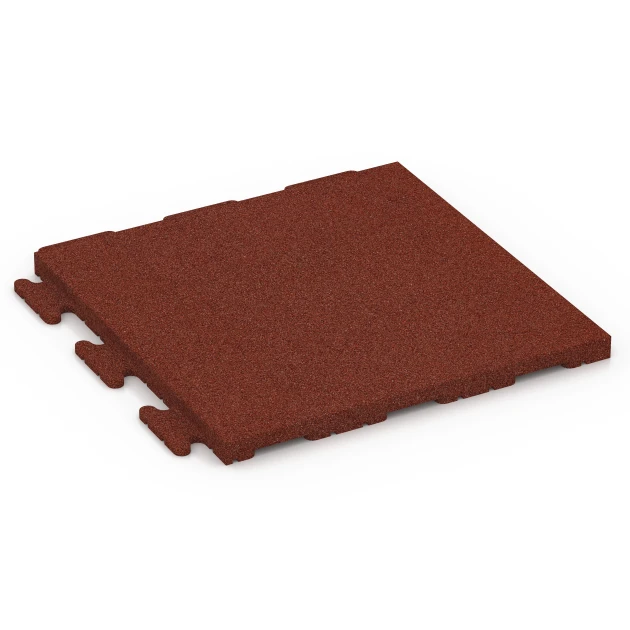
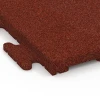
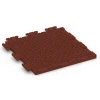
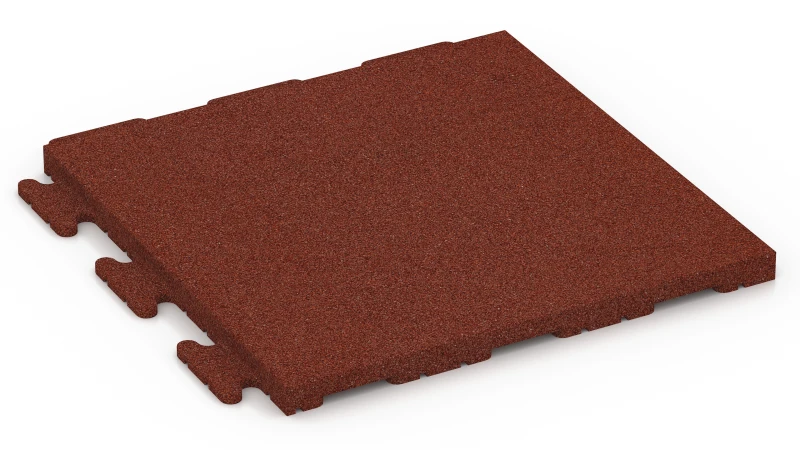
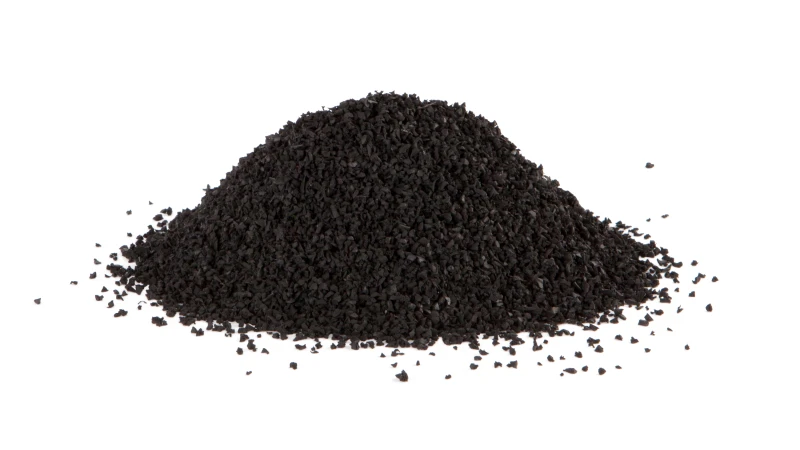
Gym Flooring Dynamic provides an elastic training surface made from rubber granules sourced from end-of-life tyres and bonded with polyurethane. It is designed for functional training and floor exercises in home gyms and outdoor gyms. Its distinctive feature is the concealed interlock. As a result, the laid surface looks like a classic tiled floor.
How does elasticity help during training?
Gym Flooring Dynamic cushions jumps and landings during box jumps, burpees and skipping. During press-ups, planks and mobility exercises, hands and knees rest on a warm, slightly yielding surface. The flooring also protects the surface underneath when you train with lighter dumbbells and kettlebells. Indoors, training is noticeably quieter. Housemates and neighbours will appreciate the difference.
Where can gym floor tiles be used?
Gym Flooring Dynamic can be used in a basement training room, a garage or on a terrace. The handy 50 × 50 cm format makes it quick to lay the floor on your own, even in alcoves and corners.
Why is the flooring suitable for outdoor use?
Gym Flooring Dynamic is water-permeable. Rainwater quickly drains through the flooring into the ground beneath. The grippy surface reduces the risk of slipping when wet. Training in an outdoor gym can therefore resume quickly after a shower.
What do the joints look like?
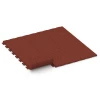
Gym Flooring Dynamic uses a concealed interlock between the tiles. The interlock is hidden beneath the surface, so only the straight joints between the tiles are visible. A grid pattern creates a classic, understated layout. A one-third offset pattern staggers the joints and gives the floor a livelier look.
How are the gym floor tiles laid?
Gym Flooring Dynamic is laid loose on a load-bearing base without adhesive or screws. The interlock keeps the tiles together during changes of direction and sprints. Edge tiles are cut to size with a circular saw or jigsaw. A damaged tile is easy to replace.


Discount
Product Highlights
Characteristics
Product Details – Material and Structure
Comparative values
Rubber mats made from PU-bound rubber granules can have a characteristic rubber smell, particularly when new. Whether and how strongly it is noticed depends on the material composition and on individual sensitivity to odours.
With WARCO rubber coverings, the inherent smell decreases over time. On well-ventilated outdoor areas such as balconies and terraces, it dissipates quickly. Heat may temporarily make the smell more noticeable.
The smell can remain noticeable for longer in indoor areas, conservatories and other poorly ventilated spaces where ventilation is limited. To reduce the initial inherent smell, rubber tiles may be stored for several days before installation in a dry, well-ventilated place. During storage, air should reach as many tile surfaces as possible.
After installation, regular brief periods of thorough ventilation or cross-ventilation support air exchange. With correct use, no adverse health effects from WARCO rubber coverings are known.
Impact-absorbing flooring made from PU-bound rubber granules reduces impact sound and the structure-borne sound it generates. The elastic floor covering absorbs impacts and reduces their transfer to the substrate.
Impact sound occurs when walking, jumping, moving furniture or setting down weights cause a floor or storey slab to vibrate. These vibrations travel through solid building components as structure-borne sound and can become audible as airborne sound in other rooms.
Structure-borne sound can also be caused by machinery and by installations fixed to the building. It may have causes and transmission paths other than impact sound, so it cannot be reduced by a floor covering alone.
Under load, a floor covering made from rubber granules deforms elastically. This deformation transfers the load to the substrate less abruptly, reduces the peak force and, through the covering’s internal damping, further weakens the remaining vibrations.
Sound-insulation tiles reduce excitation of the substrate from footsteps, jumps and impacting objects. Where higher requirements apply, multi-layer flooring systems with functional layers of differing elasticity can further reduce impact transmission. Their effectiveness depends on the properties of each layer, the load applied, and the existing floor or slab structure.
Rubber gym floor coverings made from rubber granules can be used for cardio, classes, equipment-based training, functional training, HYROX, boxing, gymnastics, free-weight training and strength training.
Their suitability depends on the thickness, elasticity and shock absorption being matched to the intended use. For cardio, classes and permanently installed training equipment, gym tiles at least 1 cm thick are suitable under normal use. For dynamic exercises, higher loads or greater requirements for elasticity and shock absorption, tiles at least 2 cm thick are recommended.
In functional training and HYROX, the covering is subjected to running, jumping, moving weights and sled exercises. For jumps and intensive contact with the surface, it must absorb shocks effectively while providing a stable training surface. Pulling and pushing sleds requires a firm, abrasion-resistant and durable surface.
For boxing and gymnastics, rubber gym floor coverings are available with elasticity and shock absorption matched to the respective movement patterns. Under permanently installed strength equipment, compressive strength, slip resistance and stable support are the main considerations.
In free-weight areas, thicker tiles or multilayer systems are required. These cushion the impact of weights being set down or dropped, distribute loads, reduce peak loads and limit the transfer of vibrations.
Multilayer systems combine different properties within a single floor covering. A dense top layer provides a firm, abrasion-resistant training surface, while a more elastic, shock-absorbing layer beneath it improves impact and vibration absorption. Density, rubber granule particle size, compaction and shock absorption are selected for each layer according to its function.
Within a comparable construction, a thicker tile allows greater deformation, resulting in greater shock absorption. There is no single gym floor covering for every application: single-layer and multilayer systems can be matched to the type of training, equipment and weights, potential drop heights, intensity of use and building conditions.
Rubber flooring for exercise equipment in an outdoor gym can be made from PU-bound rubber granules. It is slip-resistant, shock-absorbing, weather-resistant and frost-resistant.
For outdoor use, porous, water-permeable gym tiles are used. Rainwater passes through the tiles across their entire area, while the surface provides stable footing when wet.
Thickness and construction depend on the intended types of training. For calisthenics, equipment training and functional training, a balance between stability and shock absorption is required. Tiles of about 3 cm are suitable for many of these applications.
As well as thickness, density and construction affect the properties of rubber flooring. For kettlebells, barbells and other heavy weights, thicker tiles or multilayer surfacing systems are appropriate.
Where impact-absorbing surfacing is required around training equipment, the critical fall height determined in accordance with BS EN 1177 must be at least equal to the required free height of fall.
A suitable room for a home gym is dry, can be well ventilated, provides enough space for movement, has sufficient ceiling height and has a suspended floor or ground-bearing slab with adequate load-bearing capacity.
The space required depends on the intended training equipment and exercises. In addition to equipment footprints, adequate freedom of movement and safe clearances from walls, windows, radiators and other equipment should be allowed for.
Ceiling height must also accommodate overhead movements, pull-ups, skipping and jumps.
The suspended floor or ground-bearing slab must safely carry the static loads of training equipment, racks and weights, as well as the dynamic loads generated during training. Where heavy equipment or free weights are used, a structural engineer should check the load-bearing capacity if there is any doubt.
Effective ventilation allows heat, moisture and odours to escape. Particularly in rooms that are only lightly heated, the floor, walls and ceiling must remain permanently dry.
A home gym needs a specialist gym floor covering designed for point loads and dynamic loads from training equipment, free weights, jumps and other movement-intensive exercises.
For these loads, a gym floor covering made from PU-bound rubber granules is slip-resistant, protects the substrate, absorbs part of the impact energy and reduces impacts and vibrations.
For effective basic cushioning, the gym floor covering should be at least 10 mm thick. The greater the equipment weight, impact load or potential drop height of weights, the higher-performing the gym floor covering must be. Damping cannot be determined from covering thickness alone: the relevant factors are the performance values of the specific gym floor covering, such as force reduction and impact sound reduction. Density and granule fraction are particularly significant for these performance values.
Where weights are dropped, the gym floor covering must be matched to their weight and drop height. Construction protection mats and comparable makeshift measures are not designed for use as gym floor coverings.
Slip-resistant fitness tiles made from PU-bound rubber granules can be used as flooring beneath gym equipment. The tiles attenuate impacts, reduce noise and structure-borne sound, and protect the floor from abrasion and pressure marks.
To protect the floor, the tiles must be installed on a firm, level substrate. All equipment feet must bear evenly and must not rest on a tile joint. Any unevenness must be levelled before installation.
For cardio equipment, fitness tiles with a thickness of about 1 cm or more are used. Heavy strength stations, racks and weight benches require thicker tiles.
For small or narrow equipment feet, an additional metal plate spreads the point load across a larger area.
For dropped weights, a simple equipment mat is not sufficient. The low-frequency vibrations created by dropped weights require a thicker or multi-layered flooring system for the training area.
Rubber granules are used to make tiles. The main laying patterns are stack bond, diagonal bond, half bond (often called brick bond) and random bond. Which patterns are possible depends on the type of tile and its interlocking system.
In stack bond, the joints line up in both directions. Using tiles in different colours creates a chequerboard effect. Diagonal bond uses the same grid, but at an angle to the edges of the area. In half bond, each row is offset by half a tile length; in random bond, the offset changes from row to row.
Tiles without interlocks or connectors can generally be laid in any of these patterns. Tiles with push-fit connectors are usually designed for half bond, while tiles with an open or concealed jigsaw interlock are generally laid in stack or diagonal bond. Some ranges also allow tiles to be offset by half or a third of their length.
The specifications for the tile system always take precedence. A stable surface depends above all on tiles being properly connected, a suitable substrate and correct installation.
Installation of rubber tiles requires a load-bearing substrate designed to drain water. The tiles are water-permeable, so rainwater passing through them must infiltrate into the substrate or, alternatively, be discharged by a fall.
In central Europe, the suitable installation temperature is between 5 and 17 °C. Direct sunlight should be avoided, as it can cause tiles to heat up to differing degrees; throughout installation, all tiles should have an even temperature. Rain during installation does not harm the tiles, but soaked tiles must dry completely before installation.
General installation instructions must be followed, along with the requirements for the relevant product and installation system.
New rubber tiles may carry harmless release-agent residues from manufacture. Weathering washes these residues away; if required, they can be removed with water and a brush or with a pressure washer. The typical rubber smell of new tiles is harmless and reduces noticeably after a short time outdoors.
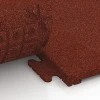
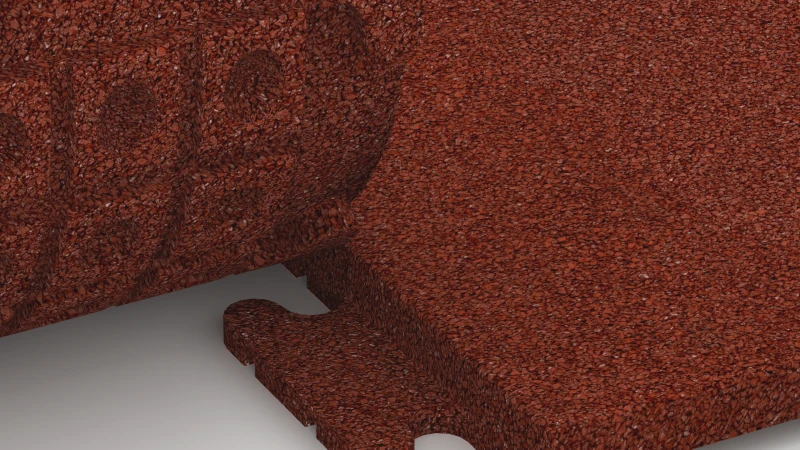
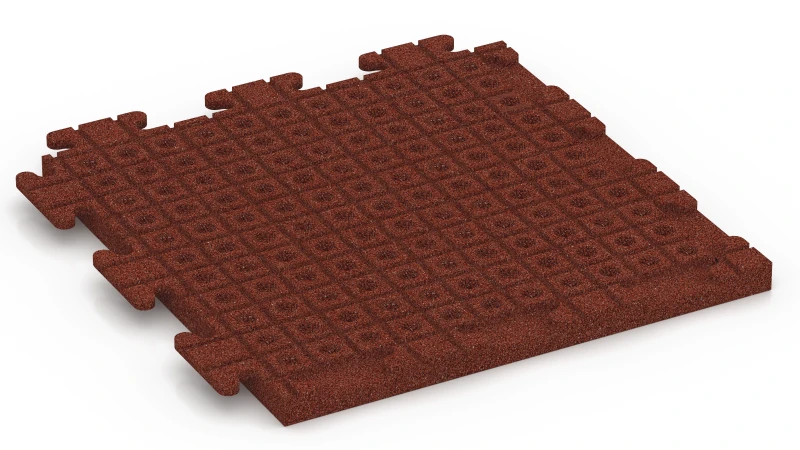
With a concealed jigsaw interlock, the interlocking teeth are not located in the visible tile edge. They sit in a stepped rebate along the underside, which forms a step in the tile edge. Two adjacent sides carry the projecting profile, while the two opposite sides carry its counterpart.
During installation, each tile is placed from above so that its rebate rests on the counterpart of the neighbouring tile and the teeth engage. The overlapping rebates support the tile edges, while the interlocking teeth stop the tiles from separating within the laid surface. Where installation conditions are demanding, the tiles can be glued together at the teeth or within the rebate.
Only the narrow joint between the rounded tile edges is visible at the surface. Because the rebates overlap, the joint does not continue down to the sub-base. The surface beneath remains fully covered, so weeds cannot grow upwards from the sub-base through the joint.
Outdoor rubber tiles should be cleared of leaves, soil and sand regularly.
Loose dirt can be swept away with a rubber broom or rinsed off with a hose. Rain also washes much of the dust and pollen away through water-permeable tiles.
Regular maintenance reduces the work required for more thorough cleaning.
For thorough outdoor cleaning, a pressure washer is suitable. The water jet loosens dirt from the textured surface and removes more persistent residues such as dog mess or food residue.
Where clean water is not sufficient, use either a neutral cleaner suitable for rubber or a mildly acidic cleaner. A specialist rubber cleaner is not required. Biodegradable Sonett WC Cleaner Mint is particularly suitable and has a pH value of around 5 to 6.
Apply the cleaner evenly, either neat or slightly diluted. After 10 to 15 minutes, work it in with a brush, then rinse the area thoroughly with clean water.
When brushing, use moderate pressure only. Excessive pressure can loosen granules from the bonded matrix.
Strongly alkaline cleaners, abrasive products and solvent-based cleaning products are unsuitable, as they can attack the surface of the rubber tiles.
The appropriate cleaning method for rubber tiles within buildings depends on the area in which they are used and the surface texture.
In private homes, rubber brooms, vacuum cleaners or mops are usually sufficient for regular maintenance. A neutral cleaner suitable for rubber should be used. A mildly acidic cleaner may be used for mineral deposits.
Water-permeable rubber floor coverings must not be flooded where the substrate does not provide suitable drainage.
For larger or commercial areas, a scrubber dryer with a cylindrical brush is recommended. The brush type and contact pressure of the scrubber dryer must be matched to the floor covering.
Within buildings, a pressure washer is only suitable for stables or appropriately equipped halls where adequate drainage is available. It can also remove stubborn dirt from the textured tile surface.