
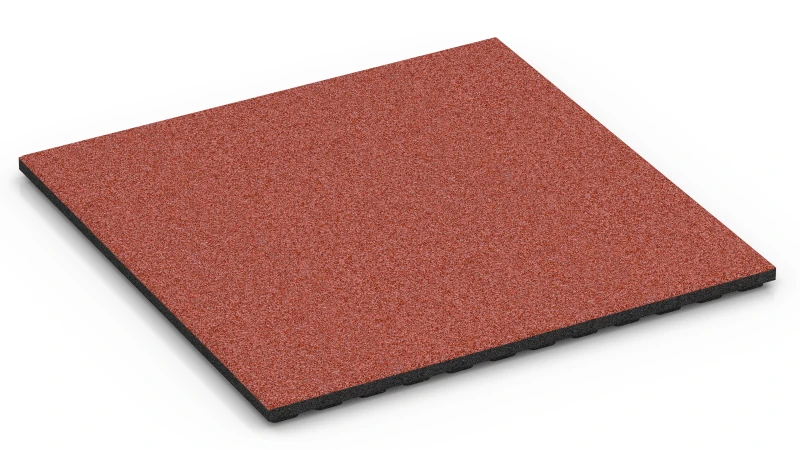
Stable Mat Premium SH "Brick red"
- /
-
Ready to ship
in approx. 7-14 days – production already under way - €78.50 / 1 Piece / m²
- (39.00 kg / Piece)
EAN: 4251469363885 | Item no.: 6388
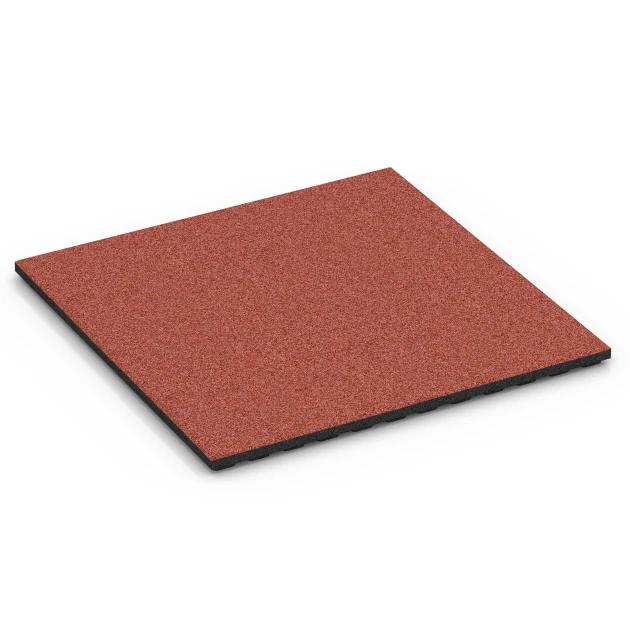
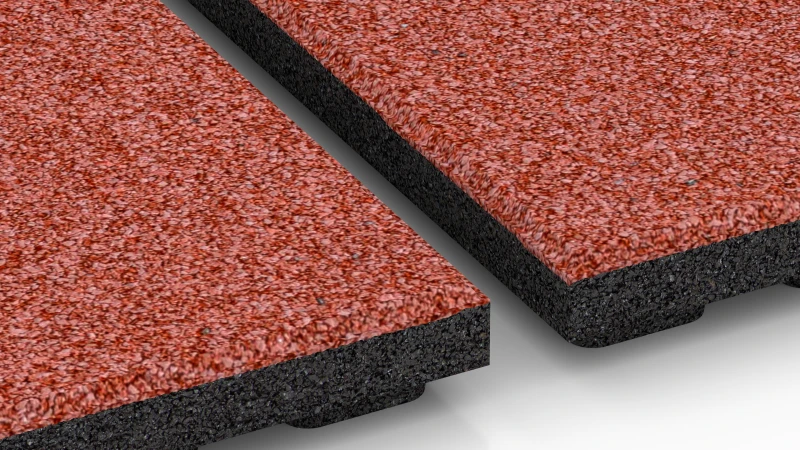
Stable Mat Premium is a 4.5 cm thick mat for lying areas, made from rubber granules bonded with polyurethane. It is designed for stables, outdoor stables and loose housing.
What does a horse need to lie down?
A horse can only get the REM sleep it needs for recovery while lying down. Horses mainly lie down on dry ground with some give. They lie down much less on wet or cold surfaces. As the horse lies down, the 4.5 cm thick mat cushions its weight and takes the hardness out of the concrete floor. It nevertheless remains firm under the hoof. As grassland animals, horses need a firm surface under their hooves. The granular surface is slip-resistant even when wet, which helps the horse get up.
What is Stable Mat Premium made from?
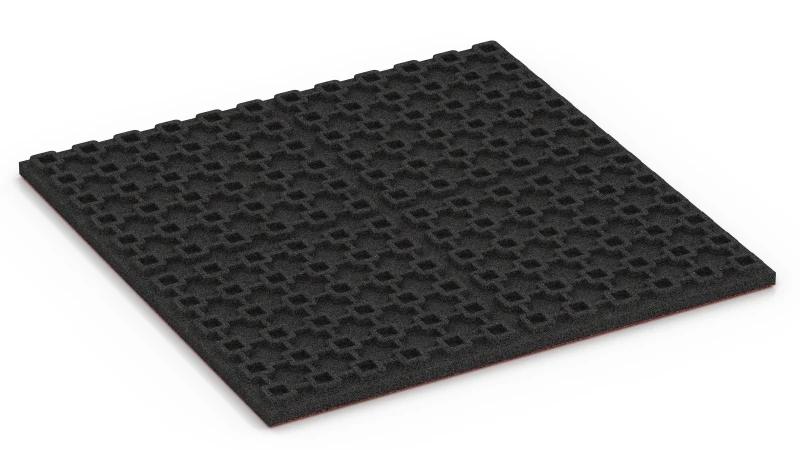
Stable Mat Premium is made from recycled tyre rubber granules (ELT). Polyurethane binds the granules together. The mat is compacted under high pressure and is very abrasion-resistant. Its weight holds it down on the stable floor. The underside has many hollow feet joined by webs. The air space beneath insulates the mat from the cold concrete. New mats initially smell of rubber, but the smell quickly fades.
How are the mats laid?
The mats are laid without adhesive in a random bond pattern. The offcut from the last mat in one row becomes the first mat in the next row. This saves material and creates the intended T-shaped joints. The base must be load-bearing and largely level. Suitable bases include concrete, concrete block paving and gravel grids filled with chippings. The area needs an edge restraint around its entire perimeter. In a stable, the walls provide this restraint. The mats are cut with a jigsaw or circular saw.
What happens to urine?
The mat allows very little urine through. Unabsorbed urine remains standing on the mat. If the horse keeps urinating there, the urine seeps beneath the mats and breaks down. This produces ammonia, which irritates the airways. This must be prevented. The horse can urinate outside the stable and lying area, but this requires constant access to an open paddock. Alternatively, enough bedding on the mats can absorb the urine, or a specially bedded corner can be provided where the horse urinates.
How much bedding is needed?
The lying area remains bedded. The layer of straw or shavings can be thinner on the mat than on bare concrete. When mucking out, remove droppings and wet patches. For deep cleaning, lift individual mats and clean them with a pressure washer.


Discount
Product Highlights
Characteristics
Product Details – Material and Structure
Comparative values
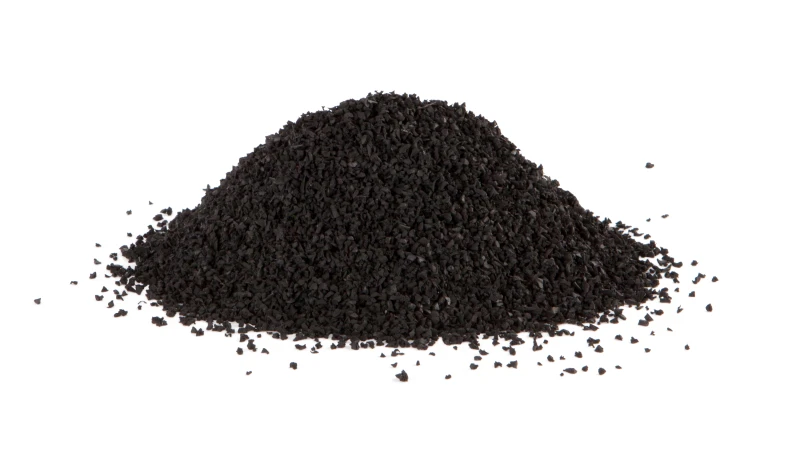
Rubber granules from end-of-life tyres are produced from tyres that are no longer in service. ELT stands for End-of-Life Tyres, the established term for tyres that have reached the end of their usable life. The resulting granules are a recycled raw material.
Collected car and lorry tyres provide the feedstock for processing. The tyres are shredded before the steel and textile fibres are separated. The remaining rubber is processed into black granules with a range of particle sizes, then separated into defined grades.
Tyres contain mainly styrene-butadiene rubber (SBR) and natural rubber (NR), so both types of rubber are present in the recovered granules. The term SBR rubber granules is common in the trade, but it does not make the origin clear, because SBR can also be newly produced and processed directly. By contrast, the term rubber granules from end-of-life tyres explicitly identifies granules recovered from used tyres.
ELT rubber granules are used in floor coverings, including sports flooring and safety tiles, as well as in road construction, building products and technical rubber goods. They are also used as the feedstock for WARCO tiles made from rubber granules bound with polyurethane. Recycling keeps the rubber in use for longer and can reduce demand for newly produced rubber.
Rubber mats made from PU-bound rubber granules can have a characteristic rubber smell, particularly when new. Whether and how strongly it is noticed depends on the material composition and on individual sensitivity to odours.
With WARCO rubber coverings, the inherent smell decreases over time. On well-ventilated outdoor areas such as balconies and terraces, it dissipates quickly. Heat may temporarily make the smell more noticeable.
The smell can remain noticeable for longer in indoor areas, conservatories and other poorly ventilated spaces where ventilation is limited. To reduce the initial inherent smell, rubber tiles may be stored for several days before installation in a dry, well-ventilated place. During storage, air should reach as many tile surfaces as possible.
After installation, regular brief periods of thorough ventilation or cross-ventilation support air exchange. With correct use, no adverse health effects from WARCO rubber coverings are known.
Rubber tiles and rubber mats from WARCO are not harmful to health when used as intended. They are made from rubber granules bound with PU; the solvent-free PU binder cures fully during manufacture.
The rubber granules are predominantly recycled from end-of-life tyres (ELTs). The PAH content of ELT rubber granules may vary according to origin and batch; PAH means polycyclic aromatic hydrocarbons. Black ELT rubber granules contain carbon black, a fine industrial soot that gives the rubber its black colour. Surface abrasion may occur during use of rubber mats.
In two-layer versions, the wearing layer is made from newly manufactured EPDM, which is coloured throughout and free from harmful substances. The possible PAH variations associated with ELT rubber granules do not occur with EPDM. Versions with an EPDM wearing layer are particularly suitable for prolonged or intensive skin contact and for areas intended for babies. The relevant product description states whether a product has a two-layer construction.
WARCO rubber tiles are made from rubber granules bound with polyurethane. Each granule is coated with polyurethane and held within the binder. The solvent-free binder cures fully during manufacture. Individual granules may remain attached to a tile after manufacture or come loose while the tiles are being laid. Any such manufacturing residue can be swept up or removed with a vacuum cleaner.
Vulcanised rubber and cured polyurethane are insoluble in water. Rainwater passing through the porous tiles does not dissolve these constituents. The same applies to individual granules left on the surface. On this basis, contamination of the soil or groundwater is not expected.
The structured underside on rubber tiles and impact-absorbing mats provides drainage, reduces the area of contact with a wet substrate, and affects both shock absorption and dimensional stability.
With porous tiles, water passes through the surfacing across its full area. On a water-impermeable substrate, drainage channels direct the water along the fall; on a water-permeable sub-base, it drains into the sub-base.
Studs and drainage feet keep the tile body clear of the substrate. This prevents the tile from remaining continuously in wet conditions and allows it to dry more quickly.
The profile moulded into the underside creates additional space for elastic deformation. It therefore improves shock absorption and reduces internal stresses, which can arise from different temperatures or moisture conditions between the top surface and underside. The profile consequently contributes to the tile's dimensional stability. Wide bearing pads also reduce local pressure peaks.
The functions performed by the underside depend on the relevant tile range. Rubber mats for indoor areas often have a continuous, unstructured underside and lie in near-full contact with the substrate.
Rubber tiles and rubber mats made from PU-bound rubber granules typically have a service life of around 10 to 15 years, although this can vary substantially with the conditions of use. Some surfaces remain in use for more than 20 years, while others require replacement after only a few years.
The type and intensity of loading determine service life. Friction causes surface wear, while high or sustained compressive loads can affect the material structure. Mechanical loading is generally lower in private settings than in commercial use. Weathering also affects service life, particularly UV radiation, temperature changes and frequent freeze-thaw cycles.
The type of granules influences ageing behaviour. An EPDM wearing layer is UV-resistant and, after an initial acclimatisation period, remains largely colour-stable. ELT granules with a pigmented binder become darker over time.
The data sheet for each WARCO product provides information on UV resistance, colour fastness and abrasion resistance, helping to select the appropriate covering. Correct installation in accordance with the installation guidelines on a level, load-bearing substrate also contributes to a long service life.
Outdoor rubber tiles made from polyurethane-bound rubber granules are frost-resistant and suitable for use throughout the winter. Their porous structure absorbs precipitation and allows it to pass downwards; water remaining in the pores has space to expand when it freezes, while the rubber granules and polyurethane binder remain elastic at sub-zero temperatures. The sub-base must also be constructed to withstand frost.
On bound sub-bases, water flows beneath and between the tiles in the direction of the fall towards the drainage system. On chippings or crushed stone, it drains vertically through the construction. If water collects beneath the tiles, a frost-susceptible sub-base may rise and then settle again after thawing. The tiles themselves remain unaffected, but the surface may become more uneven.
For winter maintenance, use a snow shovel with a smooth edge and avoid catching the tile edges. Salt used in normal quantities to melt ice does not harm the rubber granules.
Thermal insulation from floor coverings made from rubber granules is supplementary and varies with the product design and thickness; it does not replace the thermal insulation required within the building structure. Across the WARCO range, thermal conductivity is approximately 0.07 to 0.16 W/(m·K), depending on the product line. By comparison, EPS insulation materials achieve approximately 0.032 to 0.040 W/(m·K), so they provide substantially greater insulation than floor coverings made from rubber granules at the same thickness.
Thermal conductivity and thickness determine the thermal resistance of a floor covering: lower thermal conductivity produces greater thermal resistance, as does a thicker covering. On a cool mineral substrate, a dry covering made from rubber granules draws heat from the foot more slowly and therefore feels less cold. With porous outdoor coverings, thermal insulation decreases when wet because water conducts heat more readily than the air within the pores.
For the thermal insulation of flat roofs and ceilings, the performance of the complete roof or ceiling build-up is decisive. With underfloor heating, the thermal resistance of the covering slows heat output into the room; the thicker the floor covering, the greater this slowing effect.
Rubber mats and moulded items made from rubber granules, including rubber granule mats, are best cut with a circular saw fitted with either a wood-cutting blade or a rubber saw blade. The most appropriate tool depends on the product, the shape of the cut and the installer’s experience. The circular saw should have sufficient power, while blade speed should not be too high.
Where a utility knife is used, this method is generally more appropriate for experienced installers. The knife needs a sharp blade and a firm handle, and it should be guided along a metal straightedge or rail to maintain a straight cut edge. Several passes with moderate pressure will cut through the rubber mat. When guiding the knife along the straightedge, the hand can slip towards the blade; the guiding hand must therefore remain behind the straightedge and never in front of the blade, where the risk of injury is greatest.
For internal cuts or curved lines, a jigsaw is appropriate, using rubber saw blades made for jigsaws. Metal-cutting saws, blades intended for metal or stone, cutting discs and very high-speed saws are unsuitable because heat generated by friction can melt the rubber granules bound within the moulded item and smear the cut edge. This applies equally to rubber mats, safety surfacing tiles, fitness tiles, patio tiles and edging blocks made from rubber granules.
Rubber granule mats of any thickness can be cut with a jigsaw or a circular saw. A circular saw is suited to straight cuts, while a jigsaw is suited to curved cuts and cut-outs. PU-bound rubber granules can be worked in much the same way as wood, provided both saws are guided steadily with an even feed rate.
For particularly thick rubber mats or large sections to be cut, a reciprocating saw or chainsaw may be easier to handle than a guided circular saw. Thick impact-absorbing surfacing tiles also do not require a special machine: a coarse-toothed wood saw blade or a rubber saw blade is suitable. A coarse tooth pattern and moderate speed keep frictional heat low, allowing fitness tiles and patio tiles made from rubber granules to be cut cleanly.
An uneven surface only needs to be levelled before laying rubber tiles where larger depressions prevent even support or interfere with water drainage.
Minor unevenness, fine cracks, narrow joints and shallow defects are generally unproblematic. Tiles made from PU-bound rubber granules are elastic and flexible; their compliance depends on tile thickness and density. Thinner rubber tiles conform particularly well to a slightly undulating substrate.
Rubber tiles are suitable as a covering for an uneven surface and remain stable on uneven ground. Rigid concrete or stone slabs may rock on an uneven surface.
Pronounced hollows where water collects should be filled before installation. On a firm sub-base, accurately cut pieces of roofing felt can be used for filling and, where required, laid in several layers.
Sand, grit and gravel are unsuitable for local levelling because loose fill can shift over time.
Rubber flooring tiles can be installed directly over concrete, screed, asphalt or tiled floors as a loose-laid covering, without an additional sub-base.
With no additional sub-base required, the substrate must still be load-bearing, clean and sufficiently level. Remove loose material, oil and other contamination before laying. Larger irregularities, depressions and changes in level must be levelled out so that the tiles lie stably and do not create obtrusive edges.
The starting point and laying direction depend on the shape of the area and the required pattern. In many cases, starting in the centre helps to align the pattern evenly and produce similar cuts at opposite edges. For other areas, a straight boundary may provide the appropriate starting point.
Lay the tiles according to the chosen layout and join them firmly. Depending on the product, this is done using puzzle joints, dovetail joints or separate connectors. Measure the edge tiles, cut them to fit and then insert them.
Bonding is generally not required. Small cut pieces, stair treads and very small areas may require bonding.