
EAN: 4251469317918 | Item no.: 1791
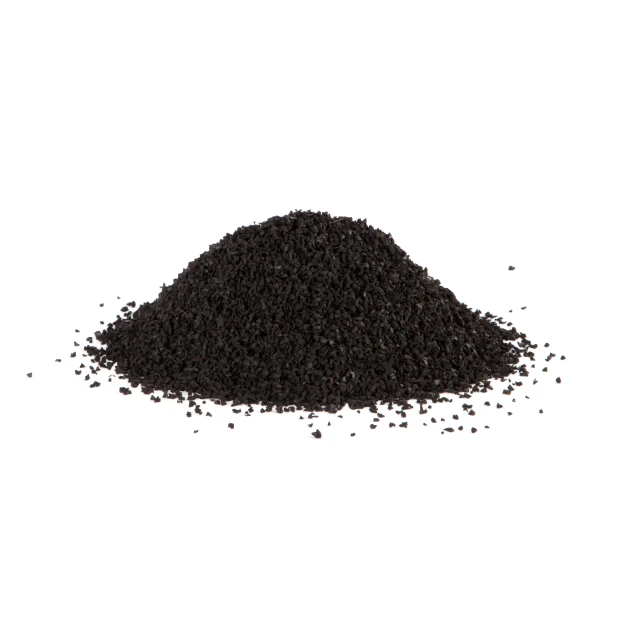
Rubber Granules from WARCO are SBR rubber granules made from end-of-life tyres. Their particle size ranges from 2 to 6 mm. The material is supplied loose in a 20 kg bag. Rubber Granules are used as a filling for punch bags. Mixed with a PU binder, they form a repair compound for surfaces made from rubber granule tiles.
What are Rubber Granules used for?
Rubber Granules give a punch bag the weight needed for training. A repair compound made from the granules and a PU binder can be used to fill gaps around posts, form junctions with walls and repair small damaged areas.
Why are Rubber Granules suitable for filling a punch bag?
Rubber Granules consist of elastic particles that provide some cushioning against punches and kicks. Fill the empty punch bag with the loose granules until it reaches the desired weight.
What are Rubber Granules made from?
Rubber Granules are produced from end-of-life tyres. The rubber is shredded and ground into irregularly shaped particles. The material is then sieved to sort the particles by size. The mix of fine and coarse particles affects how densely the filling settles and how the surface of a repair looks.
How do you use Rubber Granules with a PU binder?
Rubber Granules are mixed thoroughly with a PU binder. Use four or five parts granules to one part binder. Apply the compound directly on site with a trowel. The binder cures with moisture from the air. The compound is best applied at temperatures above 23 °C. The curing time depends on the binder, the temperature and the humidity. Curing usually takes ten to over twenty hours.


Product Highlights
Product Details – Material and Structure
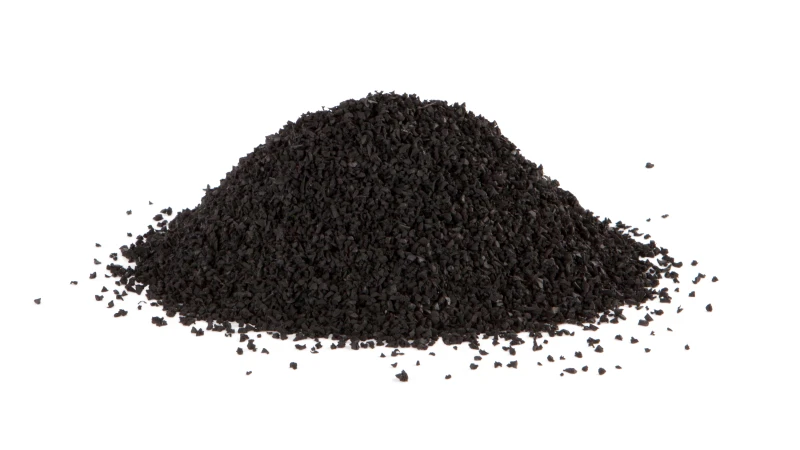
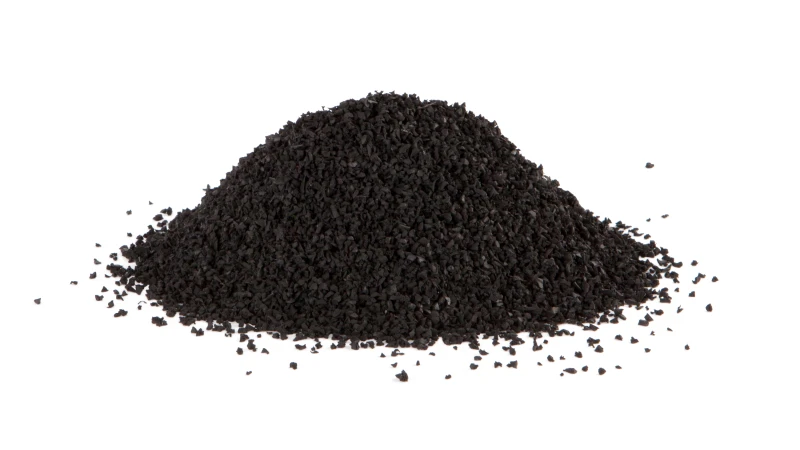
Rubber tiles are manufactured by compression moulding, in a process comparable to baking waffles. A ‘dough’ is prepared from rubber granules and polyurethane binder. For ELT rubber granules, the binder may be pigmented or clear, depending on the required colour. Coloured EPDM rubber granules are combined only with clear binder. The particle size distribution, meaning the proportion of larger and smaller granules, primarily determines the appearance of the surface. It also affects the tile’s density and elasticity.
Before filling, the contact surfaces of the press mould are sprayed with a release agent. This prevents adhesion and allows the tile to be removed cleanly after pressing. The mould defines the tile’s dimensions, edge profile and embossed pattern on the underside. The filled mixture is then pressed at around 80 °C for 10 to 30 minutes. The moulding pressure controls how densely the granules are packed within the finished tile.
After demoulding, the tile cures for several days. It is then packed and dispatched. The finished tile’s appearance, impact absorption and elasticity arise from the interaction between particle size distribution and moulding pressure. This process produces rubber tiles for varied applications, including home and garden, play and sport, fitness, and facilities for horses and dogs.
SBR rubber is so called because SBR stands for styrene-butadiene rubber, a synthetic rubber made from styrene and butadiene.
SBR rubber describes a vulcanised rubber compound based on styrene-butadiene rubber. SBR rubber granules consist of crushed, already vulcanised rubber containing SBR; they are not granulated raw rubber.
SBR was developed in the late 1920s and was known in Germany as Buna S. It is among the synthetic rubbers produced in the greatest volumes, with a large proportion used in tyre manufacturing. Other applications include conveyor belts, industrial hoses, shoe soles and floor coverings.
In WARCO rubber tiles, the SBR content comes from recycled tyre rubber granules (ELT). These rubber granules are produced by processing end-of-life tyres. Their rubber content consists predominantly of SBR and natural rubber, alongside other constituents of the vulcanised tyre compound.
The SBR-containing recycled tyre rubber granules form an elastic base. The properties of the finished rubber tile also depend on the tyre compound, particle size, PU binder and compaction.
Compared with EPDM, SBR is more sensitive to ozone and UV radiation. In two-layer tiles, coloured EPDM granules form the wearing layer, which is more weather-resistant. The recycled tyre rubber granules form the elastic backing layer beneath the wearing layer.
Rubber granules from end-of-life tyres are produced from tyres that are no longer in service. ELT stands for End-of-Life Tyres, the established term for tyres that have reached the end of their usable life. The resulting granules are a recycled raw material.
Collected car and lorry tyres provide the feedstock for processing. The tyres are shredded before the steel and textile fibres are separated. The remaining rubber is processed into black granules with a range of particle sizes, then separated into defined grades.
Tyres contain mainly styrene-butadiene rubber (SBR) and natural rubber (NR), so both types of rubber are present in the recovered granules. The term SBR rubber granules is common in the trade, but it does not make the origin clear, because SBR can also be newly produced and processed directly. By contrast, the term rubber granules from end-of-life tyres explicitly identifies granules recovered from used tyres.
ELT rubber granules are used in floor coverings, including sports flooring and safety tiles, as well as in road construction, building products and technical rubber goods. They are also used as the feedstock for WARCO tiles made from rubber granules bound with polyurethane. Recycling keeps the rubber in use for longer and can reduce demand for newly produced rubber.